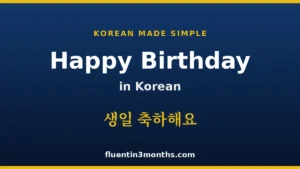



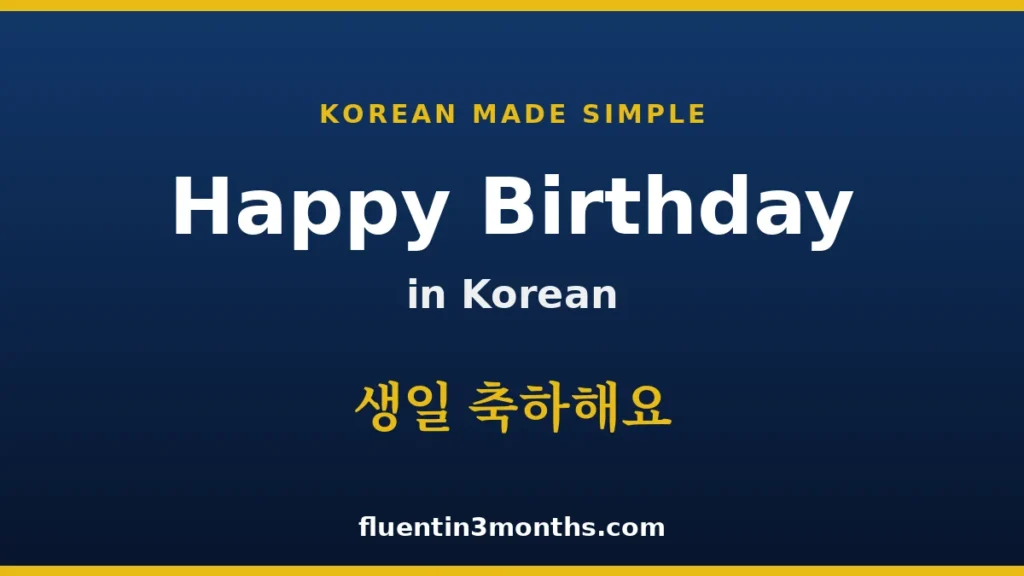
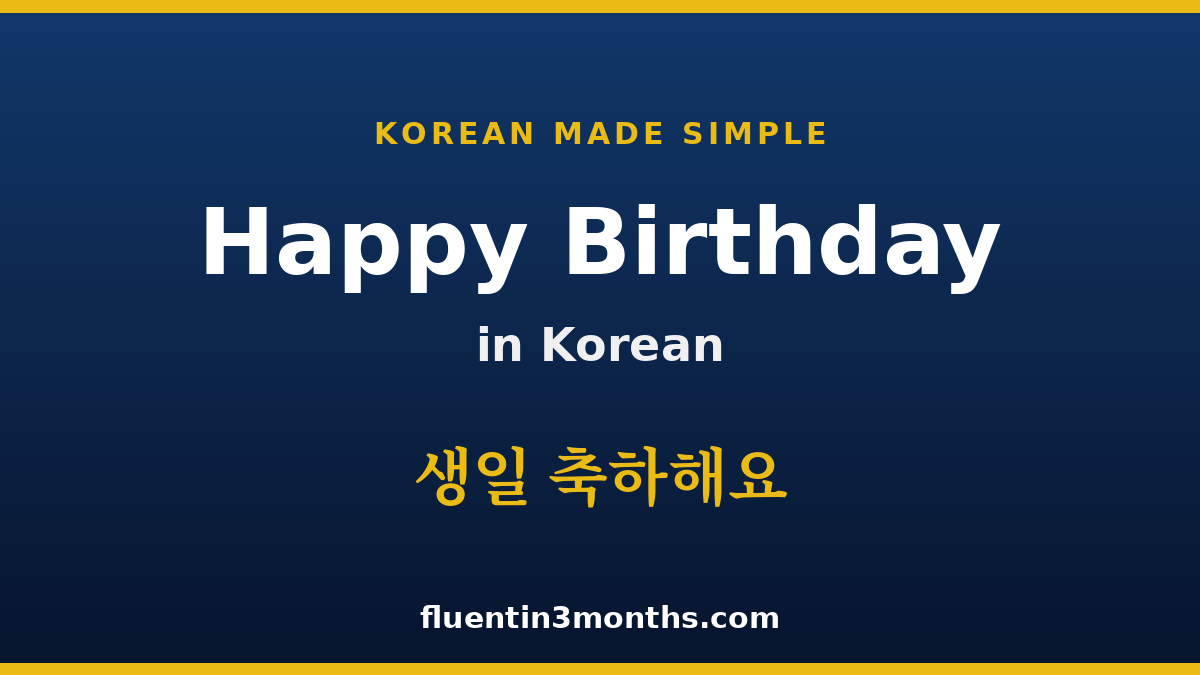
The most useful everyday way to say happy birthday in Korean is saengil chukhahaeyo (생일 축하해요). While this phrase serves as a reliable default for social interactions, the linguistic landscape of Korean birthday greetings is deeply intertwined with the country’s intricate system of social hierarchies and honorifics. Understanding how to offer these well-wishes requires more than just memorizing a single sentence; it necessitates an awareness of the relationship between the speaker and the recipient, the setting of the celebration, and the cultural traditions that define the South Korean approach to aging and life milestones.
The Linguistic Architecture of Korean Birthday Greetings
In the Korean language, politeness is not merely a matter of tone but a structural component of grammar. When wishing someone a happy birthday, the speaker must navigate different speech levels—ranging from informal (banmal) to highly formal (jondaemal). The phrase saengil chukhahaeyo (생일 축하해요) is categorized as polite, standard speech. It is appropriate for use with colleagues, acquaintances, and individuals with whom one does not share a deeply intimate bond.
The greeting is composed of two primary elements: saengil (생일), which means "birthday," and chukha (축하), which translates to "congratulations." The suffix haeyo (해요) transforms the noun into a verb form that is polite yet accessible. For more formal occasions or when addressing an elder, the language shifts significantly. Speakers may use the term saengsin (생신), an honorific noun for birthday, and combine it with the verb deurida (드리다), which denotes a humble, respectful way of giving or offering. Thus, saengsin chukhadeurimnida (생신 축하드립니다) represents the highest level of deference, typically reserved for parents, grandparents, or superiors in a professional or social hierarchy.
The Evolution of Aging: The 2023 Administrative Shift
A significant shift occurred in South Korean social and legal structures in June 2023, when the government officially moved to standardize the international age system. Historically, South Korea utilized a traditional system known as seneun nai (세는 나이), in which an infant was considered one year old at birth, and every individual would gain a year on January 1st regardless of their actual date of birth. This system often resulted in a person being two years older than their international age.
The implementation of man nai (만 나이)—the international age-reckoning system—was driven by the need to reduce administrative confusion and align South Korean law with global standards. While man nai is now the mandatory format for civil and administrative documents, the transition has been complex. In social settings, the traditional seneun nai remains deeply embedded in the cultural psyche, and many citizens continue to use it in casual conversation. Furthermore, certain government statutes still reference "year age" (yeon nai), a hybrid calculation used for specific legal regulations such as the Military Service Act or the Youth Protection Act. This multi-layered approach to age underscores the complexity of social identity in modern Korea.
Cultural Traditions and Milestones
Korean birthday customs are rooted in a mix of Confucian values and modern social practices. Perhaps the most ubiquitous tradition is the consumption of miyeokguk (미역국), or seaweed soup. This dish is inextricably linked to the post-natal recovery period, as it is traditionally consumed by mothers after childbirth. By serving this soup on a birthday, the culture emphasizes a symbolic acknowledgment of the mother’s sacrifice and the act of birth itself. While not a rigid mandate, the presence of seaweed soup at a birthday meal is a cultural touchstone that reinforces family bonds.
The most critical milestone in a Korean child’s life is the doljanchi (돌잔치), or the first birthday celebration. Historically, when infant mortality rates were significantly higher, surviving the first year of life was a monumental achievement for a family. Today, the doljanchi remains an elaborate affair. A central ritual of this event is doljabi (돌잡이), where a variety of items—such as thread, money, a writing brush, or a stethoscope—are placed before the child. The item the child selects is interpreted as a symbolic, playful omen of their future career or personality. For instance, selecting a writing tool suggests a future in academia, while money implies financial prosperity.
The Influence of Hierarchy on Communication
In South Korean society, the nuances of communication are heavily influenced by the relationship between interlocutors. It is a common misconception that age alone dictates the use of informal speech. While age is a factor, the level of intimacy and the duration of a relationship are equally critical. Casual speech, or banmal (반말), is typically reserved for established close relationships or individuals who have mutually agreed to discard formal honorifics.
This hierarchy extends even to the traditional birthday song. While the tune matches the familiar Western "Happy Birthday to You," the lyrics are adapted to incorporate the formal chukhahamnida (축하합니다) ending. It is common for groups to sing this version even when the participants use casual speech in their daily interactions. This consistency serves as a social equalizer, ensuring that the act of singing remains respectful and appropriate for the collective setting.
Practical Application and Language Acquisition
For those looking to integrate these phrases into their vocabulary, it is essential to move beyond romanization. Korean is a phonetic language, and the Roman alphabet cannot fully capture the nuances of its vowels and consonants. King Sejong the Great, who oversaw the creation of Hangul in the 15th century, designed the script to reflect the physical positions of the speech organs. By learning the alphabet, speakers gain a more accurate understanding of the language’s cadence and rhythm.
When selecting a birthday wish, context is the primary guide. For a standard message, saengil chukhahaeyo is the most versatile choice. For those wishing to express sincere warmth to a peer, the casual saengil chukha is appropriate. However, when addressing elders, the use of honorifics is not optional but a requirement of social etiquette. Using the correct level of formality demonstrates respect for the recipient and an understanding of the cultural values that underpin Korean social interactions.
Analytical Summary of Implications
The persistence of these linguistic and cultural traditions in a rapidly modernizing society like South Korea highlights the tension between global integration and traditional identity. The transition to the international age system, while administratively pragmatic, has highlighted the strength of cultural inertia. Similarly, the continued adherence to specific birthday rituals like the doljanchi and the consumption of seaweed soup demonstrates that, despite the influence of global pop culture and technology, the core tenets of family-centric Confucian values remain robust.
For the international observer or learner, mastering these greetings is an entry point into a broader understanding of Korean society. It is a reminder that language is never just a tool for communication; it is a repository of history, a roadmap for social conduct, and a vital bridge between generations. Whether through the precise selection of a verb ending or the shared experience of a birthday tradition, the act of wishing someone a happy birthday in Korean is a practice in mindfulness and respect.