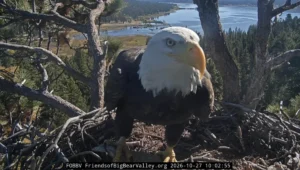


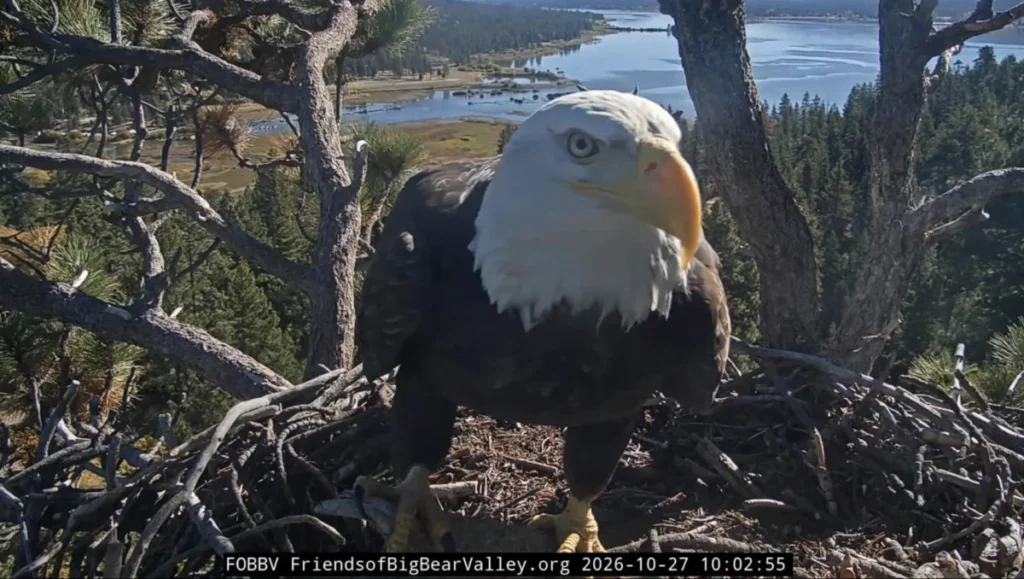
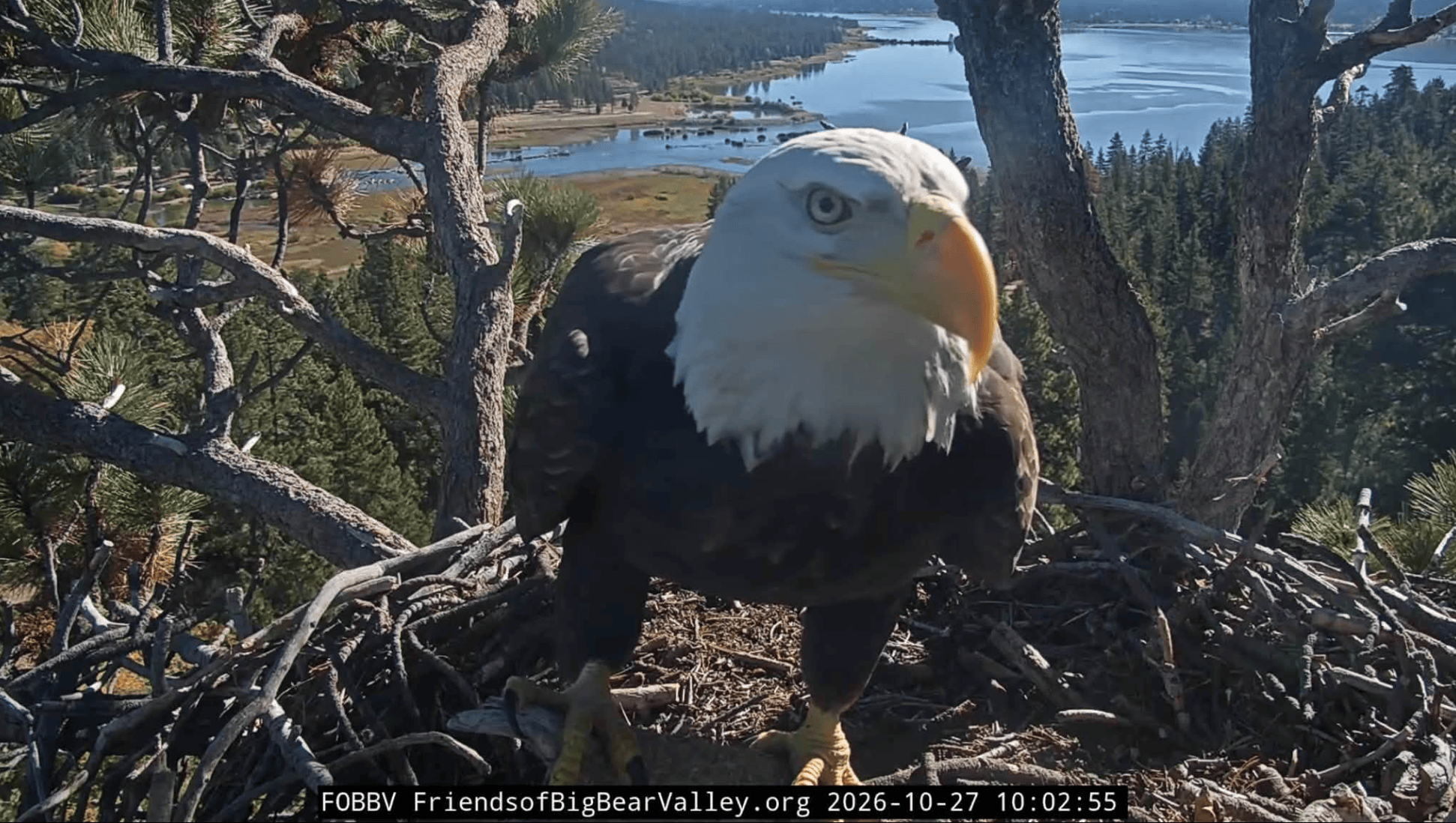
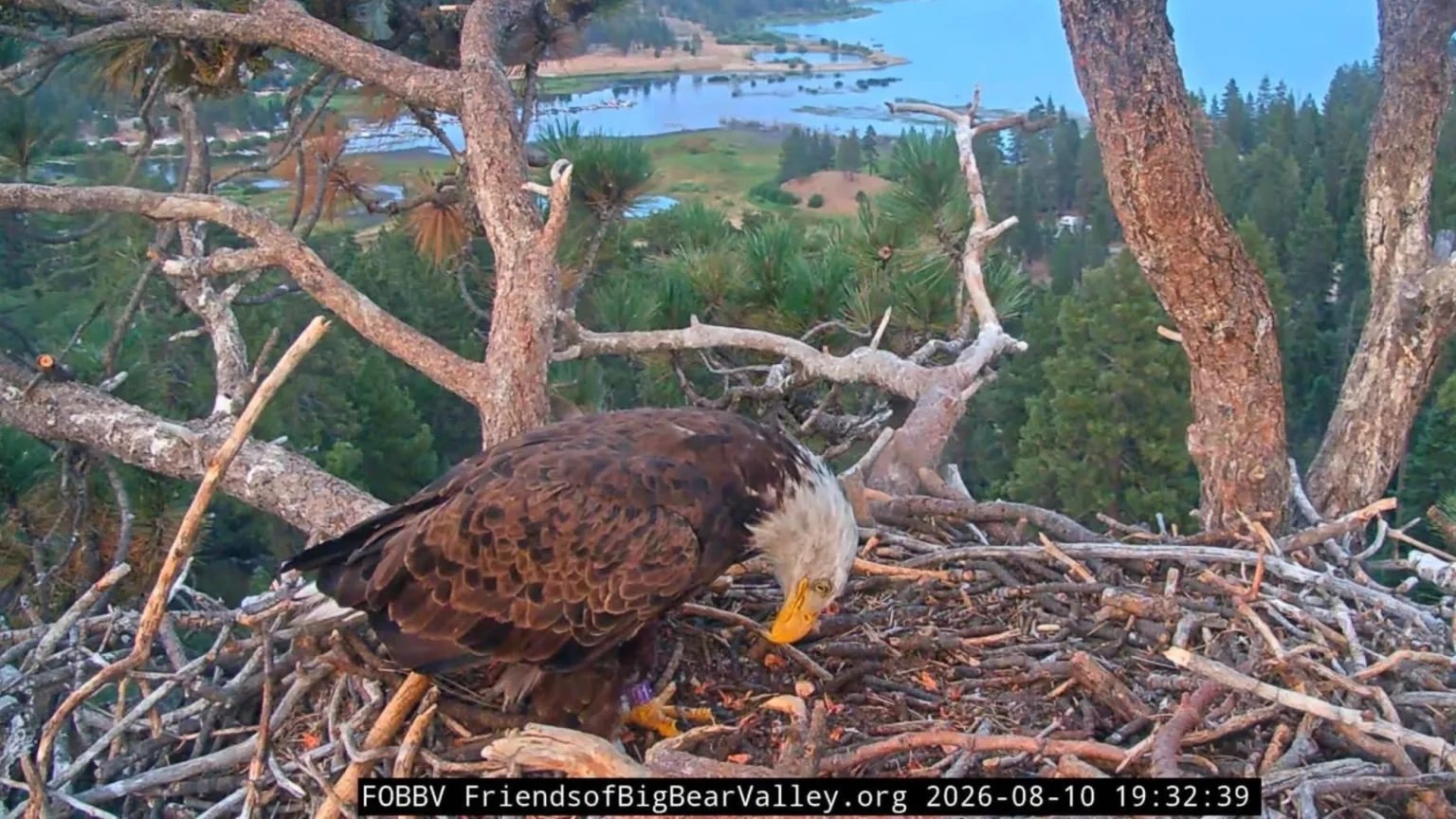
The bald eagle habitat in Southern California’s Big Bear Valley has once again captured the attention of wildlife conservationists and online observers worldwide. On Tuesday, continuous monitoring cameras operated by the Friends of Big Bear Valley (FOBBV) recorded an unidentified adult bald eagle spending approximately 30 minutes at the prominent nesting site. The visitor engaged in familiar nesting behaviors—arranging twigs and briefly positioning itself before the high-definition live-streaming equipment—before departing.
This unexpected appearance adds a new layer of intrigue to a nesting territory already experiencing a profound transitional period. The historic nest, which has served as a focal point for ornithological study and public engagement through webcams for over a decade, is currently vacant of its long-term residents. The sex and precise identity of the newly arrived adult remain unconfirmed, leaving wildlife experts and internet enthusiasts to speculate on the future dynamics of the local eagle population as the region approaches its annual mating season.
Chronology of Events and the Current Nest Status
The appearance of the unknown adult is the latest in a series of shifts at the Big Bear Valley nest. Initially spotted by sharp-eyed viewers last week, the mystery eagle returned on Tuesday for a more extended inspection of the grounds. In recent weeks, FOBBV cameras have also logged intermittent visits from a sub-adult eagle.
However, the primary occupants of the territory are notably absent. Shadow, the resident male who successfully raised his most recent clutch of chicks alongside the iconic female Jackie, has not been captured on camera since October 23. Furthermore, Kaydee—a young adult female bald eagle who frequently interacted with Shadow over the late summer and early autumn, sharing sticks and vocalizations at the nest—has not been seen since October 21.
This lull in activity is not entirely atypical for the species. Wildlife biologists frequently observe a seasonal reduction in nest-bound behavior during autumn, a period colloquially termed "bald eagle vacation." During these months, mature eagles often disperse to explore alternative foraging territories, roost in denser forest canopies for enhanced weather protection, and generally reduce their attachment to primary nesting infrastructure. Official mating and courtship behaviors for the Big Bear Valley pair traditionally commence in December, leaving a narrow window for territory establishment and partner selection.
Historical Background of the Big Bear Valley Nesting Territory
The high-altitude habitat of Big Bear Valley has a rich genealogical history well-documented by researchers and the FOBBV community. Contrary to popular belief, Jackie and Shadow were not the original architects or inhabitants of the prominent structure monitored by the current camera feeds.
The timeline of the territory’s infrastructure spans more than a decade:
- 2011–2012 Nesting Season: Jackie is successfully hatched and eventually fledges from a nest situated at the top of a dead tree within the valley.
- 2012–2013 Nesting Season: Shortly after Jackie’s departure, a severe winter storm destroys the original nest structure. Jackie’s biological parents, Lucy and Ricky, construct a new, sturdier nest in a nearby live tree located approximately 50 feet away from the original site.
- 2015–2016 Nesting Season: Lucy and Ricky abandon the secondary nest to construct a third location nearby.
- 2016–2017 Nesting Season: Lucy and Ricky permanently disappear from the valley under unknown circumstances. A juvenile female—widely believed by experts to be Jackie—begins frequenting the abandoned pad. Jackie establishes dominance over the territory, initially partnering with an eagle known as Mr. B and subsequently forming her legendary, long-term bond with Shadow.
- Summer 2026: Following the successful fledging of their latest chicks, Sandy and Luna, in mid-July, Shadow continues to maintain the nest. On August 10, Jackie passes away, initiating an unprecedented chapter for the local ecosystem. Following her death, Shadow maintains sporadic oversight of the territory, occasionally interacting with transient younger eagles such as Kaydee.
Behavioral Implications and Ornithological Context
The arrival of an unbanded, unidentified adult eagle at the Big Bear Valley site presents a complex set of ecological variables. Bald eagles (Haliaeetus leucocephalus) are renowned for their strong site fidelity, often returning to the same nesting territory for decades. However, the loss of a dominant breeding partner—such as the death of Jackie—frequently destabilizes established territorial boundaries.
Ornithologists note that vacant high-quality nesting real estate, particularly in resource-rich alpine valleys near major bodies of water like Big Bear Lake, acts as a magnet for transient or floating adult eagles seeking established territories. The presence of both a sub-adult and now an unidentified adult suggests that the geographical area remains highly desirable.
Whether Shadow will return to reclaim the territory, or if he has perished, migrated, or chosen a new mate elsewhere, remains to be seen. Similarly, it is unclear whether the newly arrived mystery eagle will attempt to displace existing claimants, court Shadow should he return, or establish a completely new pair bond with another individual in the valley.
Conservation Monitoring and Public Engagement
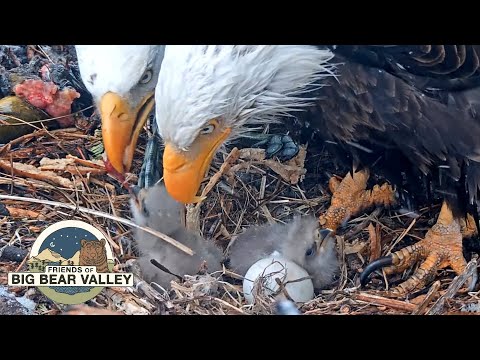
The continuous documentation of these events is made possible through the dedicated infrastructure maintained by the Friends of Big Bear Valley, a non-profit organization focused on local wildlife preservation and public education. The high-definition streaming setup—comprising Camera 1, which provides a direct, around-the-clock view of the nest bowl, and Camera 2, which offers a broader environmental perspective—serves both scientific observation and public outreach.
In response to seasonal energy conservation protocols and reduced nocturnal activity by local wildlife, FOBBV has adjusted its streaming schedule, temporarily powering down the wide-angle secondary camera during overnight hours while maintaining the primary 24/7 stream.
As December approaches—the traditional threshold for courtship and nest preparation in Southern California’s mountainous regions—all eyes remain fixed on the live feeds. Wildlife officials and naturalists emphasize that while public fascination runs high, the unfolding scenario is a natural evolutionary process governed by territorial competition, resource availability, and natural mortality. Observers and conservationists are advised to continue monitoring the FOBBV feeds as the natural history of the Big Bear Valley bald eagle population writes its next chapter.