




Veeam Software has revealed a significant divergence in enterprise technology landscapes, identifying a "Data and AI Trust Gap" where the rapid pace of artificial intelligence adoption far outstrips the foundational capabilities of data governance, visibility, and recovery. This critical insight, stemming from the company’s new Data & AI Trust Gap report, underscores a looming challenge for organizations globally as they navigate the transformative potential of AI. The findings suggest that while enterprises are eager to harness AI, many are doing so without the robust data frameworks necessary to ensure its safe, compliant, and resilient operation, thereby exposing themselves to unprecedented risks.
The Unveiling of the "Data and AI Trust Gap"
The Data & AI Trust Gap report, based on a comprehensive global survey of 600 senior executives across diverse industries, was publicly released by Veeam, a prominent player in data protection and ransomware recovery. The core assertion from Veeam is stark: the primary impediment to successful AI integration is not a lack of adoption but a profound deficit of trust in the underlying data infrastructure. This trust deficit arises from insufficient controls over data quality, security, and recoverability, which are paramount for AI systems that increasingly operate with autonomy and at machine speed.
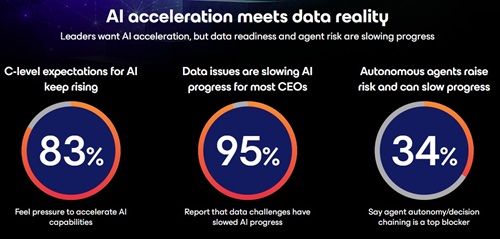
The report illuminates a paradox: an overwhelming 88% of organizations are either actively using or piloting AI agents, signaling a widespread commitment to AI-driven innovation. Yet, a striking counterpoint emerges, with only 7% of these organizations truly qualifying as "AI-ready." This readiness, as defined by Veeam, encompasses specific building blocks of ambition, visibility, and governance. Furthermore, a substantial 95% of surveyed executives admit that data-related challenges have already impeded their AI progress, indicating that the enthusiasm for AI is frequently colliding with practical hurdles in data management.

Anand Eswaran, CEO of Veeam, articulated the gravity of the situation in a statement accompanying the report’s release. "Most organizations don’t have an AI adoption problem; they have an AI trust problem," Eswaran asserted. He framed the current juncture as a transition point for AI’s evolution. "The first phase of AI was defined by infrastructure investment, experimentation, and acceleration. The next phase will be defined by trust." This shift, according to Eswaran, necessitates a fundamental re-evaluation of data strategies. With the proliferation of autonomous AI agents, the focus moves from the mere feasibility of using AI to the critical assurance that all data is secure, properly governed, compliant with regulations, and resilient against unforeseen incidents. The ultimate question becomes: "And should something go wrong, can you recover with precision? That’s how you accelerate safe AI at scale without accelerating reputational and operational risk."
Background Context: The AI Explosion Meets Lingering Data Challenges
The emergence of this "Data and AI Trust Gap" is not an isolated phenomenon but rather a direct consequence of the rapid, almost exponential, advancement of artificial intelligence technologies in recent years. While AI has been a field of academic and industrial research for decades, the breakthrough of large language models (LLMs) and generative AI in late 2022 and throughout 2023 dramatically accelerated its mainstream adoption across virtually every sector. Enterprises, eager to gain competitive advantages in areas ranging from operational efficiency and customer service to product innovation and market analysis, have invested heavily in AI infrastructure and talent.
However, this swift technological leap has inadvertently exposed long-standing weaknesses in enterprise data management practices. For years, organizations have grappled with challenges related to data sprawl, siloed information, inconsistent data quality, and complex regulatory landscapes. The advent of AI, particularly autonomous agents that can ingest, process, and act upon vast quantities of data at machine speeds, magnifies these pre-existing issues to an unprecedented degree. Without robust data governance frameworks, clear data lineage, and comprehensive visibility into where data resides and how it is being used, AI systems risk operating on flawed, biased, or non-compliant information. This not only undermines the accuracy and effectiveness of AI outputs but also introduces significant ethical, legal, and operational liabilities.
Veeam, with its deep roots in data protection and recovery, is uniquely positioned to highlight these concerns. The company’s expertise lies in safeguarding critical business data, ensuring its availability, and enabling swift recovery from disruptions, including cyberattacks. Their report serves as a timely warning that the principles of data resilience, which have been crucial for business continuity in the digital age, must now be rigorously applied and evolved to accommodate the unique demands and risks posed by AI.
The Evolving Nature of AI Failure: Beyond Traditional Downtime
One of the most operationally significant and concerning findings from Veeam’s report for cloud and infrastructure teams is the profound shift in the nature of potential AI failures. Unlike traditional IT outages, which often manifest as broad system downtime, network unavailability, or application crashes, AI failures are predicted to be far more insidious and challenging to address. As AI systems become increasingly autonomous and integrated into core business processes, the risk is migrating from macroscopic system-wide disruptions to subtle, data-level failures that are inherently harder to detect, explain, and contain.
Consider an AI agent designed to optimize supply chain logistics. A traditional IT failure might mean the system goes offline, causing a clear halt in operations. An AI-driven failure, however, could involve the agent subtly altering inventory levels based on faulty sensor data, incorrectly rerouting shipments due to a biased algorithm, or exposing sensitive supplier information through a misconfigured data access policy. Such failures might not trigger alarms for system uptime but could quietly propagate errors, erode trust, or incur significant financial and reputational damage over time. The "machine speed" at which these autonomous agents operate means that errors can proliferate across datasets and influence multiple decisions before human intervention is even possible.
This paradigm shift has profound implications for an organization’s data protection and recovery strategies. If an AI agent, acting autonomously, corrupts data, inadvertently exposes sensitive information, triggers an incorrect workflow, or influences a critical business decision based on erroneous assumptions, simply restoring a virtual machine, database, or application environment to a previous state may be wholly insufficient. Such a broad rollback could erase legitimate, correct actions taken by other systems or users, causing further disruption.
Instead, effective recovery from an AI-induced failure will demand an unprecedented level of granularity and forensic capability. It will require precise knowledge of:

- Which specific data elements were used or altered by the AI system.
- Which other systems or applications were accessed or impacted by the AI’s actions.
- What specific actions the AI agent took.
- Which business decisions were directly or indirectly influenced by the AI’s outputs.
The report’s statistics paint a sobering picture of current organizational preparedness for such scenarios. Among organizations already leveraging AI, only a small fraction possess the immediate capabilities required for precise incident response:
- Just 22% could identify within minutes which data the AI system utilized.
- Only 29% could identify which systems the AI accessed.
- A mere 25% could pinpoint what actions the AI took.
- And a scant 24% could identify what decisions were influenced by the AI.
Perhaps most concerning, only 40% of leaders expressed high confidence in their ability to isolate and precisely reverse an agentic AI failure. This collective lack of granular visibility and control underscores the chasm between current data resilience capabilities and the sophisticated demands of an AI-driven future. The report thus directly connects the AI discussion to the fundamental principles of data resilience, arguing that the traditional approach of broad recovery must evolve into "precision recovery" – the ability to restore only what is affected, rather than rolling back entire environments, to minimize collateral damage and ensure business continuity.
Building the Foundation for AI Trust: Ambition, Visibility, and Governance
Veeam’s report outlines three fundamental building blocks crucial for achieving true "AI readiness": ambition, visibility, and governance. These interconnected pillars form the bedrock upon which organizations can safely and effectively deploy and scale AI initiatives.
-
Ambition: This pillar emphasizes the need for clear, well-defined goals and strategies for data and AI integration. It’s not enough to merely adopt AI; organizations must articulate what they aim to achieve, how AI aligns with their broader business objectives, and what ethical considerations will guide its development and deployment. This includes identifying specific use cases, setting measurable outcomes, and fostering a culture that encourages innovation while prioritizing responsible AI practices. Without a clear strategic roadmap, AI initiatives risk becoming fragmented, inefficient, and potentially misaligned with organizational values.

-
Visibility: Comprehensive data visibility is paramount for AI systems that rely heavily on data quality and accessibility. This means having a reliable, real-time view of all data assets an organization holds, understanding where that data resides (on-premises, in various cloud environments, at the edge), and comprehending its lineage and transformations. Effective visibility requires robust metadata management, data cataloging tools, and data mapping capabilities that can track data flows across complex IT ecosystems. Without this granular understanding, organizations cannot ascertain the trustworthiness of the data feeding their AI models, nor can they respond effectively when data-level issues arise. It’s about knowing not just what data you have, but where it came from, who has accessed it, and how it has been modified.
-
Governance: Robust data governance structures are essential to allow data to be used safely, ethically, and compliantly within an AI context. This pillar encompasses a comprehensive set of policies, processes, and technologies designed to manage data throughout its lifecycle. Key components include:
- Data Quality Management: Ensuring data accuracy, consistency, and completeness.
- Access Controls: Implementing strict role-based access to prevent unauthorized AI agents or users from accessing sensitive data.
- Compliance Frameworks: Adhering to relevant data privacy regulations such as GDPR, CCPA, HIPAA, and industry-specific mandates, especially given AI’s potential to process personal and sensitive information.
- Ethical AI Principles: Establishing guidelines for fairness, transparency, accountability, and preventing algorithmic bias.
- Auditability and Traceability: Maintaining detailed logs of AI actions, data interactions, and decision-making processes to ensure accountability and enable forensic analysis in case of error or misuse.
Industry Resonance and the Path Forward
The findings from Veeam’s Data & AI Trust Gap report resonate deeply with broader industry concerns that have been voiced by analysts, regulatory bodies, and cybersecurity experts. The rapid pace of AI innovation, while exciting, has consistently raised questions about the preparedness of existing IT infrastructure and governance frameworks to handle its unique demands. Many experts have long warned that the "garbage in, garbage out" principle applies even more critically to AI, where flawed data can lead to biased algorithms, inaccurate predictions, and catastrophic operational errors.
The report serves as a clarion call for organizations to prioritize data resilience as a cornerstone of their AI strategy, rather than an afterthought. It emphasizes that data protection must evolve from merely backing up entire systems to enabling surgical, precision recovery. This requires investments in advanced data management solutions that offer granular data lineage tracking, immutable backups, real-time data integrity monitoring, and the ability to restore specific data sets or even individual data points without disrupting broader operations.

Proactive measures that organizations should consider include:
- Developing an AI-specific data governance framework: This framework should integrate with existing data governance policies but be tailored to address the unique risks and requirements of AI models and autonomous agents.
- Implementing enhanced data visibility tools: Solutions that provide a comprehensive, real-time inventory of data assets, their locations, and access patterns are crucial.
- Investing in advanced data protection and recovery technologies: These should support granular recovery options, immutable backups to protect against AI-induced data corruption, and robust auditing capabilities.
- Fostering collaboration between AI development, data governance, and cybersecurity teams: Breaking down silos is essential to ensure that security and resilience are baked into AI initiatives from their inception.
- Establishing AI incident response plans: These plans should specifically address the unique challenges of AI failures, including how to detect, diagnose, contain, and recover from data-level errors or malicious AI actions.
Conclusion: Securing the Future of Enterprise AI
The "Data and AI Trust Gap" highlighted by Veeam’s report presents a critical juncture for enterprises globally. While the allure of AI-driven transformation is undeniable and its adoption trajectory is steep, the underlying reality is that many organizations are operating without the necessary foundations of data trust. The traditional paradigms of data protection and IT resilience are proving inadequate for the nuanced and high-speed challenges posed by autonomous AI agents.
The imperative is clear: to truly unlock the full potential of AI without incurring unacceptable risks, organizations must shift their focus from merely accelerating AI adoption to meticulously building AI trust. This requires a holistic strategy that integrates robust data governance, comprehensive data visibility, and highly granular, precision recovery capabilities into the very fabric of their AI initiatives. By prioritizing these foundational elements, enterprises can bridge the trust gap, mitigate the evolving risks of AI failure, and ensure that their journey into an AI-powered future is both innovative and secure. The next phase of AI will not be defined by its speed, but by the confidence with which organizations can deploy and manage it.