


At exactly 9:00 a.m., an employee receives a dense, complex project report. By 9:15 a.m., an artificial intelligence-powered assistant has synthesized the document, isolated the primary risk factors, outlined three strategic recommendations, and drafted a polished executive response. This fifteen-minute turnaround represents a significant leap in operational efficiency. From a pure performance standpoint, the integration of generative AI appears to be an unmitigated success. However, for those tasked with Learning and Development (L&D), this rapid execution raises a profound and increasingly urgent question: when the machine performs the heavy lifting, what is the employee actually learning, and what cognitive muscles are being left to atrophy?
The shift toward AI-assisted workflows is not merely a trend; it is a fundamental restructuring of the knowledge economy. As organizations aggressively adopt large language models to streamline operations, the gap between "performing a task" and "learning a skill" is widening. While AI excels at eliminating repetitive, low-value drudgery, it also threatens to remove the very friction required for deep, durable learning.
The Chronology of the AI Integration Wave
The current inflection point in workplace productivity did not occur overnight. The trajectory began in late 2022 with the public release of generative AI tools that moved beyond simple automation and into the realm of complex reasoning and synthesis.
- Early 2023: Organizations began experimental deployments of AI, primarily for drafting emails and summarizing short-form documents.
- Late 2023: Integration deepened as enterprise-grade AI tools were embedded into collaborative software suites, allowing for real-time analysis of proprietary data.
- 2024: A shift toward "agentic" workflows emerged, where AI systems began initiating tasks, such as monitoring data streams and proactively suggesting corrective actions.
- 2025: The focus has shifted from simple deployment to measuring the long-term impact of these tools on human capability, marking the current phase of organizational reflection.
During this period, the goal was optimization. Companies sought to shave hours off workflows, believing that if productivity metrics improved, the business was winning. However, recent data suggests that this optimization may be creating a "capability debt."
Data-Driven Insights on AI and Cognitive Load
A randomized field experiment conducted by Microsoft researchers involving thousands of knowledge workers provided the first major quantitative evidence of AI’s impact on productivity. The study confirmed that AI users completed documents significantly faster and with higher perceived quality. Yet, when researchers looked beneath the surface of these metrics, they found that productivity and learning are not synonymous.
Supporting this, a 2025 study published in Scientific Reports highlighted that the utility of AI depends entirely on its design. When an AI system acts as an "answer engine"—simply delivering the final output—it bypasses the cognitive processes of retrieval, evaluation, and synthesis. Conversely, when designed as a "learning partner," the system encourages the user to perform these cognitive tasks, leading to stronger skill retention than even traditional in-class active learning.
The distinction is supported by the "generation effect," a well-documented psychological phenomenon. A meta-analysis of 86 separate studies confirmed that individuals who actively generate information or solutions retain that knowledge significantly longer than those who simply receive information. When AI performs the generation, the human user loses the benefit of the struggle, effectively outsourcing their own cognitive development to the machine.
The Redistribution of Critical Thinking
Recent research presented at the 2025 CHI Conference adds a layer of nuance to the debate. By examining 319 knowledge workers and over 900 real-world AI use cases, researchers identified a distinct shift in how humans exercise critical thinking. As workers grew more confident in AI’s capabilities, they reported a decrease in the initial "deep thinking" effort—such as hypothesis generation and information structuring.
However, this did not result in a total loss of cognition; rather, it represented a redistribution. The cognitive burden shifted from creation to verification and supervision. The modern employee is increasingly acting as an editor-in-chief rather than a primary author. While this is an efficient use of time, it necessitates a new set of skills: metacognition, high-level judgment, and advanced error detection. These are not innate traits; they are high-order skills that require deliberate practice. If organizations assume that access to AI automatically imparts these skills, they are likely to face a significant competence gap when the systems fail or require human intervention in high-stakes environments.
The Perspective of Learning and Development Leaders
L&D professionals are currently grappling with the reality that performance is visible, while learning is invisible. A high-performing employee using AI to clear their inbox is visible; the fact that they are no longer practicing the synthesis skills required to write those emails is invisible until a crisis occurs.
Nicholas Soderstrom and Robert Bjork, leading researchers in the field of learning, have long argued that what people do successfully while training or working is not always a reliable indicator of what they will retain or transfer to future, unassisted scenarios. This is the "consequential" reality for today’s managers. If an analyst uses AI to interpret a dataset every day for a year, but the AI is removed or the data becomes too novel for the model to process accurately, that analyst may find themselves unable to perform the core task.
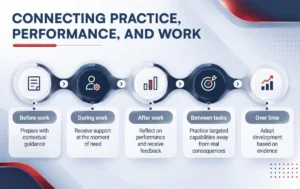
Consequently, L&D departments are being urged to adopt a more strategic framework for AI integration. The objective should not be to make learning easier, but to distinguish between "unproductive friction" (like manual data entry) and "productive friction" (like weighing competing hypotheses).
Five Strategic Questions for Organizational Leadership
To navigate this transition, L&D leaders and Chief Learning Officers (CLOs) are advised to adopt a vetting process for every AI implementation. Before integrating a tool into a workflow, they should evaluate the project against five core criteria:
- Defining the Primary Objective: Is the goal immediate execution or long-term capability building? If execution is the priority, offloading tasks is acceptable. If the employee is in a growth role, the task must remain human-centric.
- Identifying the Replaced Process: What specific cognitive step is the AI taking over? Is it routine formatting, or is it analysis and reflection?
- Assessing Capability Necessity: Is the replaced process a core competency for the role? If the employee needs to perform this task independently in the future, they must practice it without AI.
- Implementing "Challenge Before Answer": Can the workflow be designed so the employee must attempt the task or predict an outcome before the AI provides its output?
- Evaluating Transferability: At regular intervals, can the employee demonstrate competence in a "tool-free" environment?
Broader Implications for the Future of Work
The long-term success of the AI-enabled organization depends on finding the correct equilibrium. If organizations automate all cognitive effort, they risk creating a workforce that is entirely dependent on the machine, lacking the fundamental skills to troubleshoot or innovate when the AI encounters an edge case.
Conversely, those that ignore the productivity gains of AI will be outpaced by competitors. The path forward lies in "co-intelligence"—a model where AI functions as a partner that challenges the human to think more deeply, rather than a crutch that allows them to think less.
Ultimately, the responsibility of the organization is to decide which parts of thinking are essential to the human experience of work. Capabilities such as complex judgment, ethical decision-making, and original problem framing are becoming more valuable, not less, in the age of AI. The challenge for L&D is to ensure that while AI makes the work easier, the learning remains sufficiently difficult to keep the human in the loop, fully capable, and intellectually agile. The future of work is not about human versus machine, but about how human capability can be preserved and evolved in a landscape where the machine is increasingly capable of doing the work for us.