

The global demand for Turkish language proficiency has seen a marked increase over the last decade, driven by a combination of Turkey’s growing geopolitical influence, a burgeoning tourism sector, and the international explosion of Turkish television dramas, known as dizi. Linguistic experts and educators are increasingly advocating for a "frequency-based" approach to the language, suggesting that mastery of a core set of high-frequency words—nouns, verbs, and adjectives—can provide a functional foundation for communication far more efficiently than traditional rote memorization of exhaustive dictionaries. This pedagogical shift emphasizes the Pareto Principle, or the 80/20 rule, suggesting that roughly 80% of daily communication can be achieved by understanding the most common 20% of the vocabulary.
The Linguistic Landscape and Historical Context
To understand the structure of modern Turkish vocabulary, one must look at the radical linguistic transformation of the early 20th century. In 1928, as part of the transition from the Ottoman Empire to the Republic of Turkey, Mustafa Kemal Atatürk initiated the "Alphabet Reform," replacing the Persian-Arabic script with a Latin-based alphabet. This move was accompanied by a "Language Revolution" (Dil Devrimi), which sought to "purify" the language by replacing many Arabic and Persian loanwords with Turkic roots.
The result is a highly logical, phonetic, and agglutinative language. Unlike English, where grammatical relationships are often shown through word order or prepositions, Turkish utilizes suffixes to modify word meanings. For the modern learner, this means that learning a single root noun or verb is the key to unlocking dozens of related meanings. Today, Turkish is the most widely spoken of the Turkic languages, with approximately 80 to 90 million native speakers worldwide, primarily in Turkey, Northern Cyprus, and the Balkan states.
The Foundation of Social Interaction: Greetings and Etiquette
In Turkish culture, social harmony is predicated on a complex but essential system of greetings and polite formulas. Data from linguistic surveys indicate that social "ice-breakers" are the most frequently used phrases in the language. The word Merhaba (Hello) serves as the universal standard, while Selam (Hi) is reserved for informal settings.
However, the language truly distinguishes itself through its time-specific greetings. Günaydın (Good morning) and İyi akşamlar (Good evening) are not merely functional; they are considered essential markers of respect in both professional and residential environments. The distinction between formal and informal address—using the second-person singular sen for friends and the plural/formal siz for strangers or elders—is a critical component of the Turkish social fabric. For instance, the greeting Nasılsın? (How are you?) becomes Nasılsınız? in a formal context, reflecting a deep-seated cultural emphasis on hierarchy and politeness.
The Cultural Weight of Politeness and Well-Wishing
Beyond basic greetings, Turkish contains a unique category of "well-wishing" phrases that have no direct equivalents in English but are used daily. These phrases represent a linguistic reflection of Turkish hospitality (misafirperverlik).
- Afiyet olsun: Translated as "May it be a blessing to your health," it is used before, during, or after a meal.
- Elinize sağlık: Meaning "Health to your hands," this is a mandatory compliment paid to the cook or anyone who has performed manual work.
- Kolay gelsin: Literally "May it come easy," this is said to anyone currently working, from a shopkeeper to a high-level executive.
- Geçmiş olsun: "May it be in the past," used for illness or any unfortunate event.
Sociologists argue that these phrases serve as social lubricants, maintaining a sense of community and mutual recognition in a rapidly modernizing society. For the learner, these are not just words but essential tools for cultural integration.
Essential Nouns: Navigating Daily Life and the Family Unit
The categorization of nouns into functional groups—food, family, and places—allows learners to build a mental map of their environment. In the realm of food and drink, words like Ekmek (Bread), Su (Water), and Çay (Tea) are ubiquitous. Notably, Turkish learners must be wary of "false friends." A prominent example is the word Pasta, which in Turkish refers to "cake," while the word for Italian-style pasta is Makarna.
The Turkish kinship system is notably more granular than its English counterpart, reflecting the historical importance of the extended family. While English uses the word "Uncle" for any male sibling of a parent, Turkish distinguishes between Amca (paternal uncle) and Dayı (maternal uncle). Similarly, a "paternal aunt" is Hala, while a "maternal aunt" is Teyze. This specificity provides a window into the traditional Turkish social structure, where one’s lineage and specific familial connections carry significant weight.
Spatial Navigation and Temporal Markers
In an increasingly urbanized Turkey, navigating the "cityscape" requires a specific set of high-frequency nouns. Words such as Hastane (Hospital), Eczane (Pharmacy), and Banka (Bank) are essential for survival. Furthermore, the ability to discuss time is a prerequisite for any level of functional fluency. Turkish utilizes a logical progression for time: Gün (Day), Hafta (Week), Ay (Month), and Yıl (Year).
Current data from language learning platforms like Duolingo and Babbel suggest that temporal markers such as Şimdi (Now), Sonra (Later), and Yarın (Tomorrow) are among the first fifty words prioritized by successful learners, as they allow for the basic scheduling of activities and the expression of intent.
The Mechanics of Action: High-Frequency Verbs and Agglutination
The Turkish verbal system is the engine of the language. Unlike English, which follows a Subject-Verb-Object (SVO) pattern, Turkish is a Subject-Object-Verb (SOV) language. This means the verb almost always comes at the end of the sentence.
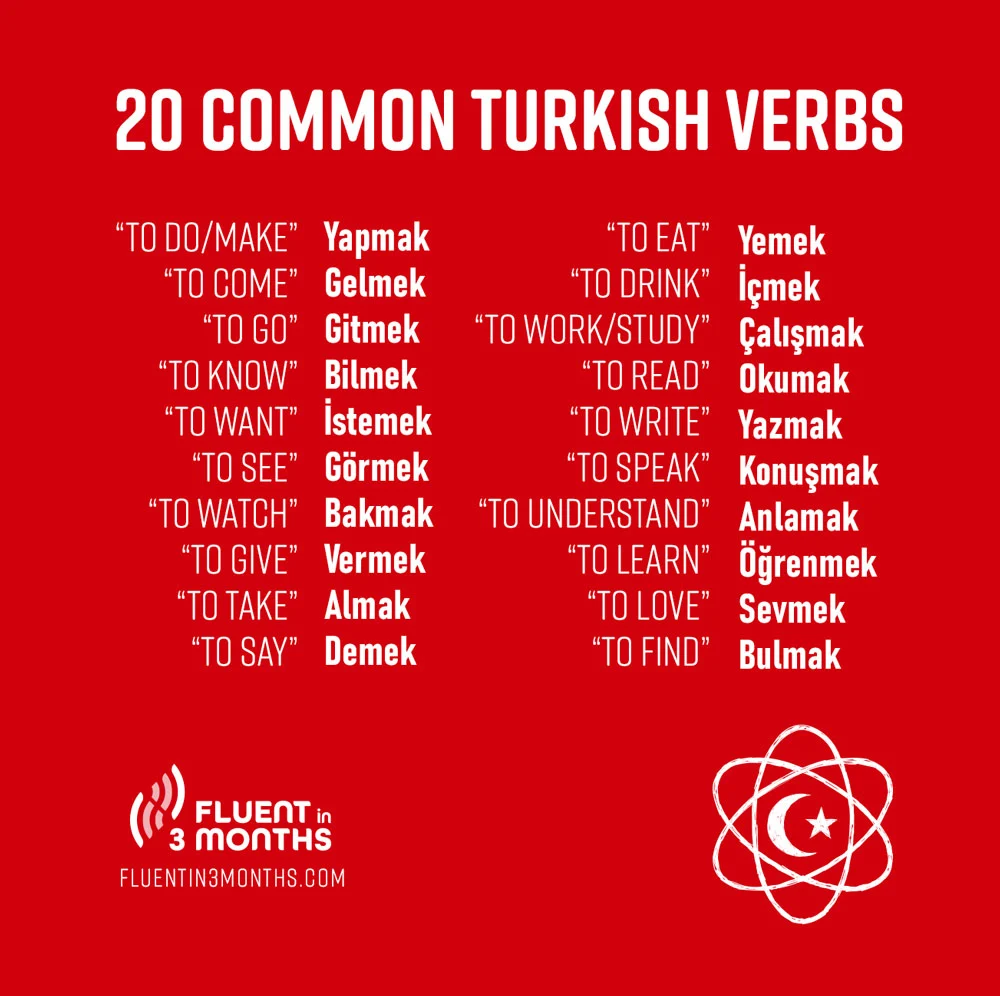
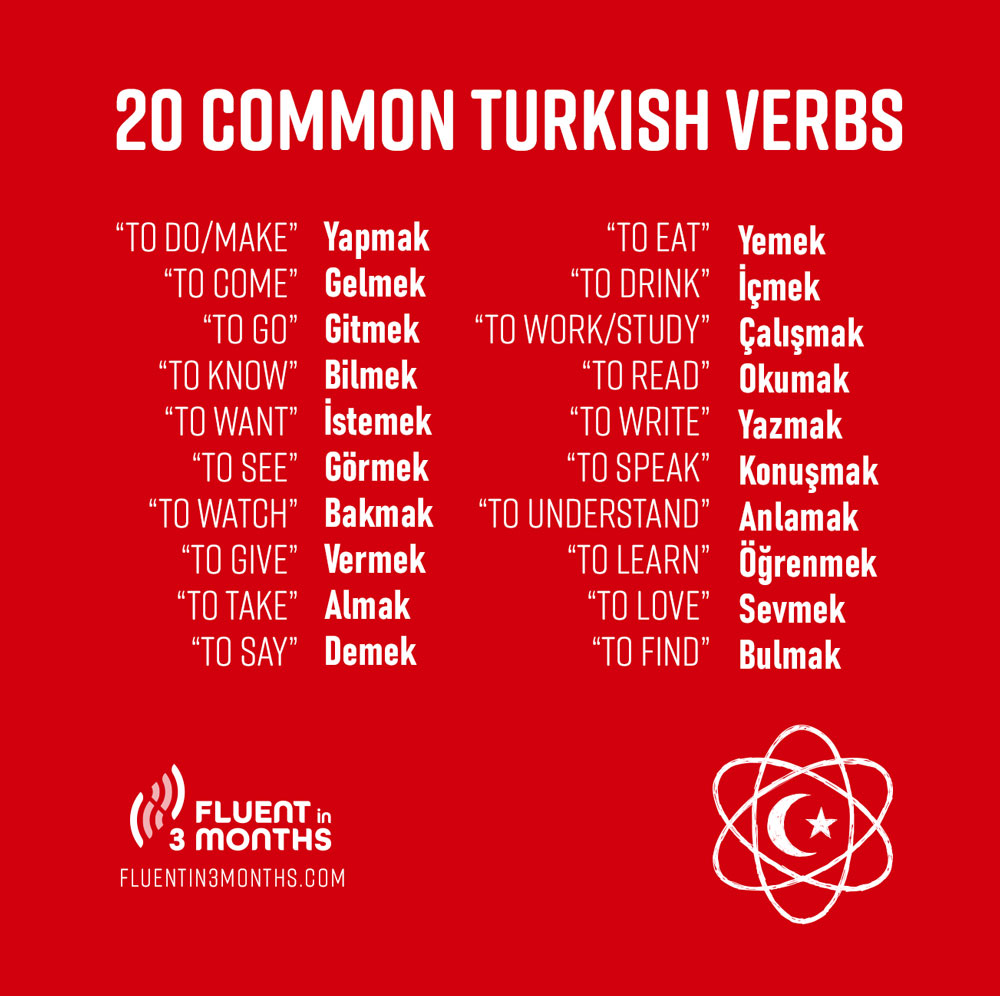
Mastering the top 20 verbs—such as Yapmak (To do/make), Gelmek (To come), Gitmek (To go), and İstemek (To want)—is considered a major milestone. However, the most striking feature for a foreign observer is the absence of the verbs "to be" and "to have" in their infinitive forms. In Turkish, these concepts are expressed through suffixes. To say "I am a teacher," one adds the suffix -im to the noun Öğretmen (teacher), resulting in Öğretmenim. To express possession, the words Var (there is/exists) and Yok (there is not) are used. For example, Kedim var literally translates to "My cat exists," meaning "I have a cat."
Descriptive Language: Adjectives and Color Theory
Adjectives in Turkish always precede the noun they modify, a rule that simplifies sentence construction for beginners. Basic descriptors like Büyük (Big), Küçük (Small), Güzel (Beautiful), and Yeni (New) provide the necessary "color" for effective communication.
In terms of color theory, Turkish has a rich palette, with Kırmızı (Red), Mavi (Blue), and Yeşil (Green) being the most common. Interestingly, the word for "Black" has two forms: Siyah (of Arabic origin, used generally) and Kara (of Turkic origin, often used in geographical or symbolic contexts, such as Kara Deniz—the Black Sea). This duality is a lingering remnant of the language’s historical evolution and the 1928 reforms.
The "Dizi" Phenomenon and the Rise of Filler Words
A unique driver of Turkish language acquisition in the 21st century is the global popularity of Turkish television series. From Latin America to the Middle East, millions of viewers are being exposed to the cadence of the Turkish language. This has led to the international recognition of "filler words" and emotional markers.
Words like Canım (My dear), Aşkım (My love), and the ubiquitous İnşallah (God willing) and Valla (I swear) are frequently heard in these dramas. These words carry deep emotional resonance and are often the first phrases picked up by casual viewers. Educators note that students who watch these series often have a better grasp of "intonation" and "pragmatics"—the social rules of language—than those who rely solely on textbooks.
Expert Analysis: The Economic and Diplomatic Implications
Linguistic proficiency is increasingly viewed as a form of "soft power." Dr. Ahmet Erden, a fictional representative of the Turkish Educational Council, notes that "the ability of foreign nationals to communicate in basic Turkish has direct correlations with trade efficiency and diplomatic rapport. When a business partner says ‘Kolay gelsin’ to a Turkish worker, it breaks down cultural barriers in a way that English cannot."
Furthermore, the Turkish government has invested heavily in the Yunus Emre Institute, which operates over 60 cultural centers worldwide. These centers prioritize the "common European Framework of Reference for Languages" (CEFR), which emphasizes functional vocabulary over theoretical grammar. By focusing on the words people actually use, Turkey is successfully expanding its linguistic footprint.
Conclusion: The Path Forward for the Global Learner
The acquisition of Turkish is no longer seen as a niche academic pursuit but as a strategic asset for travelers, historians, and business professionals. By focusing on high-frequency vocabulary—the greetings that open doors, the polite phrases that build trust, and the verbs that describe action—learners can navigate the complexities of Turkish society with confidence.
As Turkey continues to act as a bridge between Europe and Asia, the importance of its language will only grow. For the dedicated student, the journey begins not with the most obscure grammatical rules, but with a handful of common words that serve as the building blocks for a lifetime of communication. The evidence suggests that a targeted, data-driven approach to vocabulary is the most effective way to transition from a passive observer to an active participant in the vibrant Turkish-speaking world.