

The pedagogical landscape of foreign language acquisition has shifted significantly toward the "lexical approach," a method that prioritizes the mastery of high-frequency words to achieve functional fluency in a shortened timeframe. For the Turkish language—a member of the Turkic family spoken by over 80 million people globally—this strategy is particularly effective. Linguistic experts suggest that a learner does not require an exhaustive grasp of the entire Turkish lexicon to communicate effectively; rather, a foundational command of the most common nouns, verbs, and adjectives allows for a comprehensive understanding of daily life and social discourse. This strategic focus acts as a scaffolding system, providing the essential building blocks upon which complex grammatical structures and specialized terminology can eventually be constructed.
The Evolution and Modern Context of the Turkish Language
To understand the importance of Turkish vocabulary today, one must consider the historical context of the language. In 1928, as part of the sweeping reforms led by Mustafa Kemal Atatürk, the Republic of Turkey transitioned from the Arabic script to a modified Latin alphabet. This "Language Revolution" (Dil Devrimi) aimed to increase literacy and "purify" the language by replacing many Persian and Arabic loanwords with Turkish roots. Consequently, modern Turkish is a highly logical, phonetic, and systematic language.
In the 21st century, the global footprint of the Turkish language has expanded rapidly, largely driven by the "Dizi" phenomenon—the international success of Turkish television dramas. Data from the Turkish Ministry of Culture and Tourism indicates that Turkey is now the second-largest exporter of television series worldwide, trailing only the United States. This cultural export has sparked a global surge in language interest, with platforms like Duolingo reporting millions of active Turkish learners. For these students, the primary challenge is not the alphabet, but the agglutinative nature of the language, where suffixes are added to root words to convey meaning.
The Social Fabric: Greetings and the Culture of Politeness
In Turkish society, social etiquette is paramount, and the use of correct greetings serves as a vital indicator of cultural respect. The most common greeting, Merhaba (Hello), is universally accepted, while Selam (Hi) is reserved for informal settings among peers. Temporal greetings such as Günaydın (Good morning) and İyi akşamlar (Good evening) are essential for navigating daily interactions in public spaces.
A unique aspect of Turkish social discourse is the distinction between formal and informal addresses. The word for "Welcome," Hoş geldin, is used with friends, whereas Hoş geldiniz is the formal or plural version required in professional environments or when addressing elders. Similarly, the inquiry "How are you?" shifts from Nasılsın? to Nasılsıniz? based on the level of familiarity.
Politeness in Turkish extends beyond basic pleasantries into highly specific "bonus phrases" that reflect the nation’s hospitable culture. Phrases like Afiyet olsun (Enjoy your meal) and Geçmiş olsun (Get well soon) are used daily. One of the most culturally significant phrases is Elinize sağlık (Health to your hands), a compliment directed at someone who has prepared a meal or performed manual work. Another is Kolay gelsin (May it be easy for you), a polite acknowledgement offered to anyone currently working, from a shopkeeper to a construction worker.
Navigating the Daily Environment: Nouns and Kinship
The acquisition of nouns is the most immediate way for a learner to interact with their surroundings. In the realm of gastronomy, which is a cornerstone of Turkish identity, words like Ekmek (Bread), Su (Water), Çay (Tea), and Kahve (Coffee) are indispensable. Learners must be wary of "false friends" in the lexicon; for instance, the Turkish word pasta refers to "cake," while the word for pasta is makarna. Misunderstanding this distinction can lead to significant errors in service-oriented environments.
The Turkish kinship system is notably more complex than its English counterpart, reflecting a deep-seated cultural emphasis on family hierarchy. The language distinguishes between paternal and maternal relatives: a paternal uncle is Amca, while a maternal uncle is Dayı. Similarly, a paternal aunt is Hala, and a maternal aunt is Teyze. The language also provides specific titles for older siblings—Abla for an older sister and Abi for an older brother—which are often used as respectful terms of address even for non-relatives in social settings.
In urban navigation, high-frequency nouns such as Hastane (Hospital), Banka (Bank), Havaalanı (Airport), and Restoran (Restaurant) form the core of a traveler’s or expatriate’s functional vocabulary. Understanding time-related nouns like Bugün (Today), Yarın (Tomorrow), and Şimdi (Now) further enables the coordination of logistics and social appointments.
The Engine of Communication: High-Frequency Verbs
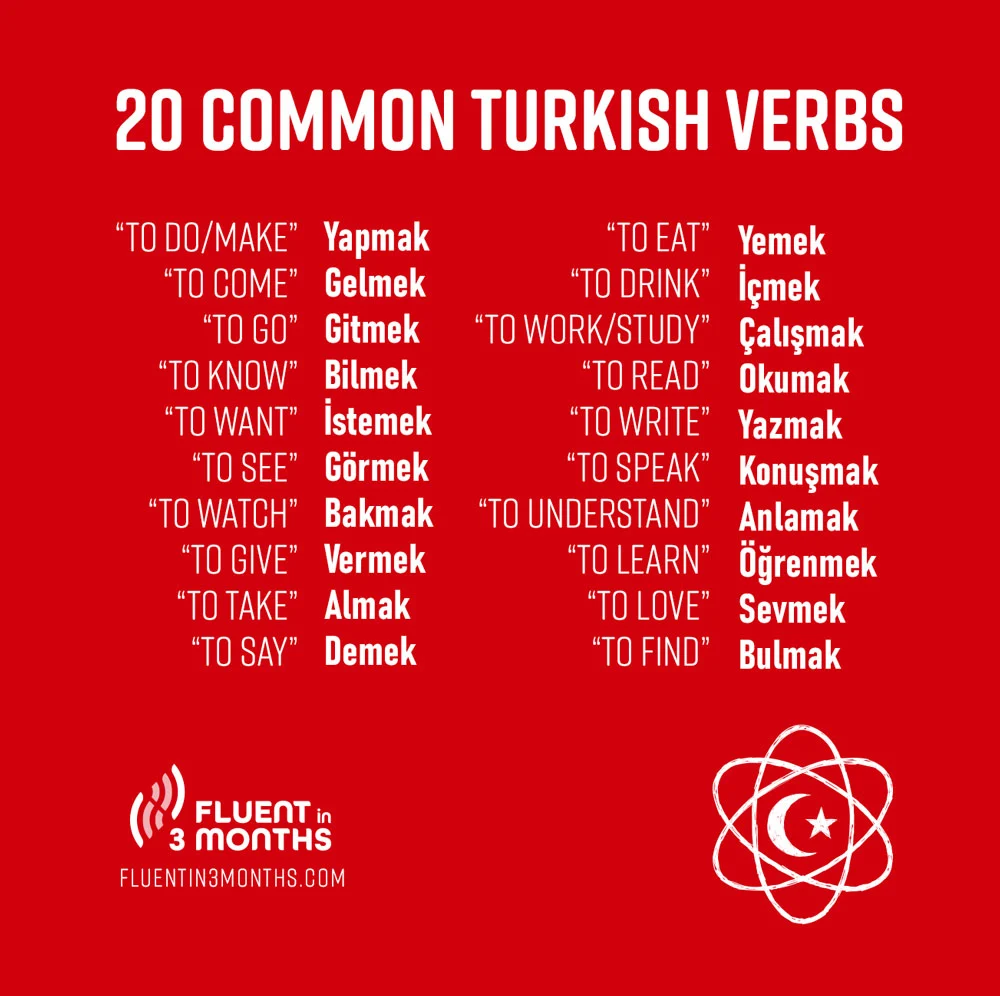
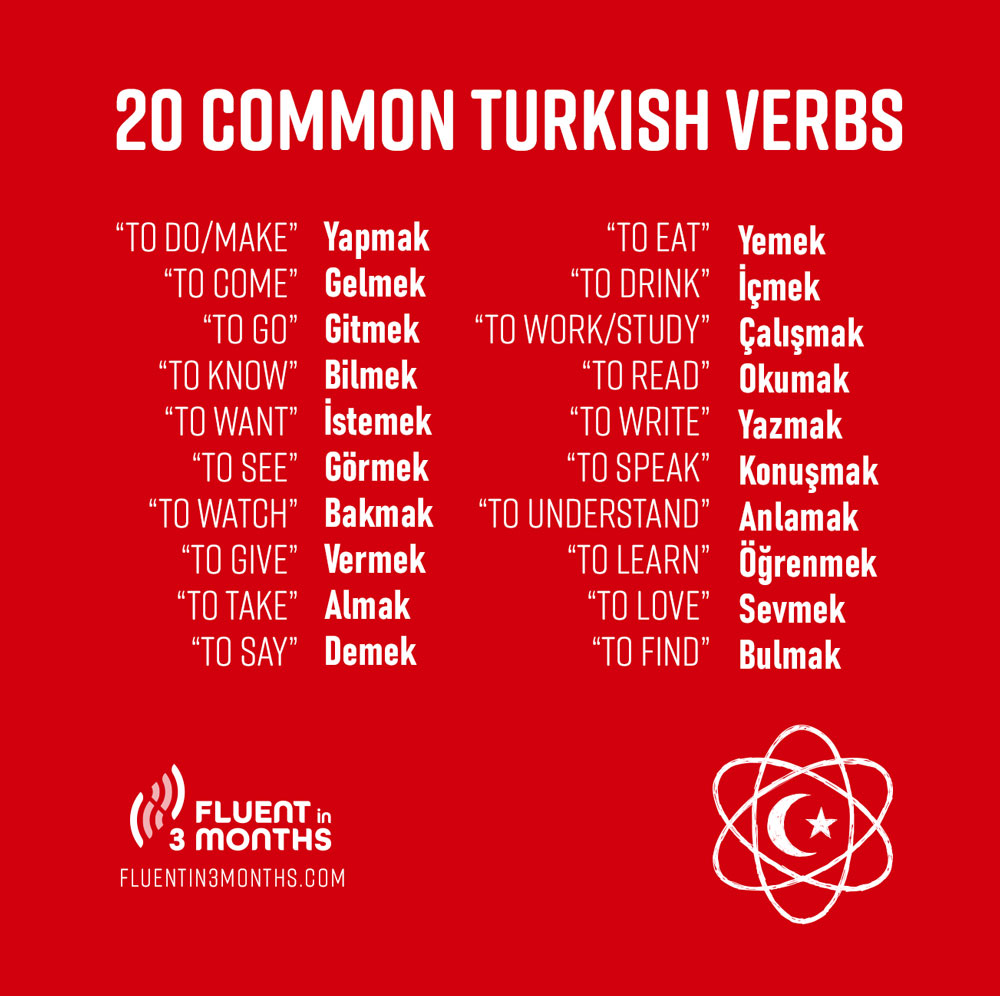
While nouns provide the subject matter, verbs are the engines that drive Turkish sentences. The most common Turkish verbs include Yapmak (To do/make), Gelmek (To come), Gitmek (To go), and İstemek (To want). A critical linguistic hurdle for learners is the Turkish word order, which typically follows a Subject-Object-Verb (SOV) pattern. Unlike English, where the verb follows the subject, in Turkish, the verb almost always concludes the sentence. For example, "I am learning Turkish" translates to Ben Türkçe öğreniyorum (literally: I Turkish learning-am).
Furthermore, Turkish does not possess separate words for the verb "to be" or "to have" in the way Indo-European languages do. Instead, these concepts are expressed through suffixes or the words var (there is/exists) and yok (there isn’t/doesn’t exist). To say "I have a cat," one says Benim bir kedim var (literally: My one cat-my exists). This structural difference necessitates that learners prioritize the memorization of root verbs to which these various functional suffixes can be attached.
Descriptive Power: Adjectives and Colors
Adjectives in Turkish are placed before the noun they modify, a structure familiar to English speakers. Common descriptors such as Büyük (Big), Küçük (Small), Güzel (Beautiful), and Yeni (New) allow for the immediate qualification of objects and experiences. The language also makes a distinction in "old" depending on the subject: Eski is used for inanimate objects, while Yaşlı is reserved for elderly people.
Colors also play a significant role in both daily description and cultural symbolism. Kırmızı (Red) and Beyaz (White) are particularly prominent due to their presence on the national flag. Other essential colors include Mavi (Blue), Yeşil (Green), and Siyah (Black). By combining these with nouns, learners can transition from basic identification to descriptive speech, such as Mavi araba (Blue car) or Büyük ev (Big house).
Connectors and Question Words: Achieving Fluency
To move beyond isolated words and into fluid conversation, learners must adopt conjunctions and connectors. Words like Ve (And), Ama (But), Çünkü (Because), and Eğer (If) act as the "glue" that binds sentences together, allowing for the expression of complex thoughts and causality.
Equally important are the "Wh-questions" that facilitate information gathering. In Turkish, these are Ne (What), Kim (Who), Neden (Why), Nasıl (How), Nerede (Where), and Ne zaman (When). Mastery of these words is often the turning point for learners, as it allows them to take an active role in conversations and seek clarification when their understanding of a topic is incomplete.
Analysis of the "Dizi" Influence and Endearment Terms
The global consumption of Turkish media has introduced a specific set of "bonus words" into the international vernacular. Viewers of Turkish dramas frequently encounter fillers and emotional expressions such as Tabii ki (Of course), Hadi (Come on), and Maalesef (Unfortunately). Religious and cultural idioms like İnşallah (God willing) and Valla (I swear) are also ubiquitous in both media and real-life dialogue, reflecting the intersection of language and traditional values.
Endearment terms such as Canım (My dear/my soul) and Aşkım (My love) are used with a frequency that often surprises Western learners. These terms are not only reserved for romantic partners but are frequently used among close friends and family members, illustrating the warmth and emotional expressiveness inherent in Turkish interpersonal relations.
Broader Impact and Implications for Global Learners
The systematic acquisition of these high-frequency Turkish words has broader implications for international relations, business, and tourism. Turkey’s strategic position as a bridge between Europe and Asia makes it a vital economic partner. Proficiency in even basic Turkish can significantly enhance a professional’s ability to navigate the Turkish market, where personal relationships and cultural nuances are highly valued.
From a cognitive perspective, learning Turkish offers a unique challenge due to its logical yet "alien" structure compared to Germanic or Romance languages. However, the high degree of regularity in Turkish grammar—with almost no irregular verbs—means that once the core vocabulary is mastered, the path to advanced proficiency is remarkably clear.
In conclusion, the mastery of the most common Turkish words is not merely a linguistic exercise but a gateway to a rich cultural heritage and a burgeoning global community. By focusing on these essential building blocks, learners can achieve a level of functional fluency that allows for meaningful engagement with the Turkish-speaking world, paving the way for deeper integration and more sophisticated communication. As the influence of Turkish media and the nation’s economic presence continue to grow, the value of this high-frequency vocabulary will only increase for students, travelers, and professionals alike.