



The U.S. Department of Education announced on Wednesday that states and districts will receive an additional $144 million this year to enhance services for infants, toddlers, children, and young adults with disabilities. This significant allocation, made possible by updated appropriations language for fiscal year 2026, marks a pivotal shift in early intervention funding by enabling states to extend support to expectant parents of children with disabilities.
In conjunction with the funding announcement, the Education Department released comprehensive guidance detailing how states can leverage funds from the Individuals with Disabilities Education Act (IDEA) to assist expectant parents in preparing for the birth of a child with a disability and planning for necessary services immediately following birth. This proactive approach represents a substantial departure from traditional early intervention funding models, which have historically focused on supporting children and their families only after a child’s birth.
The inclusion of language in the fiscal year 2026 appropriations legislation allows states to broaden the scope of IDEA Part C services, making them accessible to individuals who anticipate becoming parents to a child with a disability. Notably, this legislative change does not impose new mandates on existing Part C programs but rather offers expanded flexibility in fund utilization.
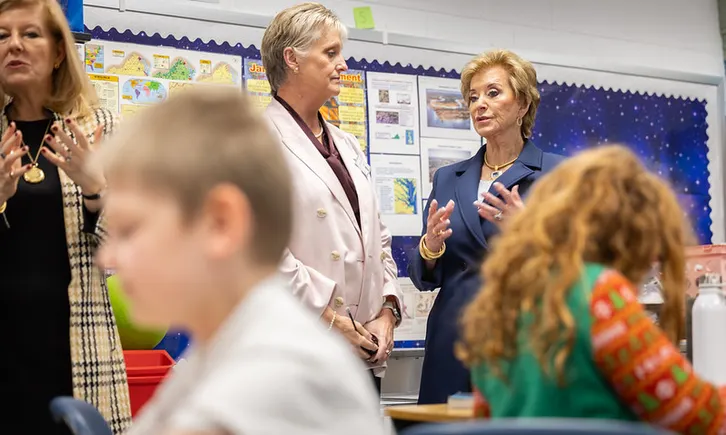
U.S. Education Secretary Linda McMahon highlighted the transformative nature of this initiative in a statement released on Wednesday. "For the first time, states can allocate funds to help parents receive support even before their child with disabilities is born, giving them accurate information and a direct path to the services their child will need on day one," Secretary McMahon stated. She characterized the $144 million in additional funding as a "substantial expansion of resources for students with disabilities and their families," underscoring it as a testament to the Trump administration’s "relentless commitment to standing with families, empowering states with more flexibility, and advancing the potential of every student."
Expanded Funding for IDEA Parts B and C
The newly allocated $144 million will be distributed to support both IDEA Part B services, which cater to students aged 3 through 21, and Part C early intervention services, designed for infants and toddlers from birth through age 2. Special education programs at state and local levels, as well as other federal funding streams like Medicaid, also contribute to these vital services.
The $144 million injection is particularly significant when considered against the backdrop of existing IDEA funding. For fiscal year 2026, IDEA Part B received an allocation of $14.2 billion, an increase of $20 million from the previous year. IDEA Part C, meanwhile, was funded at $540 million in FY26, maintaining its allocation from the prior year, according to data from the Committee for Education Funding, a nonprofit advocating for increased federal investment in education.
An Education Department spokesperson clarified via email on Wednesday that the $144 million in special education funding originates from non-expiring funds that have been returned to the agency in recent years. These funds are slated for distribution through formula grants to states and territories on July 1 and October 1. Approximately $123.6 million will be directed towards Part B grants, with the remaining $20.5 million allocated to Part C grants.
Shifting Federal Landscape and Growing Needs
This funding announcement occurs within a broader context of significant organizational changes within the U.S. Department of Education under the Trump administration. Over the preceding 16 months, the department has implemented substantial workforce reductions and transferred considerable oversight responsibilities for various programs to state and local entities as part of an effort to streamline operations and enhance decentralized decision-making.
Reports indicate that approximately half of the department’s workforce was laid off within the first ten months of 2025, impacting various divisions, including those focused on special education. For fiscal year 2027, President Donald Trump’s budget proposal outlines a drastic reduction in full-time staff for the Office of Special Education and Rehabilitative Services (OSERS), which oversees the Office of Special Education Programs responsible for monitoring state and district compliance with IDEA. The proposal aims to decrease staffing from 163 in FY25 to just 31 for FY27.
The future landscape of federal oversight for special education programming remains a subject of ongoing discussion, with Secretary McMahon having expressed interest in potentially transferring some responsibilities to other federal agencies. While no definitive plans have been finalized, the Department of Education currently maintains ten interagency agreements with five other federal agencies to manage education programs.
Supporters of these departmental changes argue that they are designed to reduce bureaucratic bloat and eliminate redundancies within the Education Department. However, educational administrative groups, disability rights advocacy organizations, and Democratic lawmakers have voiced concerns that these actions have led to confusion, inefficiencies, and a reduction in the funding and support necessary to adequately serve all students, particularly those with disabilities. Several lawsuits have been filed challenging the administration’s restructuring of the Education Department.
This period of federal downsizing coincides with a documented increase in the number of children and students qualifying for special education services. In 2024, approximately 8.2 million students aged 3-21 received services under IDEA, representing a 12.6% increase between 2019 and 2024, according to an analysis by The Advocacy Institute based on U.S. Department of Education data. This surge in demand for special education services contrasts with a slight dip in overall public school enrollment, which decreased by 0.3% in the 2024-25 school year compared to the previous year, according to separate Education Department data.
Guidance for Expanding Part C Services to Expectant Parents
The seven-page guidance document released by the Education Department provides states with a framework for utilizing Part C funding and support for expectant parents. It outlines how these funds can be employed for essential activities such as "child find," public awareness campaigns, and referral services targeted at individuals who anticipate becoming parents of an infant with a disability.
The guidance offers a concrete example: a mother who learns through prenatal genetic testing that her child will be born with Down syndrome. Under the revised guidelines, a state could utilize Part C funds to educate this expectant mother about the IDEA Part C system, facilitate referrals for relevant services, and ensure that both the mother and child receive individualized Part C services within 45 days of the child’s birth.
Research consistently underscores the desire of expectant parents for greater prenatal support. "Numerous studies have found that expectant parents often want more access to prenatal support and that providing children with EI [early intervention] services as quickly as possible improves long term outcomes," the guidance states, referencing the benefits of early intervention.
Addressing Financial Strains and Growing Needs in Early Intervention
Despite the increased federal focus and funding, many state Part C programs continue to face significant financial challenges. A 2025 survey of Part C state coordinators conducted by the Infant and Toddler Coordinators Association (ITCA) revealed that funding often fails to keep pace with the escalating early intervention needs of enrolled children and is insufficient to meet federal regulatory requirements.
The ITCA survey report indicated that the challenges faced by many states and jurisdictions are not attributable to a lack of political will, evidence-based approaches, or the need for better cost-effectiveness data. Instead, the primary obstacles are identified as a scarcity of funding and personnel, coupled with the increasing needs of infants and their families.
In 2024, approximately 458,920 infants and toddlers were served under Part C, a figure that represented a 1% decrease from the preceding year, according to The Advocacy Institute’s analysis. While the number of children served has seen fluctuations, the underlying demand for comprehensive early intervention services remains robust, exacerbated by demographic shifts and increased identification of developmental delays and disabilities. The expansion of services to expectant parents aims to address the critical need for early support, recognizing that timely intervention can significantly influence long-term developmental trajectories and improve outcomes for children and their families. This proactive approach, supported by increased federal funding and flexible guidance, represents a significant step forward in ensuring that children with disabilities receive the support they need from the earliest possible stages of life.