




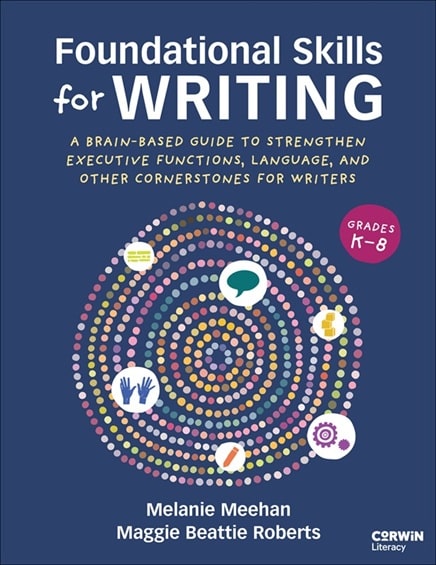
In an educational landscape increasingly dominated by discussions around literacy, a significant gap has persisted: the comprehensive and explicit instruction of writing. While phonics, fluency, and reading comprehension frequently command attention in policy debates and curriculum development, writing, an equally critical and deeply intertwined component of literacy, often remains in the periphery. Addressing this pronounced oversight, educators Melanie Meehan, a former curriculum coordinator and founder of an in-person writing center, and Maggie Roberts, a literacy consultant and veteran middle school teacher, have co-authored a new book, "Foundational Skills for Writing: A Brain-Based Guide to Strengthen Executive Functions, Language, and Other Cornerstones for Writers." Published earlier this month, the book offers a timely and neurologically informed approach to demystifying the complex act of writing for students and equipping teachers with actionable strategies.
The Neglected Pillar of Literacy: Why Writing Demands Renewed Focus
The past decade has seen an intensified national conversation about literacy, often framed under the umbrella of the "Science of Reading." This movement has rightly emphasized evidence-based practices for teaching reading, particularly in early literacy, focusing on phonemic awareness, phonics, vocabulary, fluency, and comprehension. However, critics and practitioners alike have noted that writing instruction, despite its intrinsic link to reading, has not received commensurate attention. Data from assessments like the National Assessment of Educational Progress (NAEP) consistently highlight challenges in student writing proficiency across grade levels, indicating a persistent need for more effective pedagogical approaches. For instance, the 2011 NAEP Writing Assessment, the last time it was administered, showed that only 24% of both 8th and 12th graders performed at or above the "proficient" level. This stark reality underscores a systemic issue that "Foundational Skills for Writing" seeks to confront.

Experts in cognitive science and education, including researchers like Dr. Steve Graham, have long emphasized that writing is an intricate cognitive process, demanding the orchestration of multiple mental faculties. It involves not just encoding thoughts into text but also planning, organizing, retrieving vocabulary, applying grammatical rules, and self-regulating throughout the process. When students struggle with foundational aspects, their cognitive load becomes overwhelming, diverting mental resources away from higher-order thinking and the true craft of conveying meaning. The book by Meehan and Roberts posits that by understanding the brain’s demands during writing, educators can better identify where students face roadblocks and intervene with targeted, brain-friendly instruction.
Introducing "Foundational Skills for Writing": A New Framework
Melanie Meehan and Maggie Roberts bring a wealth of practical experience and theoretical understanding to their collaboration. Meehan’s background as a curriculum coordinator and her direct work in a writing center provide insight into the systemic challenges schools face and the individual struggles students encounter. Roberts, with nearly two decades supporting teachers as a literacy consultant, offers a deep understanding of classroom implementation and teacher needs. Their combined expertise forms the backbone of a book that is both rigorously researched and eminently practical.
The central premise of "Foundational Skills for Writing" is to deconstruct the seemingly monolithic task of writing into manageable, interconnected skill categories. This approach allows educators to diagnose specific areas of difficulty and apply targeted interventions, rather than addressing writing as a singular, undifferentiated skill. The authors identify three cornerstone categories that underpin proficient writing:
-
Transcription Skills: These are the mechanics of putting words on paper or screen. They encompass handwriting, keyboarding proficiency, accurate spelling, and the development of both large and small motor skills necessary for physical execution. The automatization of these skills is crucial; when a student expends significant cognitive energy merely forming letters or recalling spellings, little is left for idea generation or sentence construction.
-
Oral Language: Recognizing that speaking and listening are direct precursors to written expression, this category focuses on the verbal skills that lay the groundwork for effective writing. This includes vocabulary acquisition, sentence construction (both simple and complex), narrative sequencing, and the ability to articulate thoughts coherently aloud. A robust oral language foundation allows students to "hear" their writing before it’s even committed to paper, facilitating clearer and more sophisticated written output.
-
Executive Functioning: Often overlooked in direct writing instruction, executive functions are the brain’s "management system." Meehan and Roberts specifically highlight working memory (the ability to hold and manipulate information), cognitive flexibility (the capacity to adapt thinking and consider alternatives), and inhibitory control (the power to resist impulses and stay focused). These functions are vital for planning, organizing thoughts, drafting, revising, and maintaining coherence over extended pieces of writing. Deficits in any of these areas can severely impede a student’s writing progress, regardless of their knowledge of grammar or spelling.
By dissecting writing into these foundational components, the book offers a structured pathway for teachers to assess student needs and build proficiency systematically.

Minute Moves: High-Impact, Low-Time Strategies for Skill Automatization
One of the book’s most innovative contributions is its collection of "Minute Moves." These are short, flexible activities, each designed to take just a couple of minutes, that can be seamlessly integrated into various parts of the school day. Unlike lengthy writing projects, Minute Moves aim to help students automatize foundational skills, thereby freeing up cognitive energy for the higher-level demands of composition. The authors emphasize that consistent, brief practice can be more effective than sporadic, extended sessions for solidifying these crucial underlying abilities. These "moves" can serve as warm-ups, transition activities, or quick interventions, making them highly adaptable for busy classrooms.
Category 1: Mastering Spelling Through Linguistic Inquiry
The book proposes three Minute Moves specifically targeting spelling, shifting the focus from rote memorization to a deeper understanding of word structure and etymology.

-
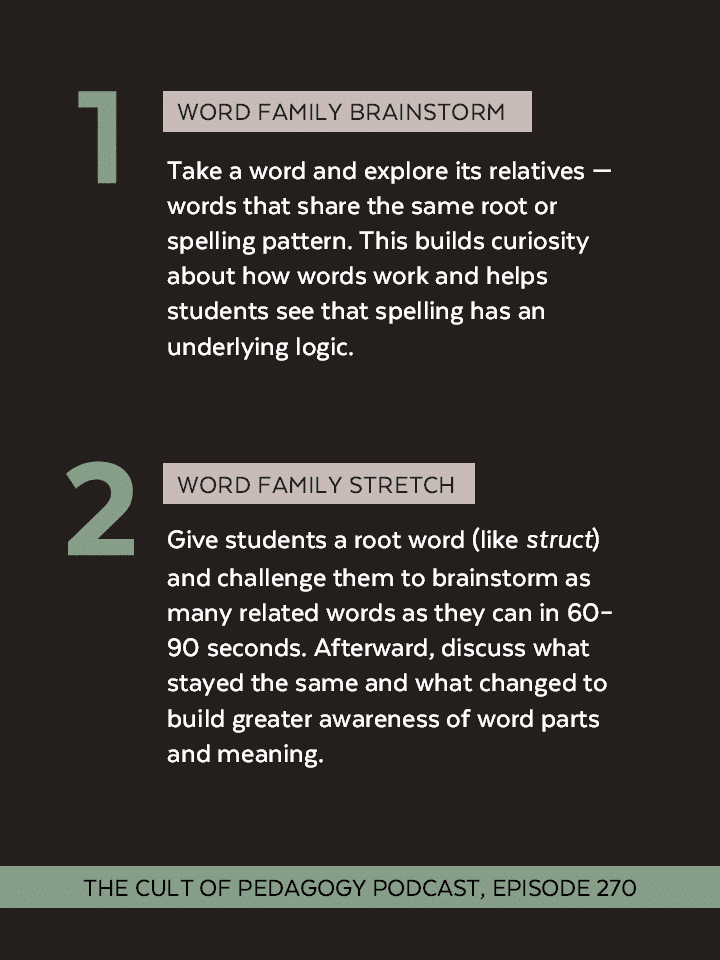
Word Family Brainstorm: Inspired by spelling researcher Rebecca Treiman, this strategy encourages students to explore the "relatives" of a given word. Instead of merely memorizing isolated words, students are guided to uncover patterns and connections. For example, when exploring the homophone "two," students might connect it to "twin," "twine," and "twenty," revealing a recurring "TW" pattern linked to the concept of "twoness." Meehan recounts a tutoring experience where a student struggling with "decision" discovered its connection to "decide," which then led to "incision," "concise," and even "scissors," all tracing back to a Latin root meaning "to cut." This approach transforms spelling from a chore into a detective game, fostering curiosity and making orthographic patterns more intuitive.
-
Word Family Stretch: Building on the brainstorm, this activity provides a root (e.g., "struct," meaning "to build") and challenges students to generate as many related words as possible within a 60-90 second timeframe (e.g., "structure," "destruction," "construct," "structural," "instruct," "instruction"). The critical follow-up is a debriefing session: "What stayed the same? What changed? How did the meaning shift with prefixes or suffixes?" This discussion helps students internalize that word parts carry meaning, reinforcing morphological awareness—a powerful tool for both spelling and vocabulary acquisition, particularly for academic language. Roberts further clarifies the distinction between "bound" roots (like "struct," which cannot stand alone) and "free" roots (like "form," which can function independently but also forms "reform," "transform," "inform"). Understanding these nuances deepens students’ metalinguistic awareness.
-
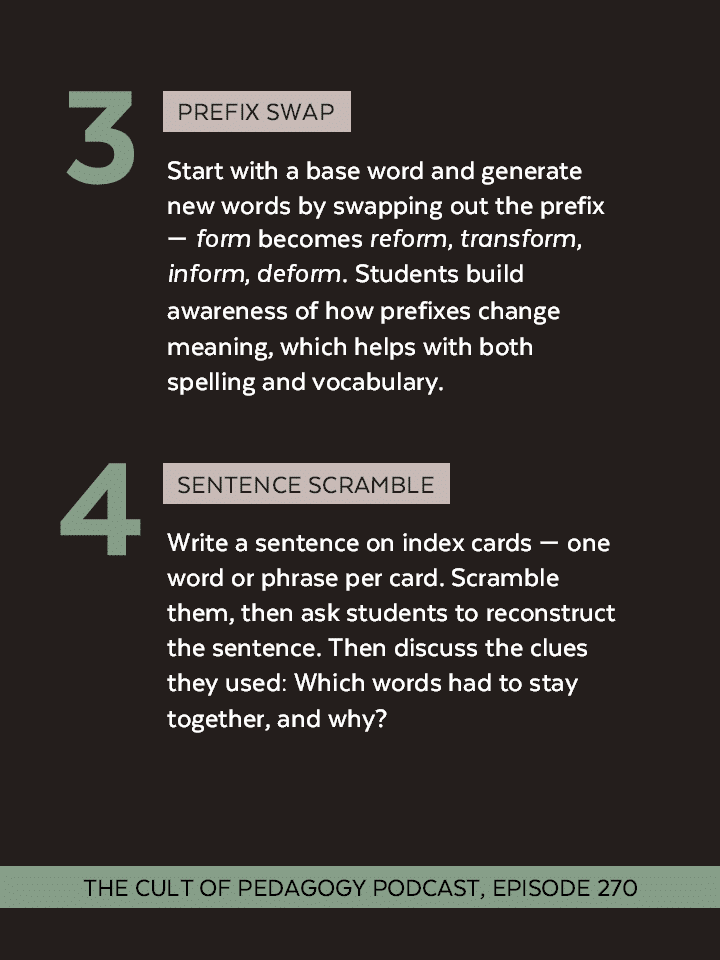
Prefix Swap: Directly linked to the previous activities, this Minute Move focuses on the specific impact of prefixes. Students are given a base word, such as "form," and asked to generate variations by swapping prefixes: "reform," "transform," "inform," "deform." Each swap necessitates a discussion about the change in meaning, highlighting the semantic power of prefixes. This strategy is particularly potent for multilingual learners, who may recognize Latin or Greek roots and prefixes from their native languages, such as understanding "benevolent" and "malevolent" through the familiar "bene" and "mal." Meehan emphasizes that these three spelling activities collectively build essential neurological pathways, facilitating quicker word retrieval and reducing the cognitive burden of spelling.
Category 2: Building Robust Sentence Structures
The book introduces three Minute Moves designed to enhance students’ command over sentence construction, moving them beyond simple, fragmented sentences towards more complex and expressive forms.
-
Sentence Scramble: This tactile activity involves breaking a sentence into its component words or phrases, written on individual index cards. Students then scramble and reassemble the sentence. The physical manipulation allows for experimentation and problem-solving. After reconstruction, students reflect on their process: "How did you figure out the order? What clues did you use? Which words had to stay together, and why?" The activity can be scaffolded by removing punctuation, adding a distractor word, or challenging students to extend the sentence. Roberts explains that the ultimate goal is to foster an "internalized understanding of sentence patterns and sentence construction," which students can then apply to their independent writing.
-
Sentence Expander: Beginning with a "kernel sentence" (e.g., "The cat purrs"), students collaboratively build upon it by asking a series of elaborative questions: "Which cat? What color? Where? When? Why?" Meehan advocates for using accessible terms like "doer" and "doing" instead of the more abstract "subject" and "predicate" to help younger or struggling writers grasp sentence fundamentals. As the sentence expands (e.g., "The fluffy orange cat is purring loudly on the sunny windowsill because it just woke up from a long nap"), students learn how to enrich their descriptions without losing clarity. The exercise also encourages rearranging elements to create different effects, allowing students to play with syntax and develop more sophisticated sentence structures.
-
Sentence Combining: Roberts describes sentence combining as a "high-impact, quick way for kids to graduate from writing a series of simple sentences to ones that are more syntactically complex, interesting, and precise." Students are given two short, often choppy, sentences (e.g., "My cat is orange. My cat is big.") and tasked with merging them into one (e.g., "My big orange cat…"). For beginners, key words can be underlined to guide insertion. As proficiency grows, students combine three or more sentences, experimenting with various conjunctions (e.g., "because," "and," "but") to alter meaning and introduce nuance. This practice directly translates to independent writing, helping students naturally integrate descriptive details and complex ideas into fluid prose.
Category 3: Cultivating Cognitive Flexibility for Dynamic Writers
The final two Minute Moves target executive functions, particularly cognitive flexibility, an essential skill for adaptive and strategic writing.
-
What’s Another Way?: This strategy directly addresses cognitive flexibility by challenging students to rewrite a given sentence in multiple ways. Questions prompt varied approaches: "What if you started with the dependent clause? What if you replaced the noun with a pronoun? What if you made it shorter?" Meehan highlights that effective writing isn’t solely about complexity; sometimes, a concise sentence carries greater impact. This exercise teaches students to intentionally vary sentence structure and length, developing a versatile "skill set" for different rhetorical effects. Crucially, Meehan notes the empowering effect of explicitly naming this as "cognitive flexibility" for students. Recognizing they are practicing a sophisticated cognitive skill can boost confidence, especially for those who have historically struggled with writing.
-
New Angle: This Minute Move expands cognitive flexibility from the sentence level to the narrative level, requiring students to retell a familiar story or scene from an alternative character’s perspective. Roberts vividly illustrates this with a memory of a high school cafeteria food fight, explaining how the retelling would drastically differ through the eyes of the exasperated teacher covered in applesauce. This activity demands that students hold multiple viewpoints simultaneously, making deliberate choices about voice, selective detail, and interpretation. Meehan often uses short videos, like the Pixar short "Snack Attack," which depicts the same event from two contrasting perspectives. In one session, she and a student each wrote from a different character’s point of view, then swapped, continuing the narrative. This not only engaged the student competitively but also fostered a profound understanding of diverse perspectives. Meehan underscores the broader societal implications: "It’s not just about writing and it’s not just about watching this show… but it’s also about democracy and thinking about how other people think and what their perspectives are."
Broader Implications for Education
The release of "Foundational Skills for Writing" comes at a critical juncture in education. As districts grapple with literacy recovery post-pandemic and continue to refine their approaches to evidence-based instruction, the book offers a crucial lens through which to examine and enhance writing pedagogy.
- Teacher Training and Professional Development: The book provides a clear framework and practical tools that can be integrated into professional development programs, equipping teachers with the knowledge of cognitive science and specific strategies to teach writing more effectively. This could lead to a more confident and skilled teaching force in writing instruction.
- Curriculum Integration: The "Minute Moves" are designed for flexibility, allowing them to be embedded within existing ELA curricula, across content areas (e.g., science, history), and even during non-instructional transitions. This seamless integration can ensure consistent, daily practice of foundational writing skills.
- Addressing Equity: By breaking down writing into explicit, teachable components, the book offers a pathway to support all learners, particularly those who have traditionally struggled. Students with learning disabilities, multilingual learners, and those from disadvantaged backgrounds often benefit most from explicit, systematic instruction in foundational skills. A clearer understanding of the cognitive demands can help educators provide targeted support, narrowing achievement gaps in writing.
- Long-term Student Benefits: Beyond immediate academic gains, developing strong writing skills has profound long-term benefits. Proficient writers are better critical thinkers, more effective communicators in professional settings, and more engaged citizens capable of articulating their ideas. By strengthening these foundational skills, Meehan and Roberts are advocating for a more robust and equitable educational experience that prepares students for success in all facets of life.
In essence, "Foundational Skills for Writing" serves as a powerful call to action, urging educators to elevate writing instruction to its rightful place alongside reading in the comprehensive literacy dialogue. By offering a brain-based understanding of the writing process and equipping teachers with innovative, time-efficient strategies, Meehan and Roberts provide a vital resource for cultivating a new generation of confident, flexible, and articulate writers.