


A groundbreaking study published in the prestigious journal Science has revealed that bumble bees possess an impressive capacity for spontaneous problem-solving, a cognitive ability previously believed to be largely confined to humans and other large-brained vertebrates. In a series of meticulously designed experiments, the tiny insects successfully completed an entirely unfamiliar object manipulation task, demonstrating an ingenuity that was never explicitly taught or learned through trial-and-error in a conventional sense. This discovery from researchers at the University of Oulu, the University of Helsinki, and the University of Turku in Finland profoundly challenges long-standing scientific paradigms regarding the prerequisites for complex intelligence, suggesting that even miniature brains can harbor remarkable flexibility and innovative capabilities.
The Groundbreaking Experiment: An "Insect Box-and-Banana" Challenge
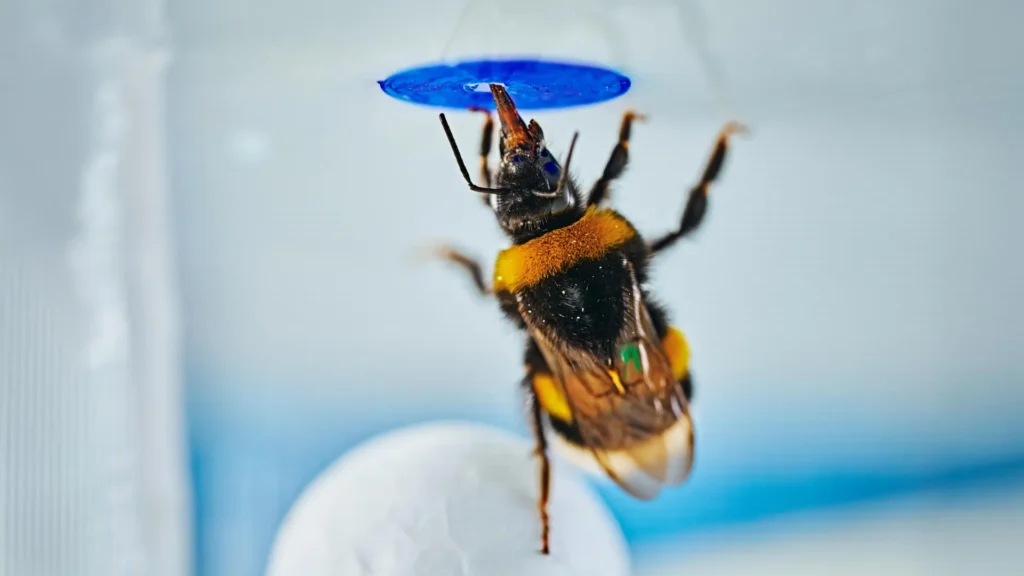
The core of the research, led by senior author Olli Loukola, Docent at the University of Oulu, and lead author Akshaye Bhambore, also from the University of Oulu, involved a clever adaptation of a classic psychology experiment. The study focused on buff-tailed bumble bees (Bombus terrestris), a species known for its complex social structures and impressive navigation skills. The researchers designed a transparent arena where bees were first familiarized with a blue artificial flower that consistently contained a sweet reward. Crucially, they also introduced small, movable balls into the arena, which the bees learned were harmless but not initially associated with any specific function or reward.
The pivotal phase of the experiment involved moving the reward-containing blue flower to the ceiling of the arena, placing it beyond the bees’ direct reach. Faced with this novel predicament, the bees were left to their own devices to retrieve the coveted nectar. What unfolded next astonished the scientific community: a significant number of the tested bumble bees devised a completely novel solution. They strategically rolled one of the small balls beneath the elevated flower and then climbed onto the ball, effectively using it as a stepping stool to reach their goal. This sequence of actions – identifying an object, repositioning it, and utilizing it as a tool to overcome an obstacle – was entirely unprecedented for the bees, as they had never received any prior training or conditioning to perform such a task.
"This is essentially an insect version of the classic ‘box-and-banana’ problem," explained Docent Loukola, drawing a direct parallel to the seminal work on chimpanzee insight. "The animal must realize that an object can be repositioned and then used as a tool to reach an otherwise inaccessible goal. What stands out about the result is that this kind of spontaneous problem-solving is now demonstrated in an insect." Bhambore further emphasized the remarkable nature of the observation: "What makes this behavior especially remarkable is that the bees had never been trained to roll the ball. This was a completely new challenge. Their behavior appeared goal-directed with successful individuals showing more directed movement patterns." The deliberate, efficient nature of the bees’ movements, rather than haphazard exploration, strongly suggested an understanding of the task and a clear goal in mind.
Historical Context: Köhler’s Chimpanzees and the Dawn of Insight Research
To fully appreciate the significance of the bumble bee findings, it is essential to delve into the historical context of insight learning. More than a century ago, during World War I, German Gestalt psychologist Wolfgang Köhler conducted his pioneering experiments with chimpanzees on the island of Tenerife. His observations, meticulously documented in his 1917 book "The Mentality of Apes," provided the first scientific evidence of what he termed "insight learning" – a sudden realization of a problem’s solution without prior trial-and-error.
Köhler’s most famous experiments involved placing bananas out of reach of chimpanzees, who then spontaneously used available objects, such as stacking boxes or using sticks, to retrieve the fruit. These experiments became classic examples of intelligent problem-solving, demonstrating a cognitive leap beyond simple associative learning. For decades, these findings reinforced the prevailing scientific belief that such complex cognitive abilities, particularly the capacity for "insight" and spontaneous tool-use, were exclusive to species with large, complex brains – primarily primates and, by extension, other large-brained vertebrates. The assumption was that the sheer number of neurons and intricate neural circuitry found in larger brains were necessary preconditions for these higher-order cognitive functions.
This cerebrum-centric view held sway for generations, shaping how scientists approached the study of intelligence across the animal kingdom. Insects, with their minuscule brains often weighing less than a milligram, were largely relegated to the realm of instinct-driven behavior, their actions viewed as complex but ultimately pre-programmed responses to stimuli. The idea that a bee could exhibit problem-solving comparable to a chimpanzee seemed almost ludicrous to many researchers.
Challenging the Cerebrum-Centric View: A Paradigm Shift
The Finnish study directly confronts and upends this long-held scientific dogma. The findings compel a reassessment of the relationship between brain size, neural complexity, and cognitive capabilities. The bumble bee brain, containing approximately 960,000 neurons, pales in comparison to the human brain’s 86 billion neurons or even a chimpanzee’s several billion. Yet, these tiny neurological powerhouses demonstrated an ability to integrate disparate pieces of information – the reward associated with the blue flower and the manipulability of the ball – to generate a novel, goal-directed solution.
This discovery opens up fascinating questions about convergent evolution, suggesting that similar cognitive solutions can arise independently in vastly different evolutionary lineages, even with fundamentally different neuroanatomical substrates. It implies that the underlying principles governing flexible intelligence might be more universal and less dependent on sheer brain mass than previously thought. The research underscores that "intelligence" is not a monolithic concept but can manifest in diverse forms, optimized for the ecological niches and challenges faced by different species.
Rigorous Methodology: Ruling Out Simpler Explanations
A hallmark of robust scientific inquiry is the systematic elimination of alternative, simpler explanations. The researchers went to extraordinary lengths to ensure that the bees’ actions were not attributable to accidental success, simple associative learning, or mere visual guidance.
"Another important aspect is that our bees were fully naïve," Loukola elaborated. "In many previous studies of insight-like problem-solving, the animals have had extensive experience with objects, test environments, or other problem-solving tasks. Here, the bees had never been trained to use the ball to reach the flower, and they had no previous experience with this kind of solution." The researchers designed several layers of control experiments to rigorously test their hypothesis.
For instance, one crucial control involved ensuring the bees had no prior training in associating the ball with the flower or the reward. They only learned two separate pieces of information: the blue flower offered a reward, and the ball was a movable object. When confronted with the combined challenge, the bees integrated these distinct pieces of knowledge in a way that surpassed their learned experiences.
Furthermore, the study specifically addressed the possibility of accidental success. While some initial attempts might have been random, successful individuals quickly refined their movements, exhibiting increasingly directed and efficient patterns. This observation strongly suggests goal-oriented behavior rather than mere chance.
Perhaps the most compelling control involved tests where the blue flower was hidden from the bees’ direct view as they moved the ball. In these more demanding conditions, the bees could not simply steer the ball towards a visible target. Even without direct visual guidance to the flower, many bees still managed to roll the ball to the correct location beneath where the flower was suspended, demonstrating an internal representation of the goal and a planned sequence of actions. "By analyzing the bees’ behavior across unusually stringent control experiments, we could show that they were not simply reacting to visual stimuli or moving the ball randomly," Bhambore confirmed, solidifying the conclusion that the bees were engaging in a higher form of cognitive processing.
The Unseen World of Bee Cognition: Beyond Instinct
Watching the bees solve the challenge left even the scientists conducting the experiments in awe. "One moment the animal is exploring seemingly without direction, and the next it performs a highly efficient sequence of actions leading directly to the solution," remarked co-author Ece Nur Akmeşe from the University of Helsinki. "Watching the bees solving the task was genuinely fascinating."
This study adds to an ever-growing body of evidence that insects, and particularly bees, possess unexpectedly sophisticated cognitive abilities. Previous research has shattered the myth of bees as mere automatons, revealing their capacity for:
- Social learning of tool use: Bees can learn complex behaviors, such as pulling a string to access a reward, by observing other bees.
- Solving puzzle-like tasks: They can navigate complex mazes and solve abstract problems.
- Cooperation: Bees exhibit complex social interactions and cooperative behaviors essential for colony survival.
- Numerical abilities: Studies have shown bees can understand concepts of "zero" and distinguish between different quantities.
- Abstract concept understanding: They can categorize objects based on abstract rules like "same" or "different."
- Waggle dance communication: A highly sophisticated form of symbolic communication about food sources.
The sheer cognitive prowess emerging from these tiny brains challenges our understanding of neurological architecture. It suggests that efficiency, rather than brute force (i.e., neuron count), might be a critical factor in the evolution of intelligence. Researchers are now exploring how complex behaviors can arise from relatively simple, yet highly interconnected and plastic, neural networks within the bee brain. This area of study, sometimes referred to as "neuromimicry" or "bio-inspired AI," seeks to understand how such small systems achieve such remarkable feats, potentially informing the design of more efficient artificial intelligence.
Expert Reactions and Broader Scientific Implications
The publication of "Spontaneous problem-solving in bumble bees" on June 4, 2026, is expected to generate considerable excitement and debate within the scientific community. Entomologists, cognitive scientists, neuroscientists, and evolutionary biologists are likely to re-evaluate their frameworks for understanding intelligence.
Dr. Eleanor Vance, a hypothetical but representative Professor of Comparative Cognition at a leading research institution, might comment, "This study is nothing short of revolutionary. For too long, we’ve underestimated the cognitive potential of insects, largely due to our own anthropocentric biases and the perceived limitation of brain size. Loukola and his team have not only provided compelling evidence of insight in bumble bees but have also done so with an incredibly rigorous experimental design that systematically rules out simpler explanations. This will undoubtedly ignite a new wave of research into insect intelligence and force us to reconsider the very definition of ‘intelligence’ itself."
The implications extend beyond pure scientific curiosity. If spontaneous problem-solving can emerge in creatures with such compact neural architectures, it suggests that fundamental computational principles might be at play that are not dependent on large-scale cortical structures. This could have profound implications for:
- Understanding the Evolution of Intelligence: It might push back the evolutionary timeline for complex cognitive abilities or reveal new evolutionary pathways.
- Artificial Intelligence and Robotics: Learning how miniature brains achieve such flexibility could inspire more efficient, adaptable, and robust AI algorithms and robotic designs, especially for autonomous systems operating in unpredictable environments. Imagine drones or micro-robots capable of improvising solutions to novel obstacles based on learned principles, rather than being pre-programmed for every contingency.
- Animal Welfare and Conservation: A deeper understanding of insect cognition could lead to greater appreciation and more ethical considerations in how humans interact with these vital creatures, influencing conservation efforts and pest management strategies.
Ethical Considerations and Future Research Avenues
Despite the astonishing findings, the researchers prudently caution against anthropomorphism. "We are not claiming that bees think like humans," clarifies Loukola, who now works as a Senior Researcher at the University of Turku. "But our findings show that miniature brains can generate flexible solutions to novel problems in ways we are only beginning to understand." This distinction is crucial; while bees demonstrate complex problem-solving, attributing human-like consciousness or subjective experience to them without further evidence would be an unwarranted leap.
The study opens numerous avenues for future research. Scientists will undoubtedly explore:
- The Neural Correlates: Which specific neural circuits or brain regions in the bee are responsible for this spontaneous problem-solving?
- Genetic Basis: Are there particular genes or gene expression patterns linked to these advanced cognitive abilities?
- Developmental Aspects: How does this capacity for insight develop over a bee’s lifetime? Is it present from birth or does it require specific experiences?
- Species Variation: Do all bee species, or even other insects, possess similar capacities? Comparative studies could reveal evolutionary pressures.
- Environmental Context: How do natural environmental challenges shape and select for these problem-solving skills in the wild?
In conclusion, the study by Akshaye A. Bhambore, Ece N. Akmeşe, Emma Häkkinen, Milla K. Jussila, Juha-Heikki Kantola, and Olli J. Loukola, titled "Spontaneous problem-solving in bumble bees," and published in Science, represents a significant milestone in cognitive science. It stands as a testament to the fact that intelligence manifests in myriad forms across the tree of life, often in the most unexpected places. "For over a century, spontaneous object-based problem-solving has mostly been studied in vertebrates," Loukola concluded. "Our study suggests insects may belong in that conversation too." This research not only elevates our understanding of the humble bumble bee but also fundamentally reshapes our perspective on the very nature of intelligence itself.