


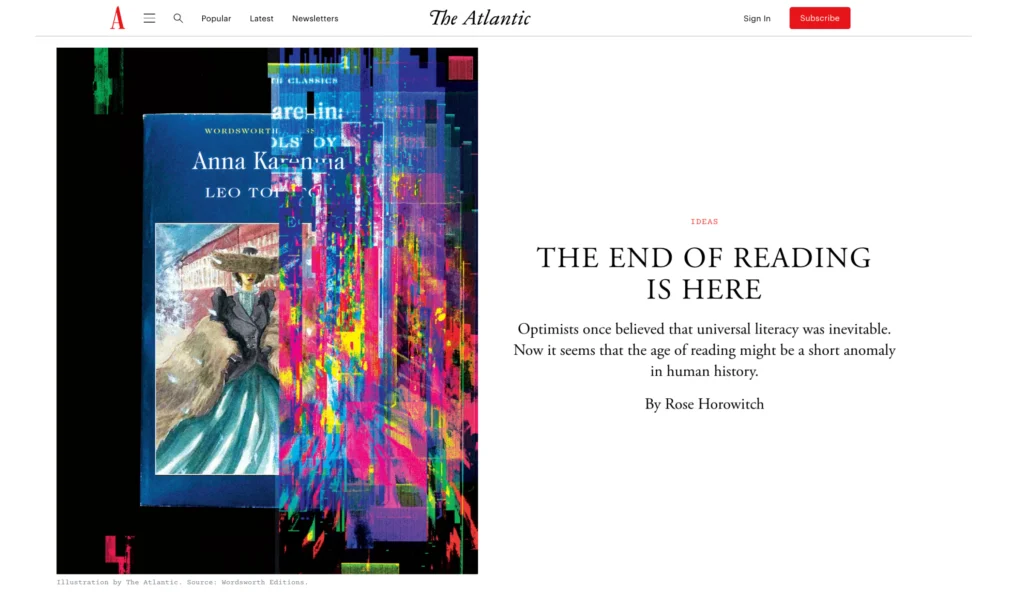
Last week, Rose Horowitch ignited a significant discussion with her expansive Atlantic article, provocatively titled "The End of Reading is Here." Clocking in at over 8,500 words—a notable irony given its subject matter—Horowitch’s analysis posits a stark reality: the ubiquitous presence of distracting digital technology has precipitated a sudden and radical reduction in reading across society. This concern is not isolated, echoing similar alarms recently sounded by commentators such as James Marriott, whose forthcoming book, The New Dark Ages, further underscores the gravity of the situation. The central question emerging from these discussions is whether this documented decline in reading habits represents a benign, natural evolution of communication, akin to the diminished role of radio in a television-dominated era, or if it signals a profound and potentially detrimental shift in human cognitive and cultural landscape.
A Shift in Cognitive Landscape: The Data Behind the Decline
Horowitch’s argument is buttressed by a wealth of compelling data, painting a clear picture of shifting engagement with the written word. While specific figures were not enumerated in the immediate response, broader trends from various research bodies provide substantial corroboration. The Pew Research Center, for instance, has consistently tracked a decline in leisure reading among American adults. Surveys frequently reveal that a significant percentage of adults have not read a book, in whole or in part, in the past year, a figure that has shown an upward trend over the last decade. More critically, the National Endowment for the Arts (NEA) has, through its "Reading at Risk" and subsequent studies, highlighted a consistent decrease in literary reading among all age groups, particularly among younger demographics. For example, data from the NEA’s Survey of Public Participation in the Arts (SPPA) has indicated that the percentage of adults reading literature for pleasure has steadily fallen since the early 1980s, with steep drops observed in the early 2000s, coinciding with the proliferation of the internet and mobile devices.
Beyond mere frequency, the nature of reading has also undergone a transformation. Cognitive scientists and educational researchers have observed a shift from "deep reading"—the sustained, immersive engagement with complex texts that fosters critical thinking, empathy, and sustained attention—to "shallow scanning." This latter mode, characterized by skimming, keyword spotting, and rapid navigation through hyperlinked content, is increasingly common in digital environments. Studies utilizing eye-tracking technology have shown that readers on screens often adopt an ‘F-pattern’ or ‘Z-pattern’ of reading, focusing primarily on headlines, initial sentences, and highlighted keywords rather than processing text linearly and comprehensively. This behavioral adaptation, while efficient for information retrieval, raises concerns about its long-term impact on cognitive processes like memory retention, analytical reasoning, and the ability to synthesize complex ideas. The rise of short-form content platforms, social media feeds, and video-centric applications further exacerbates this trend, training brains to expect constant novelty and instant gratification, making sustained engagement with lengthy, nuanced texts increasingly challenging.
Historical Context: Literacy as a Cornerstone of Civilization
To fully grasp the magnitude of this potential decline, it is crucial to understand the historical role of literacy. The advent of reading and writing was not merely an incremental technological advancement; it was a watershed moment that fundamentally reshaped human consciousness and civilization itself. As Horowitch eloquently states, "The advent of reading and writing transformed society. It altered people’s consciousness and politics, along with the intellectual feats they were capable of." This assertion finds profound resonance in the work of scholars like Walter Ong, whose seminal classic, Orality and Literacy, meticulously details how the transition from oral to literate cultures profoundly restructured human thought processes.
Ong argues that pre-literate societies operated within a different cognitive framework, one heavily reliant on memory, communal experience, and formulaic expression. The introduction of writing, particularly the phonetic alphabet, allowed for the externalization of thought, freeing the mind from the immense burden of mnemonic recall. This externalization paved the way for abstract reasoning, systematic logic, and the development of complex philosophical and scientific inquiry. It enabled the creation of extensive, cumulative bodies of knowledge that could be critically examined, debated, and built upon across generations. Concepts we now take for granted—such as the notion of an independent self, linear history, human rights, and the very idea of progress—are, in many respects, conceptual children born from the mind-shaping power of the written word. Literacy, therefore, is not simply a technology; it is, in a profound sense, the foundational technology that enabled the cognitive world we currently inhabit and often take for granted. When engagement with this foundational technology wanes, the very structures of our thought and society are implicitly threatened.
The Digital Transition: A Chronology of Changing Habits
The trajectory towards the current "reading crisis" is a complex narrative spanning several decades, marked by successive waves of technological innovation:
-
Pre-Internet Era (Pre-1990s): For centuries, print media—books, newspapers, magazines—reigned supreme as the primary vehicle for information dissemination, entertainment, and intellectual discourse. Reading was often a solitary, sustained activity, demanding focused attention and offering a deep dive into narratives and arguments. Libraries were central community hubs, and bookshelves a common feature in homes, symbolizing intellectual engagement.
-
Early Internet (1990s-Early 2000s): The dawn of the World Wide Web brought an unprecedented explosion of accessible information. Initially, there was optimism that the internet would democratize knowledge and even enhance literacy by providing vast textual resources. However, this era also marked the beginning of screen-based reading, which inherently differs from print. Hyperlinks introduced non-linear navigation, encouraging a more fragmented approach to text. While offering immense benefits in terms of information access, this period subtly began to alter reading habits, prioritizing speed and breadth over depth.
-
Smartphone and Social Media Era (Mid-2000s-Present): The launch of the iPhone in 2007 and the subsequent explosion of smartphones and social media platforms represent a critical inflection point. Digital technology transitioned from being a desktop tool to an omnipresent companion. Push notifications, constant connectivity, and algorithms designed to maximize engagement created an environment of perpetual distraction. Social media feeds, characterized by short-form posts, images, and videos, further conditioned users to consume information in bite-sized, rapidly digestible chunks. This period saw an acceleration of the decline in deep reading, as attention was increasingly fragmented and redirected towards ephemeral digital content, making sustained engagement with complex, long-form texts a counter-cultural act rather than a common practice. This is the era that Horowitch and Marriott identify as precipitating the "end of reading" or the dawn of "the new dark ages."
Implications Across Society: From Individual Thought to Collective Culture
The implications of a society moving away from advanced literacy are far-reaching, touching upon individual cognitive capacity, political discourse, cultural transmission, and even economic competitiveness.
-
Cognitive Impact: The human brain is remarkably plastic, adapting to the demands placed upon it. If the primary mode of information consumption shifts from deep reading to shallow scanning, there is a legitimate concern that the neural pathways associated with sustained attention, critical analysis, abstract reasoning, and memory formation could weaken. Deep reading cultivates patience, nuance, and the ability to hold complex ideas in mind, all crucial for higher-order thinking. A diminished capacity for deep reading could lead to a populace less capable of independent thought, more susceptible to simplistic narratives, and less adept at grappling with multifaceted problems—personal, professional, or societal. It also impacts empathy, as narratives are a powerful tool for understanding others’ perspectives, a skill fostered through immersive reading.
-
Political and Social Cohesion: A well-functioning democracy relies on an informed citizenry capable of critically evaluating information, understanding complex policy issues, and engaging in reasoned debate. If individuals struggle with deep reading, their ability to process detailed political analyses, historical contexts, or legislative proposals may be compromised. This could lead to a greater reliance on sensationalized headlines, soundbites, and emotionally charged rhetoric, exacerbating polarization and making it more difficult to find common ground or reach consensus on critical issues. The long-term stability of democratic institutions could be at stake if citizens are less equipped to engage with the intricate realities of governance.
-
Cultural and Historical Understanding: Literature, philosophy, history, and scientific treatises represent the collective intellectual inheritance of humanity. A decline in reading means a diminished engagement with this vast repository of wisdom and experience. This not only risks losing touch with the foundational ideas that shaped our civilization but also hinders our ability to contribute new insights. How will future generations interpret complex historical events, understand the nuances of cultural identity, or appreciate the evolution of human thought if they lack the cognitive tools to engage deeply with the texts that convey these stories? Marriott’s stark title, The New Dark Ages, evokes a period of intellectual regression, suggesting a potential loss of cultural memory and critical inquiry.
-
Educational Challenges: Educators worldwide are already grappling with the consequences of evolving reading habits. Students, accustomed to rapid-fire digital consumption, often struggle with the sustained attention required for academic texts. This impacts comprehension, writing skills (as reading widely informs writing), and the ability to conduct in-depth research. Educational systems face the challenge of re-cultivating deep reading skills in a world where digital distractions are ever-present, ensuring that the next generation possesses the cognitive tools necessary for success in a complex, information-rich global economy.
Expert Perspectives and Emerging Concerns
The concerns raised by Horowitch and amplified by figures like Cal Newport and James Marriott are finding resonance across various expert domains. Newport, a technology theorist and author, fervently agrees with the conclusion that reading plays a critical and privileged role in the human experience. His own recent New York Times op-ed on cognitive fitness underscores his belief that our mental well-being is as susceptible to degradation as our physical health if not actively maintained. He positions literacy not merely as an academic skill but as the very foundation of our cognitive world, stating that "essentially every cultural attribute that we celebrate – from human rights, to logic, to progress, to the very notion of an independent self – are conceptual children born from the mind-shaping power of the written word." His perspective aligns with a growing body of work from cognitive psychologists and neuroscientists who are studying the impact of digital media on brain function, attention, and memory. These researchers often highlight the distinction between the "deep processing" encouraged by print reading and the "shallow processing" often associated with screen reading, warning of potential long-term cognitive costs.
Educational leaders and policymakers, too, are increasingly voicing concerns. While embracing technology for learning, many institutions are also reinforcing traditional literacy programs, emphasizing the importance of print books, and developing curricula that explicitly teach sustained attention and critical reading strategies. There is a recognition that technological fluency must be balanced with foundational cognitive skills that are cultivated through deep engagement with text. Furthermore, a broader movement advocating for "digital wellness" and mindful technology use is gaining traction. Public health advocates and mental health professionals are increasingly recommending periods of digital detox and intentional engagement with non-screen activities, including reading, as crucial components of mental well-being and cognitive resilience.
Pathways Forward: Strategies for Cognitive Resilience
If the decline of reading represents a step backward for humanity, as Newport, Horowitch, and Marriott contend, then the critical question becomes: what actions can be taken? The proposed solutions are multifaceted, ranging from individual behavioral changes to broader societal interventions.
-
Individual Action: Newport, drawing an analogy to the public health movement of the last century, suggests tackling this mental decline similarly to how societies addressed physical health: by embracing specific routines around information consumption. He advocates for treating highly distracting digital content like "junk food"—something to be largely avoided—and purposefully scheduling a non-trivial amount of time each day for deep reading, reflective writing, and self-reflection. Just as people dedicate time to walking, jogging, and weight lifting for physical fitness, so too should they commit to "cognitive fitness" through intentional engagement with demanding intellectual activities. This involves making conscious choices to pick up a book instead of a phone, to read a long-form article instead of endless social media feeds, and to cultivate environments conducive to focused thought.
-
Societal and Institutional Responses: Beyond individual effort, systemic changes are also vital. Educational institutions have a crucial role in re-emphasizing deep reading skills, integrating classical and complex texts into curricula, and teaching students how to navigate the digital world mindfully. Libraries, traditionally bastions of literacy, can expand their role as community centers for intellectual engagement, offering reading programs, book clubs, and spaces for quiet contemplation. Public awareness campaigns could highlight the profound benefits of reading, countering the pervasive pull of digital distraction. Furthermore, there’s an argument for technological design itself to evolve. While current designs often prioritize engagement at all costs, future innovations could explore features that support focus, minimize interruptions, and encourage deeper interaction with content, though this represents a significant shift in the prevailing business models of many tech companies.
Conclusion: Safeguarding Our Intellectual Inheritance
Rose Horowitch concludes her Atlantic article with a powerful statement: "An astonishing wealth of information and wisdom has been bequeathed to us. What we’ll do with this inheritance is up to us." This sentiment encapsulates the urgency of the moment. The current trajectory suggests a potential erosion of the very cognitive and cultural foundations that have enabled human progress for millennia. The written word is more than a medium; it is a conduit to deep thought, shared understanding, and the cumulative wisdom of generations.
The choice before society is clear: allow the currents of digital distraction to passively erode the bedrock of literacy, or actively champion the practices and habits that foster sustained engagement with the written word. This requires a conscious and collective effort, a re-prioritization of deep cognitive work over superficial engagement. It’s time to recognize the critical importance of reading not as a nostalgic pastime, but as an essential practice for individual flourishing and the continued advancement of civilization. The time for passive observation is over; it is time to get up and take action, to safeguard our intellectual inheritance for generations to come.