


The modern business landscape presents an unprecedented level of complexity for leaders. Organizations are not merely adapting to change; they are actively navigating a torrent of rapid technological advancements, significant workforce disruptions, pervasive economic uncertainties, and a fundamental reshaping of employee expectations. In this high-stakes environment, leaders find themselves in a perpetual quest for solutions to problems that are becoming increasingly intricate and multifaceted. However, a closer examination of executive coaching sessions, leadership development programs, and team conflict resolution reveals a surprising truth: many of the most persistent leadership challenges stem from the neglect of a surprisingly simple, yet essential, responsibility.
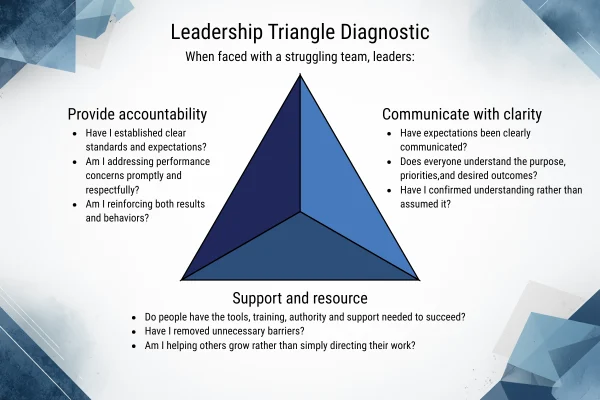
This article explores a practical framework, dubbed the "leadership triangle," which distills leadership into three core competencies that every leader must consistently demonstrate: communicating with clarity, supporting and resourcing, and providing accountability. While these principles may appear self-evident, their consistent and balanced application is the critical differentiator between effective and ineffective leadership. For Chief Learning Officers (CLOs), talent management professionals, and all individuals in leadership roles, this framework offers a robust blueprint for cultivating leaders capable of thriving amidst complexity, fostering trust, and driving superior team performance.
The Foundation of Effective Leadership: The Leadership Triangle
The leadership triangle, developed by Dr. Justin Irving, is more than just a theoretical model; it serves as a powerful diagnostic tool. When teams falter, conflict escalates, or performance plateaus, leaders can often identify the root cause by examining which side of the triangle has been inadvertently neglected. This framework is particularly valuable for CLOs and talent management professionals seeking to build a cohesive and impactful leadership pipeline.
Communicating with Clarity: The Bedrock of Alignment
The foremost responsibility of any leader is to establish clarity through effective communication. Without a clear understanding of expectations, employees cannot effectively align their efforts, contribute meaningfully to organizational priorities, or make sound decisions. Research consistently underscores the detrimental impact of uncertainty on employee engagement and performance. A 2023 study by Gallup found that highly engaged teams show 21% greater profitability, a metric directly influenced by clear communication and direction. Conversely, ambiguity breeds anxiety, erodes morale, and ultimately hinders productivity.
Many leaders mistakenly believe that simply speaking constitutes clear communication. However, communication effectiveness is not measured by the act of speaking, but by the level of understanding achieved by the audience. Clear communication empowers individuals to answer fundamental questions: What is expected of me? Why is this priority important? How does my work contribute to the larger goals? What are the key decisions I need to make?
Leadership development programs often highlight this challenge. When asked to recall frustrating leadership experiences, participants frequently cite instances of poor communication: vague expectations, shifting priorities without adequate explanation, contradictory messages, or a lack of transparency during periods of organizational change. A 2022 survey by Deloitte revealed that 70% of employees feel that clear communication from leadership is crucial for their job satisfaction and productivity.
The inherent difficulty for leaders lies in their tendency to overestimate the clarity of their own messaging. What may feel repetitive to a leader who is intimately familiar with a topic can often feel insufficient or even confusing to employees encountering the information for the first time. This gap presents a critical development opportunity for CLOs. Communication is a multifaceted leadership discipline encompassing not only expectation setting but also active listening, providing constructive feedback, compelling storytelling, and cultivating shared understanding. Organizations that intentionally invest in developing these capabilities will cultivate leaders who are far better equipped to align teams, successfully navigate change initiatives, and foster deep levels of engagement. When leaders communicate with unwavering clarity, they dismantle ambiguity and forge alignment. When they falter, confusion invariably rushes in to fill the void.
Supporting and Resourcing: Enabling Success
While clarity is paramount, it is insufficient on its own. Once expectations are clearly established, leaders must actively ensure that their team members possess the necessary support and resources to achieve those objectives. This competency aligns closely with the research of Dr. Irving, who emphasizes the leader’s fundamental responsibility to support and resource their followers. Irving posits that effective leaders recognize their role extends beyond mere direction; it involves creating the optimal conditions for others to flourish.
This perspective resonates with a growing body of leadership research indicating that long-term organizational success is frequently determined less by what leaders accomplish personally and more by what they empower their teams to achieve collectively. Sadly, many organizations inadvertently promote individuals who excel at setting expectations but struggle to identify and remove obstacles for their teams.
Employees often receive directives like: "We need to increase market share by 15% this quarter," or "Launch this new product line within six months." However, they may be provided with minimal guidance, insufficient training, inadequate time, or a lack of the requisite authority to successfully execute these ambitious goals. The predictable outcome of such a disconnect is widespread frustration, disengagement, and ultimately, burnout. A 2023 report by the American Psychological Association found that workplace stress, often exacerbated by a lack of resources and support, leads to a significant decline in employee well-being and productivity.
Support and resourcing manifest in various forms: providing access to necessary tools and technology, allocating sufficient budget, offering relevant training and development opportunities, empowering individuals with decision-making authority, and championing their efforts within the broader organization. For CLOs and talent management leaders, this competency holds particular significance. Leadership development should not solely focus on self-improvement; it must also equip leaders to become more effective developers of others.
A crucial mindset shift for leaders is transitioning from asking, "How can I achieve better results?" to "How can I help my people succeed?" This shift embodies a core principle found in servant leadership literature, where a leader’s success is intrinsically linked to the growth and achievements of those they lead. When leaders effectively support and resource their teams, they cultivate environments where individuals can not only contribute but also learn, grow, and thrive. This proactive approach fosters a culture of shared success and resilience.

Providing Accountability: Driving Performance and Growth
The third pillar of the leadership triangle is often the most challenging for leaders to embrace. Many leaders excel at communicating expectations and genuinely care about supporting their teams. However, they may hesitate when it comes to holding individuals accountable, often avoiding difficult conversations, delaying performance discussions, or hoping that problems will resolve themselves. Unfortunately, such issues rarely dissipate on their own.
Accountability is not about punishment; it is about stewardship. Effective accountability systems ensure that individuals understand whether their behaviors and performance align with agreed-upon expectations. They provide crucial feedback, reinforce established standards, and actively promote individual and team growth.
When accountability is absent, several detrimental issues emerge: underperformance can become normalized, expectations can be perceived as optional, a sense of unfairness can permeate the team, and opportunities for learning and development are missed. Ironically, the avoidance of accountability often breeds the very conflicts that leaders are attempting to circumvent.
It is vital to understand that accountability is not the antithesis of support. In healthy leadership systems, support and accountability are synergistic. Leaders provide the necessary resources and guidance for success, and then hold individuals responsible for effectively leveraging those resources and achieving their objectives. This balance is particularly critical in leadership development. Organizations often emphasize empathy, coaching, and relationship-building – all essential leadership skills. However, these skills become incomplete when leaders lack the courage to directly address performance concerns.
The most effective leaders exhibit both genuine care and direct candor. They challenge individuals not to diminish them, but because they believe in their potential for growth and success. When practiced effectively, accountability becomes a profound act of respect, signaling to individuals that their contributions are valued and that their development is a priority.
Embedding the Leadership Triangle: From Competency to System
One of the key reasons the leadership triangle resonates so strongly with CLOs and talent management professionals is its scalability. It transcends individual leader behavior and can be systematically embedded throughout an organization’s entire talent management ecosystem.
Consider the common organizational practice of developing leaders in one area while unintentionally neglecting another. Leadership development programs might focus heavily on enhancing communication skills but offer minimal training on coaching and resourcing others. Performance management systems may prioritize accountability but fail to equip leaders with the necessary tools to effectively support employee success. Succession planning discussions might evaluate past results without adequately considering the methods and leadership behaviors that contributed to those outcomes.
The leadership triangle provides a unifying language that can be seamlessly integrated into every facet of talent management, including leadership selection, onboarding processes, executive coaching, performance management frameworks, succession planning initiatives, and ongoing leadership development programs.
Imagine a scenario where leaders across an entire organization are empowered to evaluate their own effectiveness and that of their teams through a consistent lens. They would ask: "Have I clearly communicated expectations, and are they understood?" "Do my team members have the necessary support and resources to succeed?" "Are individuals being held accountable for their commitments and performance?" When these questions become ingrained in the organizational culture, leadership development evolves from a collection of disparate programs into a coherent, integrated system.
The Enduring Significance of the Triangle
The leadership triangle’s enduring utility lies in its dual function as both a developmental framework and a practical leadership checklist. When leaders encounter challenges, they can pause and engage in a simple, yet profound, self-assessment: "Have I communicated clearly?" "Am I adequately supporting and resourcing my team?" "Am I providing appropriate accountability?"
In my experience, a significant majority of leadership failures can be traced back to the neglect of one or more sides of this fundamental triangle. Sometimes, leaders hold individuals accountable for expectations that were never clearly articulated. Other times, leaders set ambitious goals but fail to provide the commensurate resources needed for success. And in yet other instances, leaders communicate effectively and offer extensive support but shy away from addressing underperformance.
The leadership triangle serves as a powerful reminder that true leadership effectiveness rarely resides in a single, isolated competency. Instead, it emerges from the dynamic and deliberate balancing of all three. As organizations continue to grapple with escalating complexity, leaders will inevitably face difficult decisions, challenging conversations, and periods of profound change. In those pivotal moments, the most effective solution may not be the discovery of a novel leadership technique. It may, in fact, be a return to the fundamental, time-tested principles of clarity, support, and accountability. By consistently applying these core tenets, leaders can build more resilient, engaged, and high-performing organizations capable of navigating the complexities of the modern world.