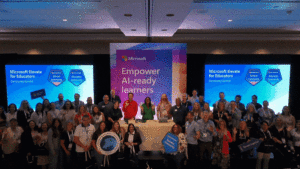




Microsoft has officially announced the general availability of the Study and Learn Agent within Microsoft 365 Copilot, marking a significant shift in how artificial intelligence is deployed in academic environments. The new tool, provided at no additional cost to education customers, is designed to address a growing tension in global education: the widespread use of AI by students for shortcuts versus the institutional need for tools that foster genuine cognitive development. By prioritizing the "coaching" model over the "answering" model, Microsoft aims to move beyond the era of AI-assisted plagiarism toward a future of AI-enhanced understanding.
The Study and Learn Agent arrives at a critical juncture for educational technology. Since the public release of generative AI tools in late 2022, school districts and universities worldwide have struggled to balance the potential benefits of AI with the risks of academic dishonesty and the erosion of critical thinking skills. Microsoft’s new offering is positioned as a "learning-first" alternative, built on the core principle that the learner must remain the primary driver of the intellectual process.
A Pedagogical Pivot: From Answers to Understanding
The central challenge identified by Microsoft and educational researchers is that general-purpose AI tools are often optimized for speed and output. When a student asks a standard chatbot to solve a calculus problem or summarize a historical event, the machine typically provides the final result immediately. This "answer-bot" behavior bypasses the productive struggle necessary for learning.
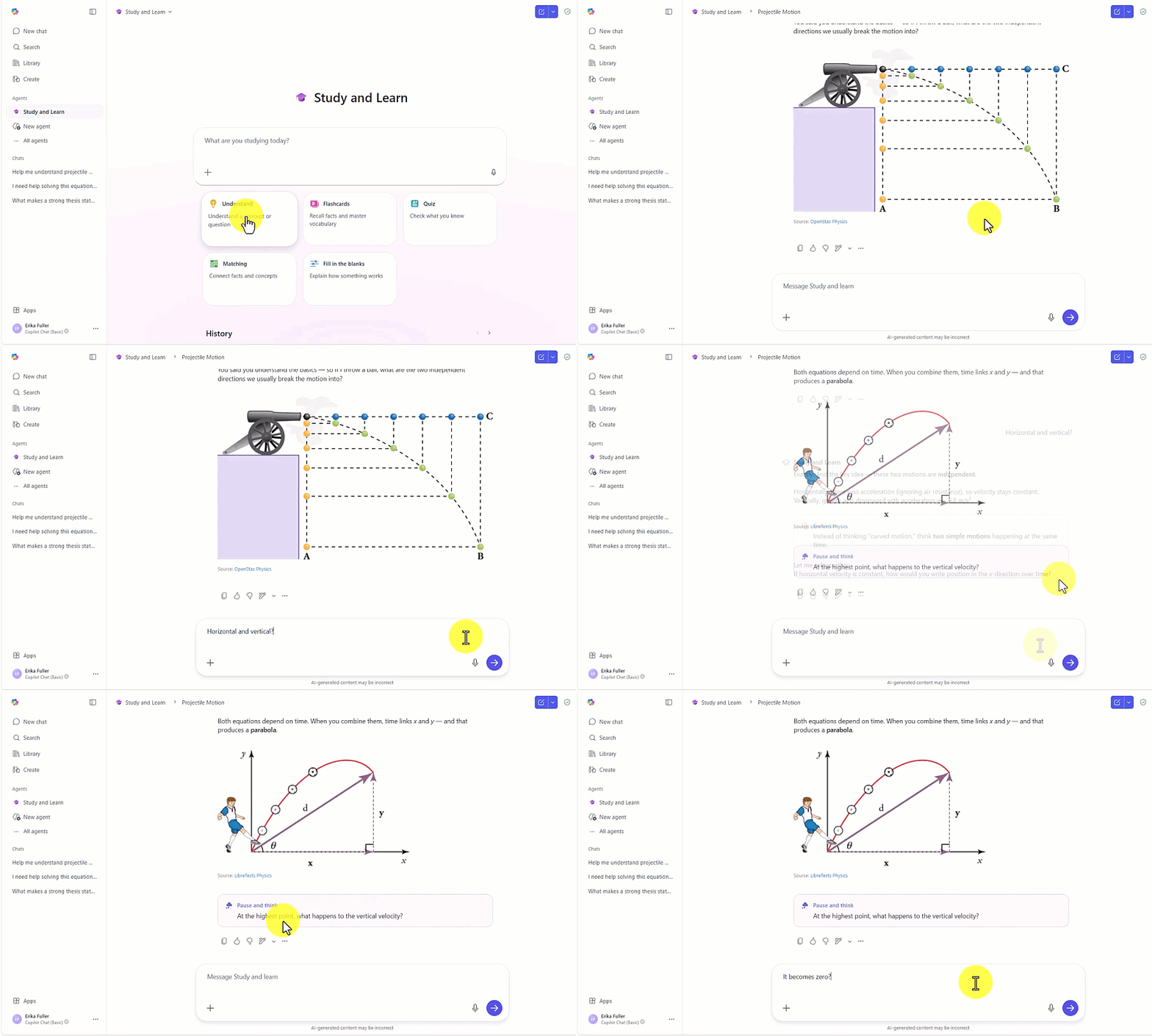
In contrast, the Study and Learn Agent is programmed to function as a tutor. If a student presents a complex problem, the agent does not provide the solution. Instead, it offers step-by-step guidance, asking probing questions that lead the student to discover the answer themselves. This methodology, known as scaffolding, is a cornerstone of educational psychology. The agent adapts its responses based on the student’s current level of understanding, providing more or less assistance as required by the specific moment of the learning journey.
The interactive nature of the tool extends to various study formats. Students can engage in guided conversations to sharpen their writing, use the agent to generate flashcards for active recall, or participate in quiz-like activities to test their knowledge of specific subjects like biology or history. For instance, a student studying the cell cycle can request a matching activity, where the agent presents terms and definitions in a game-like format to reinforce memory retention.

Built on the Foundations of Learning Science
Microsoft has emphasized that the Study and Learn Agent is not merely a filtered version of a standard Large Language Model (LLM) but a specialized tool grounded in established learning science. The experience is structured around four research-based principles designed to ensure that material "sticks" beyond the immediate completion of an assignment.
The first principle is active engagement. Research has long shown that passive reading is one of the least effective ways to study. The agent forces students to interact with the material by generating prompts that require creative or analytical responses. Second is the concept of retrieval practice. By creating quizzes and flashcards on the fly, the tool encourages students to pull information from their own memory, which strengthens neural pathways.
The third pillar is dual coding, where the agent utilizes both text and visual illustrations to explain concepts. For example, when a student is struggling with physics concepts like torque or centripetal force, the agent can search for and display diagrams to provide a visual context to the mathematical explanations. Finally, the tool focuses on metacognition—the process of thinking about one’s own thinking. By asking students to explain their reasoning, the agent helps them identify gaps in their own logic.
Chronology of AI Integration in the Classroom
The launch of the Study and Learn Agent follows a tumultuous two-year period for AI in education.
In November 2022, the release of ChatGPT led to immediate bans in major school districts, including New York City and Seattle, over concerns regarding cheating. However, by mid-2023, many of these districts began to rescind bans, recognizing that AI was an inescapable part of the modern digital landscape. In early 2024, the focus shifted toward "responsible AI," with organizations like UNESCO and various national education departments calling for tools that protect student privacy and promote pedagogical integrity.
Microsoft’s development timeline reflects this evolution. After integrating Copilot into its broader suite of productivity tools, the company began piloting education-specific features in late 2023. The general availability of the Study and Learn Agent represents the culmination of this effort to create a safe, controlled environment for students aged 13 and older. This timeline demonstrates a move away from general-purpose "chat" toward "agentic" AI—specialized programs designed for specific tasks and workflows.

Administrative Oversight and Data Security
One of the primary barriers to AI adoption in schools has been the issue of trust and control. Microsoft has addressed these concerns by placing IT administrators at the center of the deployment process. For K-12 institutions, Copilot Chat and the Study and Learn Agent are turned off by default. Access must be explicitly granted by an IT administrator, ensuring that schools have the final say on when and how these tools are introduced to their students.
Once enabled, the Study and Learn Agent operates within the Microsoft 365 Education ecosystem. This means that student data is protected by the same enterprise-grade security and privacy protocols that govern Microsoft’s corporate and government clients. Crucially, the system uses Microsoft Entra ID (formerly Azure AD) for authentication, meaning students do not need to create separate accounts or provide personal information to third-party AI providers.
From a technical standpoint, the agent is located within the left navigation bar of the Copilot app. It is currently optimized for English in the United States, though Microsoft has confirmed plans to expand language support in the coming weeks. This localized rollout allows the company to monitor performance and safety guardrails before a broader global release.
Supporting Data and Market Context
The demand for such tools is supported by recent data regarding AI usage in academia. A 2024 survey by the Pew Research Center found that approximately 1 in 4 U.S. teens who have heard of ChatGPT have used it for schoolwork. However, teachers have reported a "grey area" in usage, where it becomes difficult to distinguish between legitimate assistance and academic dishonesty.
Furthermore, the "2 Sigma Problem," a famous educational study by Benjamin Bloom, suggests that students tutored one-on-one perform two standard deviations better than those in a traditional classroom. For decades, providing a personal tutor for every student was financially and logistically impossible. AI agents like Study and Learn represent the tech industry’s attempt to bridge this gap, offering a scalable version of personalized tutoring that can provide immediate feedback to millions of students simultaneously.
Official Responses and Institutional Impact
While Microsoft has led the technical implementation, the educational community’s response has been one of cautious optimism. School leaders have signaled a clear preference for tools that include built-in guardrails. By providing a "learning-first" option, Microsoft is responding to the feedback of business decision-makers and IT administrators who require more than just a search engine or a text generator.
The Study and Learn Agent is part of a two-pronged strategy that also includes the "Teach" agent, designed specifically for educators. This dual-agent ecosystem suggests that Microsoft views AI not as a replacement for the teacher-student relationship, but as a support structure for both parties. The Teach agent assists educators in curriculum development and administrative tasks, while the Study and Learn agent handles the student-facing reinforcement of those lessons.
Broader Implications for the Future of Literacy
The introduction of the Study and Learn Agent suggests a broader shift in the definition of digital literacy. In the future, the ability to "prompt" an AI effectively—and more importantly, to critically evaluate the AI’s guidance—will be a core competency. By forcing students to remain in the "driver’s seat" of the learning process, Microsoft is attempting to cultivate a generation of students who view AI as a collaborator rather than a surrogate.
However, the success of this initiative will depend largely on the implementation at the school level. IT administrators must not only enable the software but also ensure that teachers are trained to integrate these agents into their lesson plans. There is also the ongoing challenge of the digital divide; while the tool is "no additional cost" for those with existing licenses, the requirement for high-speed internet and modern hardware remains a barrier for underfunded districts.
As the Study and Learn Agent begins to roll out across the Microsoft 365 Education network, it will serve as a high-stakes test case for whether AI can truly enhance human intelligence or if it will inevitably become a crutch. For now, Microsoft has provided the infrastructure for a more disciplined, scientifically grounded approach to AI in the classroom, placing the responsibility for learning back where it has always been: with the student.