


Microsoft has officially launched its Discovery platform into general availability, marking a significant milestone in the application of agentic artificial intelligence to the complex and often protracted world of scientific research and development. Dubbed a production-ready environment, the service is meticulously designed to empower scientists and researchers by orchestrating intricate data analysis, accelerating hypothesis generation, streamlining experimental design, and centralizing knowledge management through a sophisticated collection of specialized AI agents. This move, unveiled at Build 2026, underscores Microsoft’s pervasive strategy to integrate advanced AI capabilities across its entire product portfolio, reflecting a burgeoning global interest in leveraging AI systems to dramatically accelerate innovation across scientific and industrial sectors.
The Power of Agentic AI in Research
Agentic AI represents a paradigm shift from traditional AI models, moving beyond mere question-answering to systems capable of planning, reasoning, utilizing diverse tools, and executing multi-step processes autonomously. In the context of scientific research, this translates into AI agents that can not only retrieve information but actively engage in the scientific method: formulating hypotheses, designing experiments, interpreting results, and iterating on findings. Microsoft’s vision for Discovery is deeply rooted in this capability, aiming to empower research teams to navigate the often-repeated cycles of hypothesis formulation, rigorous experimentation, validation, and peer review with unprecedented efficiency and insight. The platform’s core, a sophisticated graph-based knowledge engine, is engineered to seamlessly connect proprietary research data with vast external scientific information. This allows AI agents to reason across complex relationships, evaluate competing findings with nuance, and robustly support iterative research processes, thereby reducing bottlenecks and accelerating discovery timelines.
Addressing the Grand Challenges of Modern Science

Modern scientific research, while incredibly advanced, faces formidable challenges that often impede progress. Researchers are frequently overwhelmed by an explosion of data, struggling to sift through vast datasets and siloed information efficiently. The traditional iterative cycles of experimentation can be slow, resource-intensive, and prohibitively expensive, particularly in fields like drug discovery, materials science, and advanced engineering. Furthermore, issues of reproducibility and the sheer complexity of interdisciplinary research often lead to fragmented efforts and delayed breakthroughs. Globally, billions are invested annually in R&D, yet the return on investment can be hampered by these inefficiencies. Microsoft Discovery directly addresses these pain points by providing an integrated environment where AI agents act as intelligent collaborators, capable of rapidly processing information, identifying novel connections, and suggesting paths forward that might elude human researchers working within traditional constraints. By automating repetitive tasks and augmenting cognitive processes, the platform aims to free up scientists to focus on higher-level reasoning and creative problem-solving.
At the Heart: The Microsoft Discovery Engine
Central to the platform’s architecture is the Microsoft Discovery Engine, a powerful computational backbone designed to support the fundamental "core loop" of scientific work. This engine facilitates a dynamic workflow that guides teams from initial evidence gathering to hypothesis generation, through execution of experiments (or simulations), detailed analysis, and subsequent iterations. It’s more than a data repository; it’s an active reasoning system. The engine’s graph-based structure is critical, enabling it to map intricate relationships between diverse data points – be they chemical structures, biological pathways, material properties, or experimental conditions. This allows the AI agents to perform sophisticated relational reasoning, inferring connections and evaluating the strength of different findings, which is paramount in fields where interdependencies are complex and often non-obvious. The general availability release signifies that this engine is now robust and scalable enough to serve as a "production-ready platform" for demanding R&D environments across both academic institutions and large enterprises.
Ensuring Trust and Reproducibility: Governance in Agentic AI
For enterprise IT departments and research organizations, the adoption of AI platforms in sensitive scientific contexts raises critical questions about governance, data security, and the integrity of research outcomes. Microsoft has proactively positioned Discovery as a system that prioritizes these concerns. The platform is engineered to connect seamlessly with an organization’s institutional knowledge bases, proprietary domain-specific data, advanced simulation tools, and a wealth of external scientific information, all while maintaining stringent controls over outputs and workflows. A key design principle is to keep "human judgment" firmly at the center of all research decisions. This means that while AI agents can accelerate analysis and suggest pathways, human scientists retain ultimate oversight, reviewability, and control. Outputs are designed to be transparent and auditable, and workflows are structured to be reproducible, addressing a significant concern in scientific integrity. This human-in-the-loop approach is crucial for building trust, ensuring regulatory compliance, and upholding the rigorous standards required in scientific and industrial research where the stakes are often extremely high.
Democratizing Access: The Microsoft Discovery App Preview
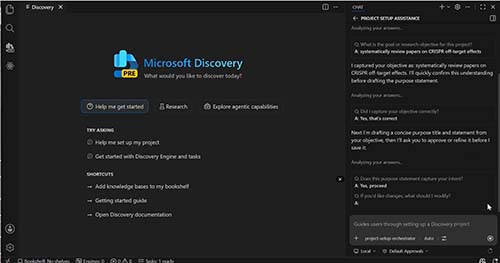
Recognizing that not all research teams are ready for or require a full enterprise-scale deployment, Microsoft also launched a preview of the Microsoft Discovery app. This local desktop experience is specifically aimed at individual researchers, students, academic laboratories, and smaller scientific teams. The app is designed to lower the barrier to entry for exploring the potential of agentic AI in research. It can be easily downloaded from GitHub and integrated with an existing GitHub Copilot account, providing a familiar and accessible environment. This standalone application allows smaller teams to begin experimenting with AI-powered literature review, sophisticated hypothesis generation, advanced scientific reasoning, and iterative experimental design without the complexities of a broader platform integration. It serves as an invaluable sandbox, enabling users to gain practical experience and understand the benefits of agentic AI before potentially scaling their operations to the comprehensive Microsoft Discovery platform. This strategic offering helps democratize access to cutting-edge AI tools, fostering innovation across a wider spectrum of the scientific community.
Pioneering Applications: Early Success Stories and Diverse Use Cases

Microsoft highlighted several compelling early use cases, demonstrating the platform’s versatility and transformative potential across various research institutions and industry partners. These examples underscore the real-world impact Discovery is already beginning to make.
-
Accelerating Materials Science and Energy Solutions:
Yale Engineering has leveraged the Discovery Engine in their groundbreaking work related to small molecule design for grid-scale aqueous organic redox flow batteries. Professor David Kwabi emphasized how this collaboration effectively combines human-led experimentation with the AI’s unparalleled ability to explore vast and complex chemical design spaces. This fusion is critical for accelerating the discovery of new materials vital for next-generation energy storage solutions, a field demanding rapid innovation to address global energy challenges. Similarly, the Pacific Northwest National Laboratory (PNNL) is utilizing Microsoft Discovery in crucial areas such as energy storage and biosystems engineering. Their work includes developing "self-driving scientific workflows" that seamlessly connect AI agents with advanced laboratory automation, paving the way for autonomous research environments where discovery can proceed at an unprecedented pace. -
Advancing Biological and Pharmaceutical Innovation:
In the realm of biological discovery, Ginkgo Bioworks has partnered with Microsoft, deploying specialized AI agents capable of analyzing massive and intricate biological datasets, generating novel hypotheses, and designing sophisticated experiments. This application holds immense promise for synthetic biology, drug discovery, and personalized medicine, where the ability to rapidly identify and test new biological pathways or drug candidates can dramatically shorten development cycles and reduce costs. The pharmaceutical giant GSK is also actively exploring Discovery for various drug development workflows, from early-stage target identification to optimizing clinical trial design, signaling a potential revolution in how new medicines are brought to market. -
Industrial R&D and Resource Optimization:
Beyond academic and bio-pharma sectors, Discovery is finding critical applications in heavy industry and manufacturing. BHP, a leading global resources company, is employing the platform to study advanced copper leaching methods. This application aims to enhance resource extraction efficiency, reduce environmental impact, and optimize operational costs in large-scale mining operations. Syensqo, a high-tech materials company, is harnessing agentic AI in its work on next-generation heat transfer fluids crucial for semiconductor manufacturing. As semiconductor technology continues to advance, the demands on thermal management solutions become increasingly complex, making AI-driven materials discovery essential for maintaining innovation cycles in this critical industry. These industrial applications underscore the platform’s capacity to drive both scientific breakthroughs and significant economic value.
Microsoft’s Broader AI Vision: Discovery as a Strategic Pillar
The announcement of Microsoft Discovery’s general availability aligns perfectly with the company’s broader, aggressive agent strategy, which is being systematically expanded across its entire ecosystem. This includes deep integration within Azure’s formidable cloud capabilities, enhancements to Microsoft Foundry for industrial applications, the developer-centric GitHub platform, and the ubiquitous Microsoft 365 suite. Discovery represents a vertical application of this overarching strategy, specifically targeting a niche but extraordinarily high-value audience: organizations where research cycles are inherently expensive, data-intensive, and subject to stringent regulatory or scientific review. By weaving agentic AI into the fabric of scientific R&D, Microsoft is not merely offering a new tool but is positioning itself as a foundational partner in the future of scientific and industrial innovation, much like it has done with enterprise software and cloud computing. This strategic positioning leverages Microsoft’s vast technological infrastructure and its commitment to responsible AI development, aiming to create an indispensable platform for global research.
The Evolving Landscape of Scientific R&D: Implications and Outlook
The introduction of Microsoft Discovery carries profound implications for the evolving landscape of scientific research and development. It signals a future where the pace of discovery is dramatically accelerated, where the vast oceans of scientific data become navigable and actionable, and where complex interdisciplinary problems can be tackled with unprecedented computational power. The potential for reducing the time and cost associated with bringing new innovations to market – from life-saving drugs to sustainable energy solutions – is immense. This platform could democratize access to advanced research capabilities, empowering smaller labs and institutions to compete on a more even footing with larger, well-funded organizations.

However, the widespread adoption of agentic AI in science also necessitates careful consideration of ethical implications. Issues such as potential biases in AI algorithms, the need for robust data governance, and the imperative to maintain human accountability in critical research decisions will remain paramount. Microsoft’s emphasis on "human judgment at the center" is a direct acknowledgment of these responsibilities. In a competitive landscape featuring other AI-for-science initiatives from tech giants and specialized startups, Microsoft’s advantage lies in its enterprise-grade security, deep integration with Azure services, and a comprehensive ecosystem that spans from individual developer tools to large-scale industrial solutions. Discovery stands as a testament to Microsoft’s belief that agentic AI is not just an enhancement but a fundamental shift that will redefine the boundaries of scientific possibility.
Microsoft Discovery is now generally available for organizations seeking to integrate agentic AI into their research workflows. The Microsoft Discovery app is accessible in preview, with features subject to refinement before its final release. For more comprehensive information and detailed insights, interested parties are encouraged to visit the official Microsoft blog.