



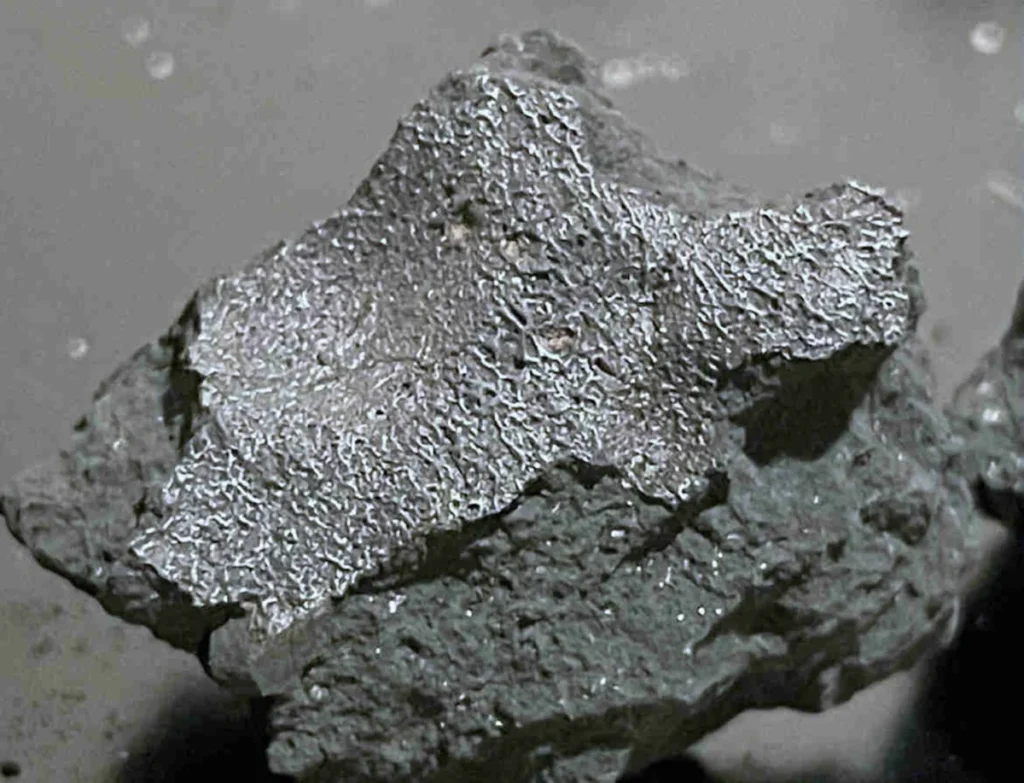
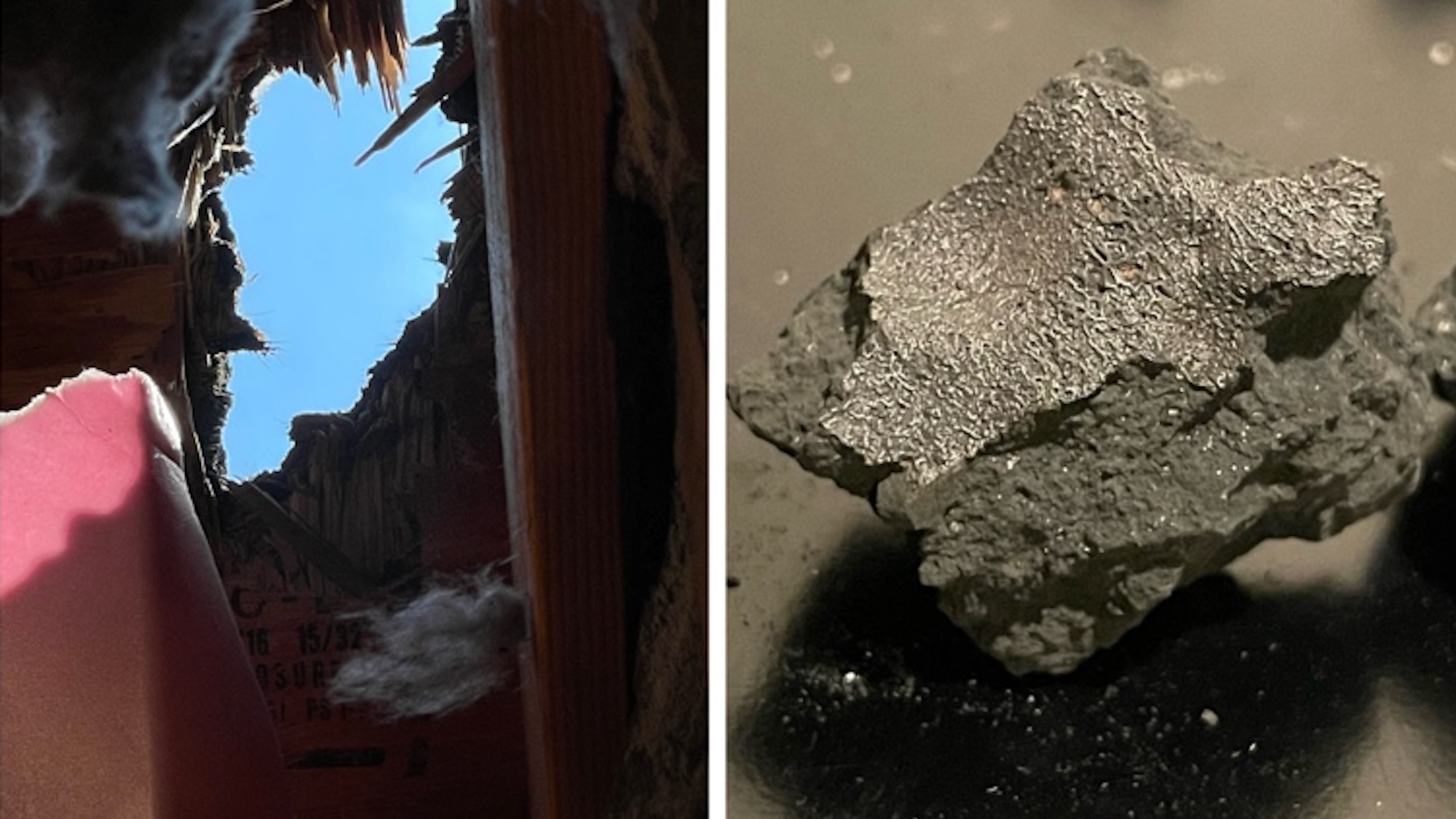
The morning of July 16, 2024, began as a typical summer day for a resident of Hillsborough, New Jersey, until a sudden and violent impact disrupted the silence of his home. A loud crash, followed by the sound of splintering wood and drywall, led the homeowner to his bedroom, where he discovered a scene of cosmic significance. A suitcase-sized meteorite had pierced the roof of his residence, leaving a gaping hole in the ceiling and scattering debris across his personal belongings. The incident, which occurred exactly two years ago tomorrow, has since become the focal point of an international scientific investigation, the results of which were recently published in the journal Science Advances.
The homeowner, whose quick thinking has been praised by the scientific community, described an immediate and pungent sulfur-like odor filling the room. Upon inspection, he found his bed, carpet, and surrounding furniture covered in black dust and rocky fragments. Recognizing the potential importance of the objects, he utilized disposable gloves and aluminum foil to carefully collect the specimens, storing them in glass jars to prevent terrestrial contamination. This meticulous preservation proved vital for the subsequent forensic analysis conducted by astronomers and chemists from the SETI Institute, NASA, and several international research universities.
Atmospheric Entry and Trajectory Analysis
The event was not isolated to the Hillsborough residence; it was a widely observed celestial phenomenon that captivated the Northeastern United States. On that morning, a fireball streaked across the daylight sky at a velocity estimated in the tens of thousands of miles per hour. The entry was documented by multiple camera systems across Connecticut, Pennsylvania, and New Jersey, providing researchers with a wealth of triangulation data.
Witness reports corroborated the visual evidence, with at least 16 individuals reporting a distinct shockwave that rattled windows and doors. This sonic boom was the result of the space rock’s rapid disintegration approximately 22 miles above the Earth’s surface. As the meteor broke apart under the intense pressure and heat of atmospheric friction, it created a debris field that was large enough to be detected by Doppler weather radar.
The radar readings flagged a lengthy trail of pebble-like fragments descending over Staten Island and portions of northern New Jersey. According to the trajectory data analyzed by the American Meteor Society and NASA’s Meteoroid Environment Office, the largest surviving fragments were projected to land in the vicinity of Hillsborough. The recovery of the bedroom specimen confirmed these calculations with startling precision.
Scientific Classification: The Rarity of the CM1/2 Type
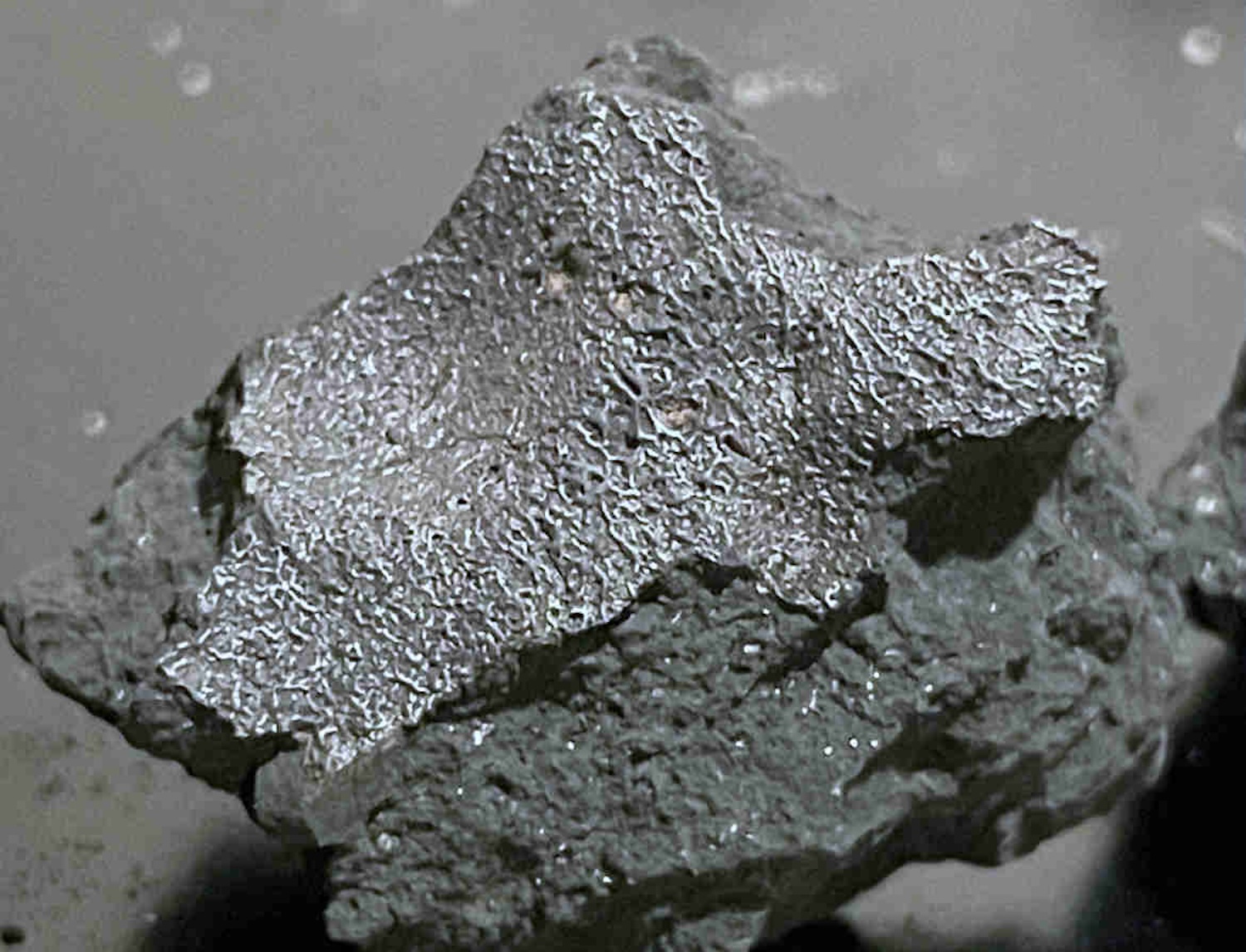
Upon receiving the samples, researchers at the SETI Institute and NASA began an exhaustive physical and chemical characterization of the meteorite. Initial visual inspections revealed a dark, charcoal-like exterior known as a fusion crust—a thin, melted layer formed during the rock’s high-speed passage through the atmosphere.
The internal composition of the Hillsborough meteorite identified it as a member of the carbonaceous chondrite family, specifically the CM type. Carbonaceous chondrites are among the most primitive known materials in the solar system, containing high proportions of water and organic compounds. However, the Hillsborough specimen exhibited unique characteristics that defied standard classification.
Typically, these meteorites are categorized as CM1 or CM2 based on the degree of aqueous alteration—the process by which liquid water reacts with minerals inside the parent asteroid. The Hillsborough fragments showed evidence of being significantly altered by ancient water while still part of their parent body, yet they retained features of less-altered material. Consequently, the team classified it as a CM1/2 carbonaceous chondrite. This marks only the 22nd observed atmospheric entry of a CM-type meteorite in recorded history and only the second time a CM1/2 intermediate type has been witnessed and recovered on Earth.
"A forensic study of the fragments revealed that they contained preserved bits from near the surface of a primitive asteroid where it experienced concentrated salty fluids," explained Peter Jenniskens, a senior research scientist at the SETI Institute and NASA. According to Jenniskens, the homeowner’s rapid response ensured that these are the most pristine CM1/2 meteorites currently available for study, as they were shielded from the Earth’s moisture and biological activity.
Evidence of Prebiotic Chemistry and Briny Origins
The most profound discovery within the Hillsborough meteorite lies in its micro-chemistry. Detailed analysis revealed the presence of salt-laden fragments that provide a window into the conditions of the early solar system. Scientists believe the meteorite originated from near the surface of its parent asteroid, in a region where liquid water once flowed and subsequently evaporated.
This evaporation process concentrated various salts, creating a briny environment. Within these brines, researchers identified the chemical compound phosphate. On Earth, phosphates are essential components of DNA, RNA, and ATP (adenosine triphosphate), the primary energy carrier in all living cells. The presence of phosphate in a soluble state within the meteorite suggests that the parent asteroid possessed the necessary ingredients to kickstart complex chemical reactions between minerals and organic materials.
The study also highlighted a significant concentration of organo-metallic compounds. On Earth, these compounds are vital to biological functions, including the production of chlorophyll for photosynthesis in plants and the transport of oxygen in animal blood. Phil Schmitt-Kopplin, an organic mass spectrometry specialist at the Technical University of Munich, noted that a high fraction of the compounds found in the meteorite were the direct product of organic chemistry interacting with minerals.
While researchers are still debating whether these compounds formed through brine chemistry or were the result of earlier impact processes on the asteroid, their presence reinforces the theory that meteorites served as the primary delivery mechanism for the building blocks of life.
International Collaboration and Isotope Research
The analysis of the Hillsborough meteorite was a global effort, involving experts from the United Kingdom, Japan, and Germany. Queenie Chan, a cosmochemist at Royal Holloway University in London, and Nana Ogawa, a biogeochemist at the Japan Agency for Marine-Earth Science and Technology, conducted isotope studies of the carbon and nitrogen found within the samples.
Isotopes are variants of chemical elements that serve as "fingerprints," allowing scientists to trace the origins of matter. The study of the Hillsborough fragments suggested that the organic matter contained within them is consistent with the material that would have been delivered to the early Earth billions of years ago.
"Isotope studies suggest that primitive carbonaceous chondrites, including CM-types, delivered organic matter to the early Earth," stated Chan and Ogawa in a joint observation. Furthermore, the meteorite was found to contain a variety of amino acids—the fundamental units of proteins. The diversity and pristine nature of these amino acids provide researchers with a rare opportunity to study prebiotic molecules that have remained unchanged since the dawn of the solar system.
Historical Context and Broader Implications
The Hillsborough strike joins a short list of documented instances where meteorites have impacted human structures. Notable historical parallels include the 1954 Sylacauga meteorite in Alabama, which struck a woman sleeping on her sofa, and the 1992 Peekskill meteorite in New York, which crushed the trunk of a parked car. However, the Hillsborough event is scientifically distinct due to the rare chemical "intermediate" nature of the rock and its high organic content.
Beyond the immediate excitement of a "house-call" from space, the Hillsborough meteorite serves as a critical data point in the field of planetary defense and astrobiology. It reminds the scientific community that asteroids are not merely inert rocks but are complex, "proto-planet" worlds capable of hosting sophisticated chemistry.
The findings suggest that the conditions necessary for life—liquid water, organic carbon, salts, and phosphates—were widespread in the early solar system. As NASA and other space agencies continue to explore asteroids through missions like OSIRIS-REx and Hayabusa2, the Hillsborough meteorite provides a terrestrial benchmark for comparing samples returned directly from space.
Conclusion: A Cosmic Legacy in a Glass Jar
The property damage sustained by the Hillsborough homeowner, while disruptive, has ultimately facilitated a major leap in our understanding of Earth’s origins. The suitcase-sized visitor from the asteroid belt has confirmed that the ingredients for life are not unique to our planet but are part of a broader celestial heritage.
As the scientific community continues to analyze the data from the Hillsborough fall, the focus remains on the "briny" chemistry that defined the meteorite’s parent asteroid. The discovery of phosphates and amino acids in such a pristine state offers a compelling narrative of how life may have been "seeded" on Earth. For now, the fragments stored in glass jars two years ago remain some of the most valuable specimens in modern cosmochemistry, proving that sometimes, the most profound secrets of the universe can land right in our own bedrooms.