

In a significant move to redefine the role of artificial intelligence in the classroom, Microsoft has announced a suite of new AI-powered teaching capabilities and student-centered experiences designed to shift the focus from mere productivity to deep learning and critical thinking. The announcement comes as new data reveals that 92% of students and education leaders, along with 88% of educators, have already integrated AI into their school-related workflows. However, as the initial novelty of generative AI matures into a permanent fixture of the academic landscape, the technology giant is pivoting its strategy toward "learning science," ensuring that AI serves as a pedagogical partner rather than a shortcut for task completion.
The latest Microsoft AI in Education Special Report, released in 2026, underscores a critical gap between usage and preparation. While adoption is nearly universal, the demand for structured support is high: 66% of educators and 52% of students expressed a desire for monthly or quarterly AI training. Furthermore, there is an urgent call for clearer guidance on the responsible and ethical use of these tools. Microsoft’s new initiatives, integrated directly into the Microsoft 365 Education ecosystem, aim to address these needs by providing secure, student-centered experiences that are grounded in established educational research.
The Evolution of AI in the Classroom: From Answer Engine to Learning Coach
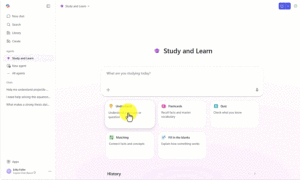
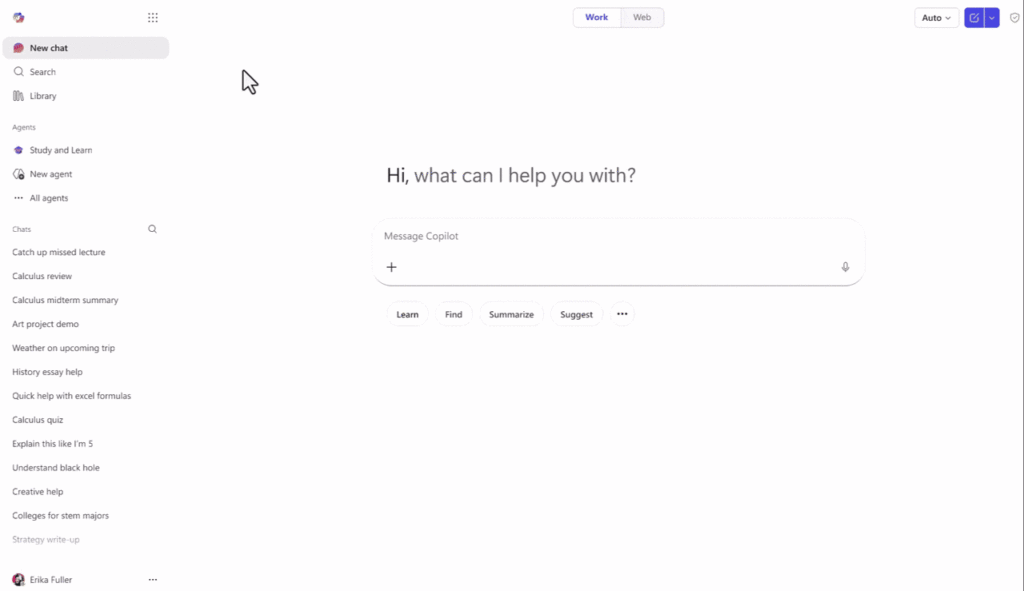
The centerpiece of this update is the "Study and Learn Agent," a sophisticated experience within Copilot Chat tailored specifically for students aged 13 and older. Unlike traditional generative AI, which often provides direct answers to queries, the Study and Learn Agent is programmed to function as an interactive learning coach. This distinction is critical in a pedagogical context; the tool is optimized for learning outcomes rather than speed.

Drawing on research-based principles such as scaffolding and active recall, the agent helps students navigate complex concepts without doing the work for them. It utilizes a series of guided questions to prompt critical thinking, offers interactive practice tools like digital flashcards and quizzes, and provides immediate, constructive feedback. By encouraging independent thinking and knowledge retention, the tool seeks to mitigate concerns that AI might lead to the atrophy of student problem-solving skills.
Complementing this is the introduction of "Copilot Notebooks," an AI-powered workspace designed to help students remain focused on their own curriculum materials. Within the Microsoft 365 Copilot app, students can upload lecture slides, handouts, readings, and personal notes. The AI then assists the student based strictly on these provided sources, a technique known as grounding. This minimizes the risk of hallucinations—where AI generates false information—and ensures the assistance is relevant to the specific syllabus. The tool also includes a feature to transform these materials into interactive study guides for self-testing and review.
Empowering Educators through Data-Driven Design
The new capabilities for teachers were developed through the Education Insiders Program, a collaborative initiative that allows educators to provide direct feedback on software development. These tools are designed to integrate seamlessly into daily workflows rather than adding another layer of administrative burden.
One of the most anticipated features is the new Unit Plans dashboard. This tool assists educators in mapping out entire modules of study, aligning lesson plans with curriculum standards while suggesting diverse instructional strategies. By automating the more rote aspects of lesson preparation, Microsoft aims to free up educator time for high-value interactions with students. These features are currently being rolled out to preview communities and are expected to reach general availability in the coming months.

To further bridge the gap between technology and the user, Microsoft is introducing "Teach and Learn" taskbar shortcuts on Windows devices. These shortcuts provide personalized, one-click access to AI tools, ensuring that both teachers and students can utilize these resources without disrupting the flow of a lesson. For institutional leaders, the rollout is designed with robust governance and security features, allowing IT administrators to deploy these tools with confidence that data privacy and institutional standards will be maintained.
A Global Framework for AI Literacy
The announcement also highlights a broader commitment to AI literacy, recognizing that access to technology is only half the battle. According to Microsoft’s research, 87% of education leaders and 79% of students agree that effective and responsible AI use is vital for future career success. To meet this demand, Microsoft has collaborated with international bodies to establish a standardized approach to AI education.
Microsoft has supported the AI Literacy Framework developed by the European Commission and the Organisation for Economic Co-operation and Development (OECD) in partnership with CodeAI. This framework provides a shared playbook for policymakers and curriculum designers, outlining what students should understand about AI by the time they graduate. The framework is built on four pillars:
- Understanding AI: Grasping the basic mechanics of how algorithms and data processing work.
- Using AI: Developing the technical skills to prompt and interact with AI tools effectively.
- Evaluating AI: Critically assessing the outputs of AI for bias, accuracy, and ethical implications.
- Creating with AI: Using AI as a creative partner to solve problems or generate new content.
In tandem with this, Microsoft worked with ISTE (International Society for Technology in Education) and ASCD to launch an "AI Literacy for Educators" credential pathway. This professional development program is part of the Microsoft Elevate for Educators initiative, which offers community support and capacity-building resources. The program is designed to help teachers move from basic awareness to expert-level integration of AI in their pedagogy.

Chronology of AI Integration in Education (2022–2026)
The journey to this current state of AI integration has been rapid. Following the public release of advanced generative AI models in late 2022, the 2023 academic year was largely defined by a "reactionary phase," where many school districts initially banned the technology due to concerns over plagiarism and academic integrity.
By 2024, the narrative shifted toward "exploration." Educational institutions began to realize that AI was a permanent fixture and started developing "Acceptable Use Policies." In 2025, the focus moved toward "integration," with tech providers embedding AI into existing productivity suites like Microsoft 365 and Google Workspace.
The current 2026 milestone represents the "sophistication phase." The industry has moved beyond the excitement of chatbots to the development of specialized "agents" that adhere to learning science. This timeline illustrates a move from fear and restriction to a nuanced, framework-based adoption that prioritizes student agency and educator support.
Implications for the Future of Pedagogy
The shift from AI as an "answer engine" to a "learning coach" carries significant implications for the future of education. Academic experts suggest that this could lead to more personalized learning at scale. In a traditional classroom, a single teacher may struggle to provide one-on-one scaffolding for 30 different students simultaneously. An AI coach can provide that individualized attention, meeting students at their specific level of understanding.

However, this transition also raises questions about the digital divide. While Microsoft’s tools are being integrated into existing Microsoft 365 Education accounts—often at no additional cost—institutions without the budget for modern hardware or high-speed internet may find themselves further behind. Furthermore, the reliance on AI for scaffolding requires students to have a baseline level of critical thinking to know when the AI’s guidance is helpful versus when it might be leading them astray.
From a data privacy perspective, Microsoft has emphasized that its AI experiences are built with institutional-grade security. For K-12 environments, IT administrators maintain strict control, and the "Study and Learn" features are disabled by default until an administrator enables Copilot Chat. This "opt-in" approach is a direct response to global data protection regulations like GDPR in Europe and COPPA in the United States, ensuring that student data is not used to train underlying public AI models.
Conclusion: Preparing for the Next Academic Cycle
As the 2025-2026 academic year concludes, the focus for educational institutions is now on the upcoming fall semester. The push for AI literacy is no longer an elective pursuit but a foundational requirement. By aligning its technological roadmap with global frameworks like those of the OECD and providing tangible training pathways through Elevate for Educators, Microsoft is positioning itself as a primary architect of the modern classroom.
The success of these tools will ultimately be measured not by the speed at which students complete their assignments, but by their ability to demonstrate deeper conceptual understanding and a robust ability to navigate an AI-augmented world. As Microsoft’s report concludes, the goal is to help every student and educator use AI with confidence today, while preparing them for the unforeseen challenges of tomorrow’s workforce.