

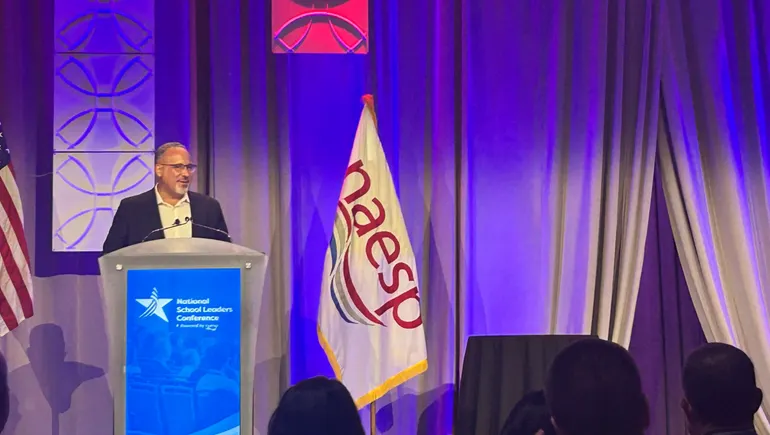
ORLANDO, Fla. – In a compelling address to elementary and middle school administrators at the National Association of Elementary School Principals’ National School Leaders Conference, former U.S. Education Secretary Miguel Cardona emphasized the critical role of principals as both managers and visionary leaders, particularly during what he described as a "tough time to lead." Drawing from his extensive career, including a decade as an elementary school principal in Meriden, Connecticut, which he fondly recalled as his favorite professional period, Cardona urged attendees to embrace innovation and align their daily actions with their core values.
Cardona, who now leverages his expertise through his consulting firm, Cardona Solutions, acknowledged the immense pressures faced by school leaders. These pressures stem from the complex task of balancing the diverse needs of students, teachers, the community, central offices, and superintendents. He cautioned against the temptation to merely "get by managing" and instead championed the qualities of "most exceptional principals" who masterfully integrate management with impactful leadership.
"Today, our students are looking to us to lead," Cardona declared to the assembled educators. "They look to us to challenge a broken status quo, to challenge opportunity and achievement gaps that have been normalized across our country. They look to us to repair division in our country, in our state, in our communities – and sometimes in our school." His remarks underscored the profound responsibility principals bear in shaping not only academic outcomes but also the social and emotional well-being of their students and the broader school community.
The conference, held on Wednesday in Orlando, provided a platform for Cardona to share actionable advice and lessons learned throughout his distinguished career, which notably included his tenure leading the U.S. Department of Education under the Biden administration. His address centered on empowering principals to innovate while navigating the inherent complexities and demands of their positions.
Embracing Innovative Collaboration in Education
A cornerstone of Cardona’s message was the power of intentional collaboration. He recounted his experience as Connecticut’s education commissioner during the peak of the COVID-19 pandemic, where a meticulously crafted school reopening plan became a national model. This plan, he explained, was the result of deliberate partnerships with epidemiologists, unions, and school boards, leading to "quick and lasting results."
This success in Connecticut garnered national attention and was instrumental in his nomination as education secretary by then-President Joe Biden. Cardona highlighted that at the time of his appointment, approximately half of the nation’s schools were operating in-person. He attributed the subsequent achievement of reopening virtually all schools within nine months to the collaborative approach pioneered in Connecticut.
"And what I noticed in Connecticut, it wasn’t the schools that were best-resourced that opened the quickest," Cardona stated. "Rather, it was the schools with leaders who knew how to intentionally collaborate." This observation provides a critical insight into the efficacy of leadership strategies, suggesting that resource allocation, while important, is not the sole determinant of success. Instead, the ability of leaders to foster robust partnerships and engage stakeholders effectively plays a pivotal role.
Cardona urged school leaders never to underestimate the transformative potential of collaboration, emphasizing its applicability to a wide array of challenges, from teacher retention and improving working conditions to adapting to evolving technological landscapes. He posited that when school leaders involve more individuals in the decision-making and implementation processes, it fosters greater ownership and sustainability, alleviating the burden of carrying every responsibility alone. This principle of shared governance and collaborative problem-solving can lead to more resilient and effective educational environments.
Leading with Effective Pedagogy and Student Well-being
Beyond collaboration, Cardona advocated for leveraging sound pedagogy to address the most pressing issues facing schools. He specifically cited the ongoing debate surrounding student screen time and device policies as an area ripe for innovative pedagogical approaches.
"A lot of the public debate is about whether or not to ban devices or how we can limit screen time," Cardona observed. He then challenged the audience to consider a different focus: "But what if… instead of focusing our energy on that, we focused on creating more pro-social interactions between students?"
This reorientation suggests a shift from reactive policy-making to proactive engagement with students’ developmental needs. Cardona proposed concrete strategies, such as increasing opportunities for students to participate in clubs or extracurricular activities. He even suggested aiming for ambitious participation rates, such as ensuring "90% of a school’s 4th- and 5th-graders to sign up for a club," as a means to foster greater peer interaction. Furthermore, he encouraged schools to forge partnerships with local organizations and businesses for student volunteer opportunities, thereby cultivating essential life and social skills.
His impassioned plea, "Let’s give them a reason to put their damn phones down," resonated with the audience, highlighting the need for engaging and meaningful educational experiences that naturally draw students away from excessive digital consumption. This approach underscores the importance of creating an environment where learning is intrinsically rewarding and socially connected, thereby addressing the root causes of device overreliance rather than merely managing its symptoms.
Auditing Calendars to Reflect Core Values
Cardona also stressed the importance of principals innovating in how they manage their own time, even when faced with significant obstacles. He shared his personal experience as Education Secretary, where the initial nine months were consumed by "just putting out fires all day." This reactive posture, he realized, was unsustainable and hindered strategic progress.
To counter this, he instructed his scheduling team to implement regular two-hour blocks dedicated to "instructional leadership." These protected periods were used for vital activities such as meeting with staff, conducting building walkthroughs, and engaging with superintendents who might be navigating crises, including school shootings.
This proactive allocation of time, Cardona explained, enabled him to "identify ways to move the needle forward in our country, not put out somebody else’s fires." He strongly encouraged the principals in attendance to adopt similar practices, designating a trusted staff member as a "gatekeeper" to safeguard this valuable instructional leadership time from competing demands and distractions.
"Your calendar is a reflection of your values," Cardona asserted, urging attendees to conduct a personal audit. He prompted them to identify their highest priorities as school leaders and then to examine their past calendars to ascertain whether their schedules genuinely mirrored these values. "Is there a match between what you want to do and what you do?" he asked, posing a direct challenge to self-reflection.
This principle of calendar auditing, Cardona noted, extends beyond professional responsibilities to encompass personal life as well. He candidly admitted to struggling with work-life balance during his tenure as Education Secretary, commuting weekly between Washington, D.C., and his family in Connecticut. However, he and his teenage daughter developed a creative solution: early Saturday morning outings for what they dubbed "Saturday shenanigans."
"If you do not schedule the things that are most important to you now, they will not happen – your family, your health, your faith," Cardona warned. "The job will burn you if your calendar does not reflect your values." This final sentiment encapsulates the overarching theme of his address: that effective leadership is not merely about managing tasks, but about embodying and enacting one’s deepest convictions through deliberate action and intentional time management.
The implications of Cardona’s message are far-reaching. By emphasizing innovative collaboration, pedagogical leadership, and values-driven time management, he provided principals with a framework for navigating the complexities of modern education. The success of the Connecticut reopening plan, supported by data indicating a rapid return to in-person learning nationwide, serves as a powerful testament to the efficacy of his strategies. The call for principals to actively cultivate pro-social interactions among students and to prioritize their personal well-being through disciplined scheduling offers a roadmap for building more resilient, engaged, and effective school communities in an era marked by both unprecedented challenges and significant opportunities for transformative leadership.