


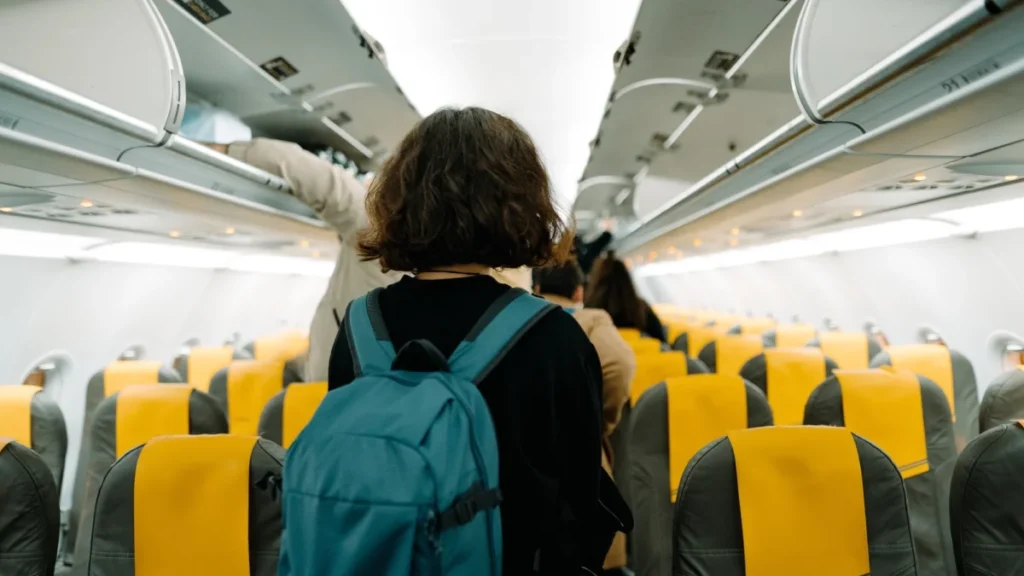
Navigating the logistical labyrinth of air travel in the mid-2020s has become a test of endurance for the modern passenger, characterized by a complex array of boarding groups, priority zones, and tiered loyalty statuses. What was once a relatively linear process of entering an aircraft has evolved into a significant bottleneck in the aviation industry, with empirical data suggesting that boarding times have nearly tripled over the last several decades. While historical records indicate that boarding a commercial jet in the 1970s typically required approximately 15 minutes, contemporary estimates now place that figure at 40 minutes or more. This regression in efficiency has prompted researchers and data scientists to investigate the underlying causes of "boarding bloat" through sophisticated computer modeling and behavioral analysis.
The Jacobs Simulation: Visualizing the Bottleneck
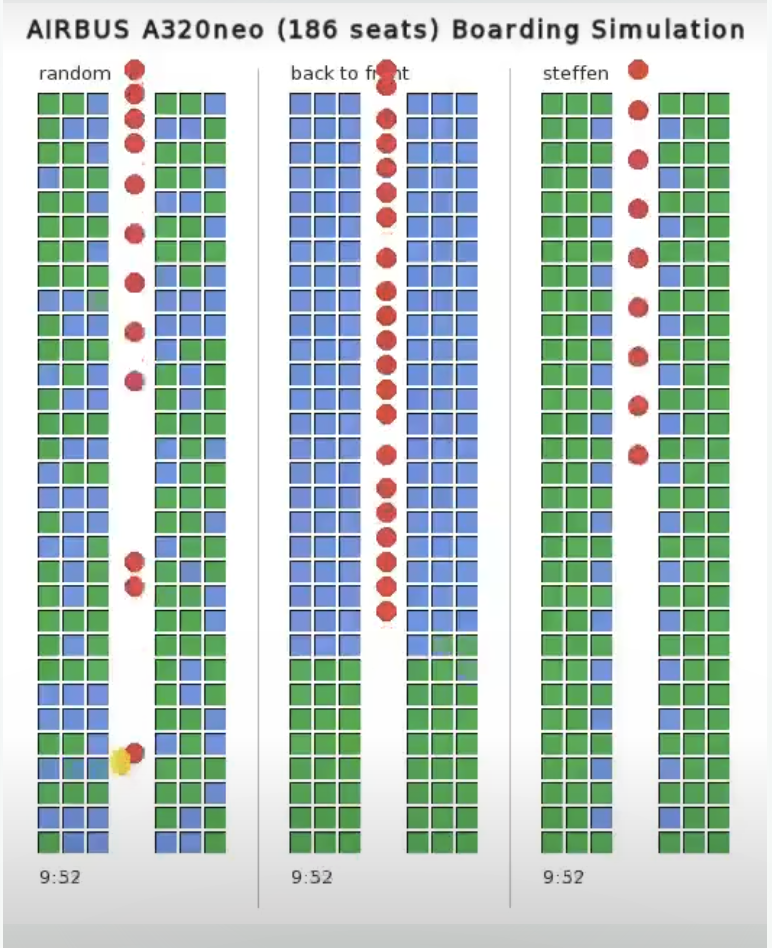
Adam Jacobs, a master’s student at the University of Florida, recently brought this frustration into the digital spotlight by developing a comprehensive boarding simulator. Utilizing a computer model of a 186-seat Airbus A320neo—a workhorse of modern narrow-body fleets—Jacobs visualized the movement of passengers to compare the efficacy of different boarding strategies. The simulation, which gained significant traction on professional and social media platforms like LinkedIn and Instagram, provides a side-by-side comparison of three primary methods: random boarding, back-to-front boarding, and the scientifically optimized "Steffen method."
In the simulation, passengers are represented as dynamic red dots traversing the cabin aisle. As they reach their assigned rows and successfully stow their luggage, the blue squares representing empty seats transition to green, signaling a completed seating action. By running these scenarios simultaneously under identical conditions, Jacobs provided a stark illustration of how procedural choices directly impact the "turnaround time"—the critical window an aircraft spends on the ground between flights.
The results of the simulation were definitive. The Steffen method, which prioritizes boarding window seats in a specific alternating row sequence, completed the process in just 11 minutes and 16 seconds. Random boarding, a method famously utilized by Southwest Airlines for decades (though recently modified), followed with a time of 17 minutes and 59 seconds. Most notably, the "back-to-front" method—which many passengers and airline staff intuitively believe to be the most logical approach—performed the worst, requiring 31 minutes and 15 seconds to fully seat the cabin.
The Paradox of Back-to-Front Boarding
The failure of the back-to-front method in the simulation highlights a phenomenon known in aviation circles as "aisle interference." When an airline boards the rear of the plane first, it creates a high-density cluster of passengers all attempting to access the same limited aisle space and overhead bins simultaneously. This results in a "stop-and-go" effect where the entire line must wait for a single passenger to stow a bag or for a seated passenger to stand up to allow someone into a middle or window seat.
Despite its poor performance in simulations, variations of back-to-front or zone-based boarding remain the industry standard. The reason for this persistence is rooted less in physics and more in the psychological management of crowds. Airlines utilize zones to prevent massive surges of passengers at the gate, creating an illusion of order even if the process inside the cabin remains fundamentally inefficient. However, as the Jacobs simulation demonstrates, this perceived order does not translate to a faster departure.
The 2008 Shift: How Ancillary Fees Reshaped the Cabin
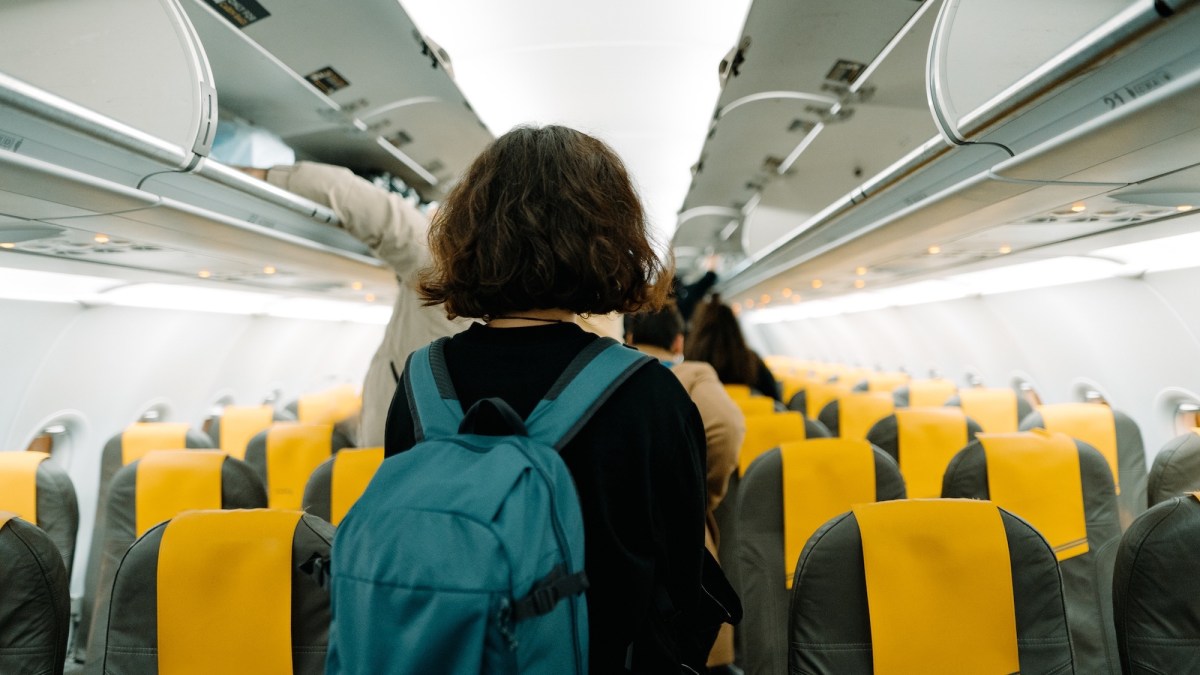
To understand why boarding has slowed so dramatically since the 1970s, analysts point to a pivotal shift in airline economics that occurred in 2008. During the global financial crisis and a period of skyrocketing fuel prices, major carriers began unbundling their services, most notably by introducing fees for checked baggage. Previously, checked bags were included in the base fare, encouraging passengers to travel with only small personal items.
The introduction of checked bag fees incentivized travelers to maximize their carry-on allowance to avoid extra costs. This led to a dramatic increase in the volume of luggage entering the cabin, turning the overhead bins into high-value real estate. Consequently, the boarding process became a competitive race for bin space.
Airlines quickly identified this new passenger priority as a revenue opportunity. By creating multiple "priority boarding" tiers, carriers could charge passengers for the right to board early and secure overhead space. This monetization of the boarding sequence added layers of complexity—groups 1 through 9, "Basic Economy" restrictions, and credit card-linked perks—that further fragmented the process. As Massoud Bazargan, a professor at Embry-Riddle Aeronautical University, noted, the revenue generated from bag fees and priority boarding sales has essentially "killed" the incentive for airlines to prioritize the fastest possible boarding times.
The Steffen Method: An Astrophysical Approach to Aviation
The fastest method identified in Jacobs’ simulation, the Steffen method, is named after Jason Steffen, an astrophysicist who developed the concept in 2005. Steffen’s interest in the problem began when he found himself trapped in a long, stagnant boarding line at Seattle-Tacoma International Airport. Applying the same mathematical modeling techniques he used to study exoplanets, Steffen sought to eliminate the primary cause of delays: "aisle interference" and "seat interference."
The Steffen method operates on a highly specific sequence:
- Passengers in window seats on even-numbered rows board first (e.g., 2A, 4A, 6A).
- Passengers in window seats on odd-numbered rows follow.
- The process repeats for middle seats (even then odd).
- The process concludes with aisle seats (even then odd).
By spacing out passengers by at least two rows, the method ensures that multiple people can stow their luggage simultaneously without blocking one another. In academic trials and physical tests conducted by television programs like MythBusters, the Steffen method consistently outperformed all other strategies, often cutting boarding times by 50% or more compared to standard industry practices.
Practical Barriers and the Human Element
Despite its mathematical perfection, the Steffen method faces significant hurdles in real-world implementation. The primary criticism, often echoed by travelers on social media, is that the method is "inhumane" for families and groups. Because the sequence is based on seat position rather than party affiliation, a family of four would likely be forced to board in four different waves, a logistical nightmare for parents with young children or travelers assisting elderly companions.
Furthermore, the method assumes a level of passenger compliance and physical uniformity that rarely exists. In a simulation, every "red dot" moves at a predictable speed and stows their bag in a set amount of time. In reality, passengers vary in mobility, some struggle with heavy bags, and others may be distracted or unfamiliar with the process. Critics argue that the time spent organizing passengers into the exact Steffen sequence at the gate would likely negate the time saved during the actual boarding.
The Economic Reality of Turnaround Times
From a purely operational perspective, every minute an aircraft sits at a gate represents a cost. Airlines must pay gate lease fees to airports, and a grounded plane is a plane that isn’t generating revenue. In a high-frequency environment, such as a low-cost carrier operating short-haul flights, saving 10 minutes per boarding could theoretically allow an airline to squeeze an extra flight into a daily schedule across its entire fleet.
However, for major legacy carriers, the math is different. The revenue generated from selling "Priority Boarding" and the operational ease of zone-based loading often outweigh the marginal gains of a faster turnaround. This creates a disconnect between the "science" of boarding and the "business" of boarding. As Jacobs observed in his analysis, the current system is designed to maximize revenue first and passenger comfort second, with efficiency a distant third.
Future Outlook: Technology and Design Solutions
While the Steffen method may never become the universal standard, some airlines are experimenting with "hybrid" approaches. United Airlines, for instance, recently reintroduced the "WILMA" method (Window-Middle-Aisle), which boards passengers in window seats first, then middle, then aisle. While not as granular as the Steffen method, it aims to reduce seat interference while allowing families on the same row to board together in certain configurations.
Other solutions focus on hardware rather than procedure. Newer aircraft are being outfitted with "Space Bins" that allow bags to be stored on their sides, significantly increasing capacity and reducing the "bin hunt" that slows down the aisle. Additionally, the implementation of biometric boarding—using facial recognition instead of scanning paper or digital boarding passes—is aimed at reducing the friction at the gate entrance.
Ultimately, the science of airplane boarding remains a tug-of-war between mathematical efficiency and human behavior. As long as the cabin remains the primary battleground for luggage space and the gate remains a source of ancillary revenue, the 40-minute boarding process is likely to remain a staple of the modern travel experience. The Jacobs simulation serves as a reminder that while we have the data to fix the problem, the solution requires a fundamental shift in how airlines value their passengers’ time versus their bottom line.