



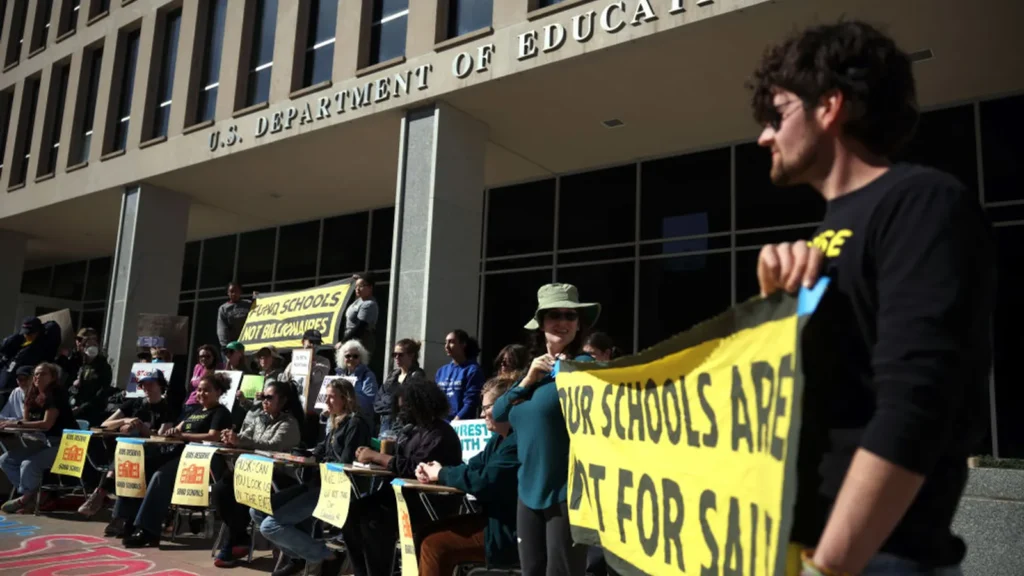
A sweeping report released Monday by the U.S. Department of Education’s Office of Inspector General (OIG) has detailed significant staffing reductions within the department during the initial phase of the second Trump administration, revealing a disproportionate impact on units responsible for crucial legal duties, statutory functions, and oversight activities. The report, spanning from January 20, 2025, to March 31, 2025, indicates that nearly half of the department’s workforce was eliminated, leading to the dismantling of numerous suboffices and raising serious questions about the department’s capacity to fulfill its congressionally mandated responsibilities.
The Inspector General’s findings paint a stark picture of an agency undergoing a dramatic downsizing. Between the specified dates, the department shed at least 1,579 employees out of a total workforce of 3,902, representing a substantial 40% reduction. This aggressive attrition led to the closure of several suboffices across 15 of the department’s 17 main offices. The OIG specifically noted that these eliminated units "appear to have been performing statutory functions or oversight and monitoring functions," underscoring a potential erosion of the department’s core operational capabilities.
Beyond direct staffing cuts, the report highlights the broader consequences of this workforce reduction. The Trump administration’s actions resulted in the termination of 90 grants, collectively valued at $504 million. The OIG identified teacher training programs and mental health services as particularly hard-hit sectors by these grant cancellations. Furthermore, 129 contracts, totaling $1.3 billion, were also terminated, suggesting a widespread disruption in the department’s operational partnerships and service delivery mechanisms.
A Detailed Look at the Impact on Key Offices
The OIG report provides specific examples to illustrate the severity of these reductions. The Office for Civil Rights (OCR), a vital component for enforcing federal anti-discrimination laws in education, experienced a substantial blow. On January 20, 2025, OCR employed 598 individuals across 11 regional offices and 18 suboffices. However, a reduction-in-force (RIF) implemented on March 11, 2025, significantly impacted its structure. This RIF alone affected six regional offices, seven suboffices, and resulted in the departure of 291 employees. An additional 55 OCR employees left the department through other means within the same reporting period, further depleting its ranks.
The consequences for OCR’s operational capacity are profound. The OIG report emphasizes that the 13 impacted OCR regional offices and suboffices, which were entirely devoid of staff by March 31, 2025, were previously responsible for critical statutory and oversight functions. These included conducting complaint investigations and compliance reviews across a wide spectrum of educational institutions, from preschools and K-12 schools to colleges and universities, as well as other entities involved in education. The elimination of these offices raises concerns about the department’s ability to address civil rights violations and ensure equitable access to education.
Another area significantly affected was the Office of Special Education and Rehabilitative Services (OSERS). Within OSERS, 14% of its 177 staff members, spread across three suboffices, were impacted by the March 11, 2025, RIF or other separation means. This downsizing resulted in a complete absence of employees in these OSERS suboffices. Consequently, the department’s capacity to coordinate, monitor, and oversee activities related to policy formulation, program planning, regulatory development, evaluation, and grants and contract scheduling in these specific areas was severely compromised. This could have far-reaching implications for students with disabilities and individuals requiring rehabilitative services.
Timeline of Reductions and Statutory Responsibilities
The period under review, January 20, 2025, to March 31, 2025, marks a critical juncture for the Department of Education. This period coincided with the beginning of a new presidential term and the subsequent implementation of significant administrative changes. The OIG report focuses on the impact of these changes, particularly the reduction-in-force actions.
- January 20, 2025: The second Trump administration begins. The Department of Education’s workforce stands at 3,902 employees. Key offices like OCR and OSERS have established regional and suboffice structures in place to carry out their statutory duties.
- March 11, 2025: A significant reduction-in-force (RIF) is implemented across the Department of Education. This action directly impacts numerous employees and leads to the closure of multiple suboffices.
- March 31, 2025: The end of the OIG’s reporting period. By this date, at least 1,579 employees have been separated from the department, and several suboffices, including those performing critical legal and oversight functions, are left with no staff.
- December 2025: (As mentioned in a later statement) A court order mandates the return of some OCR employees to their positions, indicating ongoing legal challenges to the department’s actions.
The OIG report, a comprehensive 83-page document, refrains from issuing explicit recommendations. However, it raises pointed questions regarding the department’s stance on cooperating with the investigation. The OIG noted that the Education Department withheld certain requested documents and interviews, citing "ongoing litigation" challenging the downsizing efforts.
The OIG summary stated, "Although the Department has repeatedly cited concerns about ongoing judicial proceedings and court orders, it has not explained how granting us access to requested documents and to staff would place it at risk of noncompliance with those proceedings and court orders." This suggests a lack of transparency and potential obstruction in the OIG’s ability to conduct a thorough assessment.
Departmental Response and OIG’s Counterarguments
In its response to a draft of the OIG’s report, the Education Department proposed the inclusion of language emphasizing that binding judicial orders constrained its ability to share information with the OIG. Furthermore, the department took issue with the OIG’s suggestion that some changes implemented between January and March 2025 appeared to have impacted statutory functions or oversight and monitoring duties. The department argued that such wording could be misinterpreted by the public and stakeholders, leading them to believe that the department was not fulfilling its responsibilities under federal law due to the reduction-in-force efforts.
The department contended that such interpretations risked "confusing the public and stakeholders" and was "inconsistent" with its alleged continuation of these responsibilities for over a year following the March 2025 RIF.
However, in the final report, the OIG stood firm, stating that the Education Department had failed to provide "corroborating evidence" to support its claims of continued performance of certain statutory responsibilities since the March 2025 RIF. The OIG maintained its original findings and did not alter the draft report based on the department’s comments.
Reactions from Stakeholders and Unions
The implications of the OIG report have drawn sharp reactions from various stakeholders. Ellen Keast, the Education Department’s press secretary for higher education, offered a contrasting perspective in a statement released Tuesday. She asserted that the OIG report "doesn’t accurately account" for a court order in December 2025 that reinstated some OCR employees. Keast further argued that the report "demonstrates how effective the Trump Administration is," claiming that with reduced staff, the department "effectively implemented some of the most sweeping higher education reforms in decades while returning education to the states." This statement frames the downsizing as a strategic move towards decentralization and efficiency.
Conversely, Rachel Gittleman, president of American Federation of Government Employees Local 252, which represents 2,000 current and former Education Department employees, offered a much more critical assessment. Gittleman stated that the report clearly indicates the Trump administration has been "systematically destroying" the agency. She interpreted the Inspector General’s findings as evidence that "the Department can no longer do its job – it cannot fulfill its congressionally mandated duties, prevent waste, fraud and abuse, or follow federal law." This union leader’s perspective highlights concerns about the erosion of the department’s core mission and its ability to uphold legal and ethical standards.
Broader Implications and Future Concerns
The OIG report’s findings have significant implications for the landscape of federal education policy and enforcement. The drastic reduction in staff, particularly in units responsible for legal duties and oversight, raises concerns about the department’s capacity to:
- Enforce Civil Rights: The impact on the Office for Civil Rights suggests a potential weakening of the federal government’s ability to investigate and address discrimination in educational settings, potentially leaving vulnerable student populations more exposed.
- Support Students with Disabilities: The decimation of staff in the Office of Special Education and Rehabilitative Services could hinder the effective implementation of laws and regulations designed to ensure that students with disabilities receive appropriate educational services.
- Monitor Grant and Contract Compliance: The termination of grants and contracts, coupled with staffing reductions in oversight roles, could lead to increased risks of waste, fraud, and abuse in federal education funding.
- Uphold Statutory Obligations: The core functions of the department, as defined by federal law, may be compromised if the necessary personnel and infrastructure are not in place to carry them out.
The department’s resistance to full cooperation with the OIG, coupled with its efforts to reframe the narrative around its downsizing, suggests a continued tension between administrative objectives and the oversight responsibilities of independent watchdogs. The report serves as a critical document, providing a factual basis for understanding the consequences of significant administrative restructuring on the operational capacity and legal standing of a key federal agency. The long-term effects of these staffing reductions on the American education system will likely continue to be a subject of scrutiny and debate.