




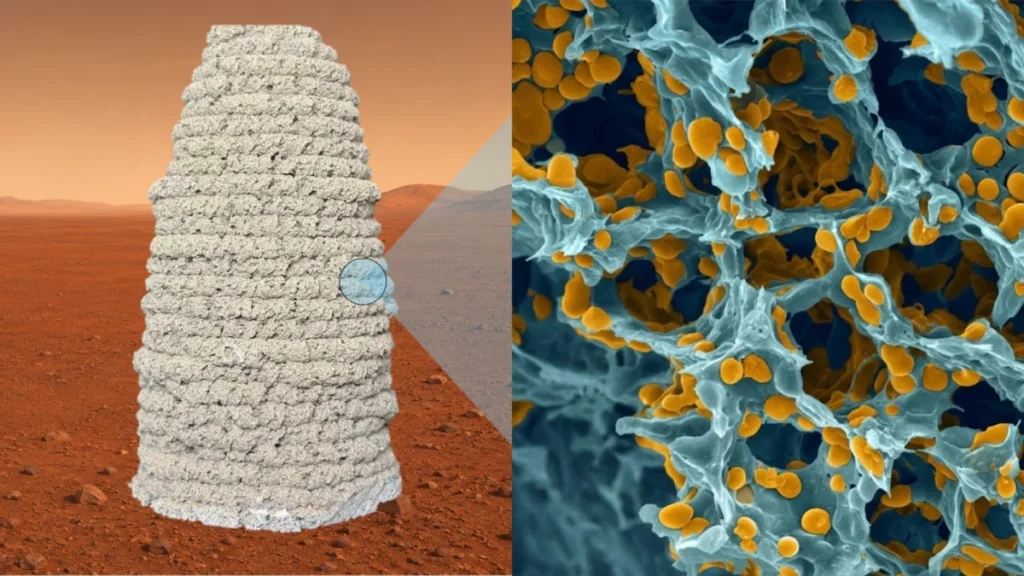
The pursuit of permanent human habitation on Mars has long been encumbered by one fundamental law of interplanetary logistics: hauling heavy construction equipment and raw materials from Earth is economically and logistically prohibitive. As space agencies and private aerospace contractors eye the Red Planet for crewed missions in the coming decades, the imperative to "live off the land" has shifted from a theoretical exercise to an urgent engineering hurdle. Addressing this challenge, a team of researchers at The Hong Kong University of Science and Technology (HKUST) has unveiled a breakthrough method for 3D-printing sturdy, lightweight, and recyclable living building materials directly suited for the harsh environmental realities of Mars.
Published in the journal Chem Circularity, the new research demonstrates that a combination of everyday gelatin, sand, and laboratory-engineered yeast can be extruded and solidified under simulated Martian conditions. By mimicking the principles of terrestrial freeze-drying, the HKUST team has proposed a low-energy, highly efficient manufacturing paradigm that could allow future astronauts to construct multi-story habitats out of local regolith substitutes and biological binders.
The Hostile Architecture of Mars
Building on Earth’s neighbor is vastly more complicated than undertaking even the most ambitious terrestrial construction projects. The Martian surface presents a hostile cocktail of extreme physical challenges. The atmospheric pressure on Mars is roughly 0.01 atmospheres—essentially a near-vacuum compared to Earth. Furthermore, the planet lacks a robust magnetosphere or a thick atmosphere, leaving the surface exposed to relentless cosmic radiation and solar particle events.
Temperature fluctuations are equally punishing. The Martian surface regularly plunges to lows of -81 degrees Fahrenheit (-63 degrees Celsius) and can drop even further depending on latitude and season. In these conditions, traditional water-based concrete mixes would instantly freeze before curing, or flash-boil and evaporate due to the lack of atmospheric pressure.
Previous aerospace engineering efforts have explored various forms of in-situ resource utilization (ISRU) to create Martian and lunar habitats. Proposals have ranged from melting local basaltic rocks into interlocking bricks to mixing Martian dust with human urea and blood proteins to form makeshift biocomposites. While innovative, many of these approaches demand massive amounts of thermal or electrical energy to melt materials or maintain high-pressure curing chambers—resources that will be at an absolute premium during early exploratory missions.
The Freeze-Drying Inspiration
The breakthrough at HKUST originated from an unexpected culinary observation rather than traditional aerospace laboratories. Jishen Qiu, a civil engineer and co-author of the study, looked at how perishable fruits and foods are structurally altered during commercial freeze-drying.
"My inspiration came from freeze-dried fruits that become harder," Qiu noted in a statement detailing the research. "So I asked myself if we can take advantage of that and make some materials."
In the food preservation industry, freeze-drying—or lyophilization—involves freezing a product and subsequently reducing the surrounding pressure to allow the frozen water in the material to sublime directly from the solid phase to the gas phase, bypassing the liquid state entirely. Qiu and his research team hypothesized that this exact physical phase transition could be harnessed to solidify building materials in the near-vacuum of Mars without requiring specialized, heavy pressure vessels.
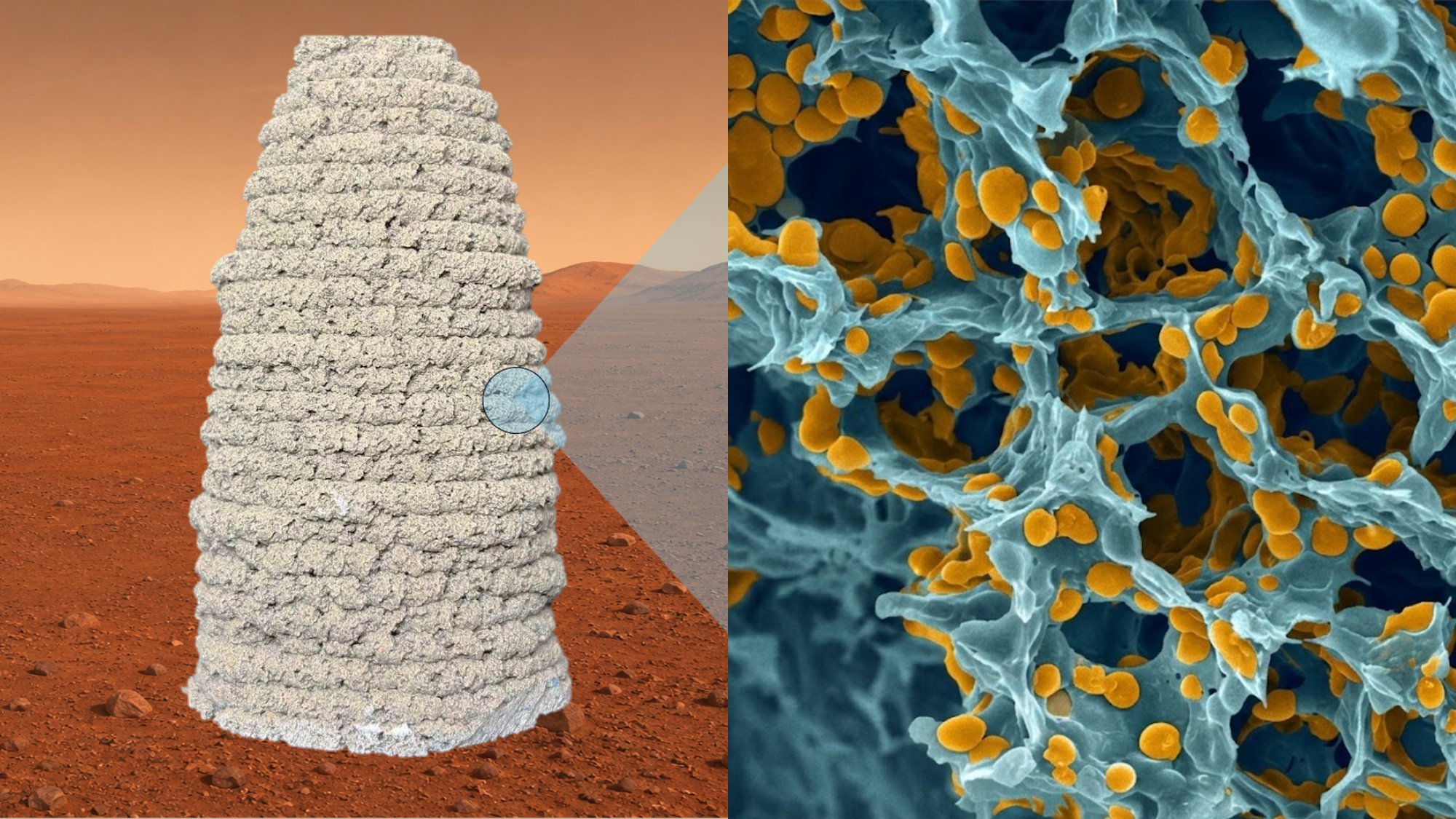
To adapt this concept for construction, the researchers formulated a specialized bio-ink composed of standard sand and an adhesive binder. Gluing disparate grains of sand together requires a resilient and flexible adhesive matrix. To achieve this, the team engineered yeast microbes capable of producing specialized adhesive proteins. These proteins closely mirror the sticky, organic tethers that marine mussels use to anchor themselves firmly to rocks amidst pounding underwater tides.
When the sand, gelatin, and engineered yeast are thoroughly mixed, the yeast cells become coated in these adhesive proteins. The resulting slurry is then loaded into a 3D printer and extruded into a chamber simulating Martian conditions: temperatures dropping to -30 degrees Celsius (-22 degrees Fahrenheit) and a low atmospheric pressure of 0.01 atmospheres.
As the bio-ink is extruded, the water within the mixture instantly freezes and sublimates. This rapid transition leaves behind a highly porous, foam-like solid matrix that is both remarkably light and structurally sound.
Chronology of Development and Testing
The development of the HKUST living building material represents the culmination of systematic biomaterials research spanning several years, moving from molecular biology concepts to physical prototyping:
- Phase I: Molecular Engineering: Researchers isolated and modified specific yeast strains to optimize the secretion of mussel-mimetic adhesive proteins, ensuring high yield and strong binding affinity when combined with organic gelatin matrices.
- Phase II: Rheological Testing: The team formulated various ratios of sand, gelatin, and yeast-based bio-ink to ensure the mixture could pass smoothly through standard 3D-printer nozzles without clogging, while retaining its shape immediately post-extrusion.
- Phase III: Environmental Chamber Simulation: Prototypes were extruded inside specialized vacuum and thermal chambers designed to replicate the atmospheric pressure, gas composition, and extreme cold of the Martian surface.
- Phase IV: Structural Analysis: Initial test structures—currently scaled down to the size of a wine cork—were subjected to rigorous compressive strength testing to evaluate their load-bearing capabilities.
Despite their diminutive size, the prototype domes exhibited a compressive strength comparable to low-grade terrestrial concrete. Because Earth’s gravitational pull is roughly three times stronger than that of Mars, structural integrity requirements are far more forgiving on the Red Planet.
"This is actually strong enough to build a one- or two-story building on Earth," Qiu explained, highlighting the mechanical advantages of the material. "So, you can probably easily build a multistory building on Mars with the material."
Advantages Over Traditional ISRU Methods
The HKUST approach offers several critical advantages over conventional space-construction paradigms, particularly regarding energy efficiency and material lifecycle management.
Traditional 3D-printing systems designed for space often rely on sintering—using high-powered lasers or concentrated solar heat to melt regolith into solid ceramic blocks. Sintering processes are notoriously energy-intensive, requiring vast electrical grids or dedicated nuclear reactors to generate the necessary thermal output. By contrast, the HKUST freeze-drying method relies on ambient environmental conditions. The extreme cold and low pressure of the Martian exterior do the heavy lifting of solidifying the material, drastically reducing the required energy footprint.
Furthermore, the inclusion of living yeast introduces a biological safety net and a pathway toward circular material usage. Traditional concrete or sintered rock is largely static and difficult to repair if fractured. However, biological materials possess self-healing potential.
"As long as there’s one yeast that’s still alive, you can grow them again," Qiu pointed out.
If a structural component suffers minor cracking or degradation from micrometeorite impacts or thermal stress, the living yeast components could theoretically be rehydrated and fed with simple nutrient solutions to propagate and repair the adhesive matrix from within. Additionally, because the binder is organic, old or decommissioned structures could potentially be melted down, recycled, or repurposed rather than left as permanent industrial waste on an pristine planetary body.
Challenges and Future Horizons
Despite the promising laboratory results, the research team is quick to emphasize that significant hurdles remain before this technology can be deployed on interplanetary missions.
The most prominent question is whether engineered yeast strains can survive the multi-faceted hazards of the Martian environment over extended periods. While the freeze-drying process preserves the material during fabrication, the surface of Mars is continually bathed in ionizing radiation and ultraviolet light that can rapidly degrade organic macromolecules and damage cellular DNA. Future iterations of the research will need to test the biological resilience of the yeast under simulated cosmic radiation fluxes and determine what depth of shielding is required to protect the living components within thicker wall structures.
Additionally, scaling up the technology from wine-cork-sized prototypes to full-scale architectural components will require the development of large-scale, automated 3D-printing rovers capable of operating autonomously in remote, dusty environments.
As space agencies continue to refine their architectures for human exploration, innovations like the HKUST living building material illustrate the growing convergence of biotechnology and aerospace engineering. By turning physical environmental constraints—such as extreme cold and low atmospheric pressure—into manufacturing assets, researchers are moving closer to making sustainable, self-repairing Martian colonies a tangible reality.