


The landscape of global commerce and technological innovation is shifting at an unprecedented velocity, bringing to our school doors a new generation of early learners equipped with complex, multifaceted needs and expectations. These young students are destined to navigate an adulthood defined by continuous disruption, emerging artificial intelligence paradigms, and volatile, multi-directional career paths. Unlike previous generations whose success was largely anchored in the accumulation of static knowledge, tomorrow’s workforce will rely on an entirely different cognitive toolkit. They must master the ability to synthesize disparate information streams, pivot with agility, and sustain a lifelong trajectory of continuous learning. Ultimately, their long-term viability will hinge not on what they memorize, but on their innate capacity to maintain relentless curiosity, bounce back from setbacks, exercise creative problem-solving, and adapt fluidly to perpetual uncertainty.
Despite this profound evolution in workforce demands, public and institutional funding structures continue to lag behind. Educational systems routinely attempt to serve this new breed of dynamic learners within physical and architectural spaces engineered for an obsolete, industrial-era model of schooling. The disparity between required investment and actual capital allocation has reached a critical juncture. If educational stakeholders and policymakers are genuinely committed to preparing students for an unpredictable tomorrow, a comprehensive overhaul of the physical and pedagogical environments where foundational learning takes place is no longer optional—it is an absolute imperative.
The Architectural Mismatch in Early Childhood Education
To understand the urgency of this educational transformation, one must first examine how young children organically process the world. Early learners do not sit quietly at individual desks absorbing passive lectures; rather, they learn dynamically through physical movement, tactile exploration, imaginative roleplay, and active social engagement. Every waking moment serves as an experiential laboratory for discovery. A casual negotiation over shared building blocks becomes an intensive masterclass in conflict resolution and communication. Constructing an unstable tower teaches applied physics and spatial reasoning. Outdoor recess functions as an unscripted curriculum in physical collaboration, risk assessment, and emotional resilience.
During early childhood, cognitive, social, emotional, and physical development do not occur in isolated silos; they happen simultaneously and interdependently. Consequently, the physical environment itself functions as an active, silent participant in the educational process. Yet, public policy and district planning have historically relegated early childhood education to scaled-down versions of traditional elementary school classrooms. Frequently, pre-K and kindergarten programs are shoehorned into retrofitted, leftover spaces that prioritize administrative convenience, spatial efficiency, and standardized testing logistics over rich, tactile developmental experiences.
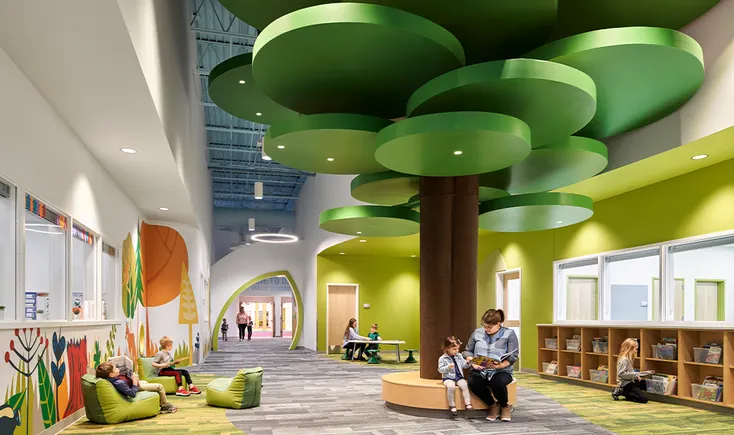
In stark contrast, purpose-built early learning environments are meticulously engineered around the distinct sensory and psychological ways young children experience reality. In these progressive spaces, classrooms transform into living ecosystems of discovery. They intentionally integrate dedicated zones for imaginative play, multi-sensory exploration, collaborative storytelling, hands-on making, gross-motor movement, and quiet emotional reflection. Furniture, fixtures, child-sized makerspaces, and ergonomic learning tools are dimensioned precisely to the physical scale of the child. This deliberate scaling fosters a profound sense of personal autonomy, confidence, and independence as students independently navigate their surroundings. Furthermore, seamless architectural integration with nature, outdoor learning pavilions, and age-appropriate play landscapes actively support neurological development while cultivating an enduring fascination with the natural world.
When educational architecture is intentionally calibrated to be welcoming, cognitively stimulating, and developmentally appropriate, young learners experience a psychological safety net. They feel secure enough to explore uncharted concepts, comfortable enough to experience true belonging, and confident enough to embrace academic challenges. These formative early encounters lay down the neural pathways and emotional attitudes that dictate a person’s lifelong relationship with learning.
A Historical Retrospective: From Industrial Schoolhouses to Adaptive Ecosystems
The architectural lineage of modern schooling traces its roots directly back to the late 19th and early 20th centuries, an era engineered to supply a compliant, regimented workforce for industrial factories and assembly lines. The prevailing school design of that epoch—characterized by linear rows of stationary desks, central administrative surveillance, and heavily compartmentalized 45-minute subject periods—was explicitly optimized for mass production and standardization.
Throughout the mid-20th century, school construction booms across North America and Europe doubled down on this factory-model paradigm, prioritizing cost-per-square-foot metrics and durability over pedagogical flexibility. While progressive educators such as John Dewey and Maria Montessori long championed experiential, child-centric learning environments, their pedagogical philosophies were frequently marginalized during periods of systemic educational retrenchment, such as the post-Sputnik push for rigorous, standardized math and science drills.
It was not until the turn of the 21st century, catalyzed by the digital revolution and the transition to a knowledge-based economy, that education researchers began to systematically study the direct correlations between physical school design and cognitive output. By the 2010s, post-occupancy evaluations of modern school facilities revealed a compelling data trend: flexible, nature-integrated, and acoustically balanced spaces measurably reduced student stress hormones, lowered disciplinary infractions, and accelerated literacy acquisition among early elementary cohorts.
Despite these empirical insights, early childhood spaces remained the last frontier of institutional design reform. State and federal funding initiatives historically funneled the vast majority of capital improvement bonds toward high school science laboratories, athletics complexes, and career-technical vocational wings. Only within the past decade have forward-thinking school districts and architectural firms begun to pivot capital investment strategies toward the pre-K and kindergarten level, recognizing that retrofitting high schoolers for the modern economy is a curative approach when preventative architectural intervention at age four yields exponentially higher returns.
Cultivating Lifelong Agility Over Rigid Readiness
The ultimate benchmark of a successful early childhood education program has long been misidentified as mere kindergarten readiness—a narrow set of behavioral compliance metrics and baseline alphabet and numeral recognition. However, developmental psychologists and educational economists argue that the true objective of early learning is far more profound: the generation of a perpetual, self-sustaining cycle of wonderment, rigorous inquiry, and structural adaptability.
The contemporary workforce is experiencing a structural paradigm shift driven by exponential technological acceleration. According to consensus labor analytics, a significant percentage of the jobs that today’s kindergarteners will hold upon entering the labor market have not yet been invented. Entire industrial sectors are materializing and evaporating within single decade cycles. Twenty years ago, artificial intelligence engineering, algorithmic ethics, and renewable energy grid management were niche academic pursuits; today, AI is fundamentally restructuring virtually every white-collar and blue-collar industry worldwide. As automation and machine learning assume routine cognitive and physical labor, human uniqueness will rely exclusively on uniquely human attributes: intuition, creative synthesis, high-order empathy, and complex problem-solving.
This economic reality must directly inform architectural and pedagogical design for our youngest populations. The goal of the early learning ecosystem is not to drill children for a deterministic job function, but to construct psychological frameworks that allow them to continuously learn, unlearn, and relearn throughout an unpredictable lifespan. Supportive early learning environments intentionally reject passive consumption models in favor of open-ended exploration. They actively encourage inquiry-based methodologies, granting children the spatial and emotional autonomy to formulate hypotheses, test physical ideas, navigate failure safely, and iterate through trial and error. By embracing ambiguity and managed risk in a supportive physical setting, children develop the psychological resilience required to navigate complex global changes without paralysis.
Leading school districts that have prioritized purpose-built early learning environments report observable shifts in student engagement metrics. Administrators note that students emerging from flexible, inquiry-driven pre-K frameworks display higher levels of intrinsic motivation, exhibit superior collaborative competencies during group tasks, and demonstrate a marked willingness to tackle novel, unstructured academic challenges compared to peers from legacy, highly regimented classroom environments.
Economic Implications and Strategic Policy Analysis
From a macro-level economic perspective, the underinvestment in early childhood educational infrastructure represents a profound systemic inefficiency. Economic analyses consistently demonstrate that every dollar invested in high-quality early childhood education and supportive developmental environments yields a substantial return through reduced remedial education costs, lower rates of juvenile justice system involvement, and significantly elevated lifetime earnings potential.
Yet, capital expenditure data reveals a persistent strategic misalignment. While municipal bond measures routinely pass multi-million-dollar packages for high school stadium renovations and STEM wings, standalone, purpose-built early learning centers remain underfunded, frequently relying on volatile local property taxes or patchwork federal grant cycles. This structural oversight ignores the foundational mechanics of human neurological development. Human brain plasticity is at its absolute peak during the first five years of life, a critical window during which foundational neural connections are forged at a rate of over one million new neural connections per second.
Neglecting the physical environments in which these formative years unfold is tantamount to constructing a high-rise skyscraper on a shallow, unverified foundation. Educational economists and urban planners stress that future-proofing a community’s workforce requires treating early learning architecture with the identical strategic gravity historically reserved for higher education research universities and regional economic development zones.
Furthermore, the integration of sustainable, biophilic design principles—such as maximized natural daylighting, indoor-outdoor learning connections, non-toxic building materials, and acoustic optimization—yields measurable physiological benefits for young learners. Clinical studies indicate that exposure to natural light and views of greenery directly correlates with improved cognitive processing speeds, enhanced attention retention, and reduced cortisol levels in young children. In an era where childhood anxiety and sensory processing disorders are on the rise, the physical architecture of the school building acts as a vital therapeutic and developmental buffer.
Conclusion: Starting Where the Future Starts
As educational leaders, policymakers, and architects look toward the horizon of 21st-century schooling, the imperative is clear. The conversation surrounding future-readiness can no longer remain exclusively fixated on high school graduation rates, collegiate tracking, and post-secondary workforce development programs. While those milestones remain critical components of the educational continuum, their structural integrity is entirely dependent upon the strength of the foundation laid in early childhood.
The youngest learners currently entering our school systems are developing cognitive habits, emotional coping mechanisms, and behavioral postures that will dictate how they engage with complex challenges for the next eight decades. The specific technical skills required for tomorrow’s economy will inevitably transform, but the underlying cognitive proficiency to learn, unlearn, adapt, and grow will remain universally relevant.
If educational systems are genuinely serious about preparing students for futures that defy current prediction models, the intervention strategy must begin precisely where the future itself originates. By strategically prioritizing, funding, and purposefully designing environments for our youngest learners, communities are not merely checking off boxes for school readiness; they are making a high-yield, generational investment in lifelong human success and societal resilience.