


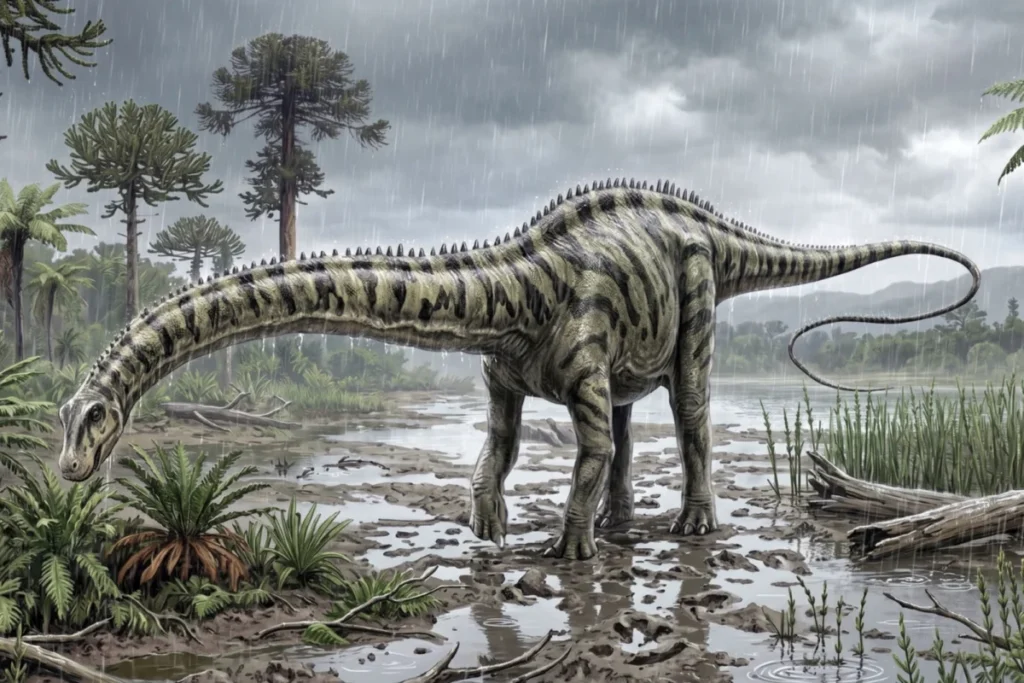
Paleontologists have uncovered the first-ever confirmed fossil evidence of a Diplodocus outside of North America, unearthing a remarkable collection of 14 well-preserved tail vertebrae and several chevron bones in the municipality of El Castellar, located within the province of Teruel, Spain. Published in the Journal of Vertebrate Paleontology, the discovery shatters a century-old paleontological consensus that these iconic, long-necked sauropods were strictly confined to the western regions of North America. This historic find not only expands the known geographic range of one of Earth’s largest prehistoric animals but also fundamentally challenges our understanding of Late Jurassic continental connectivity, migratory patterns, and intercontinental faunal exchange between ancestral landmasses.
Anatomy and Identification of the Spanish Titan
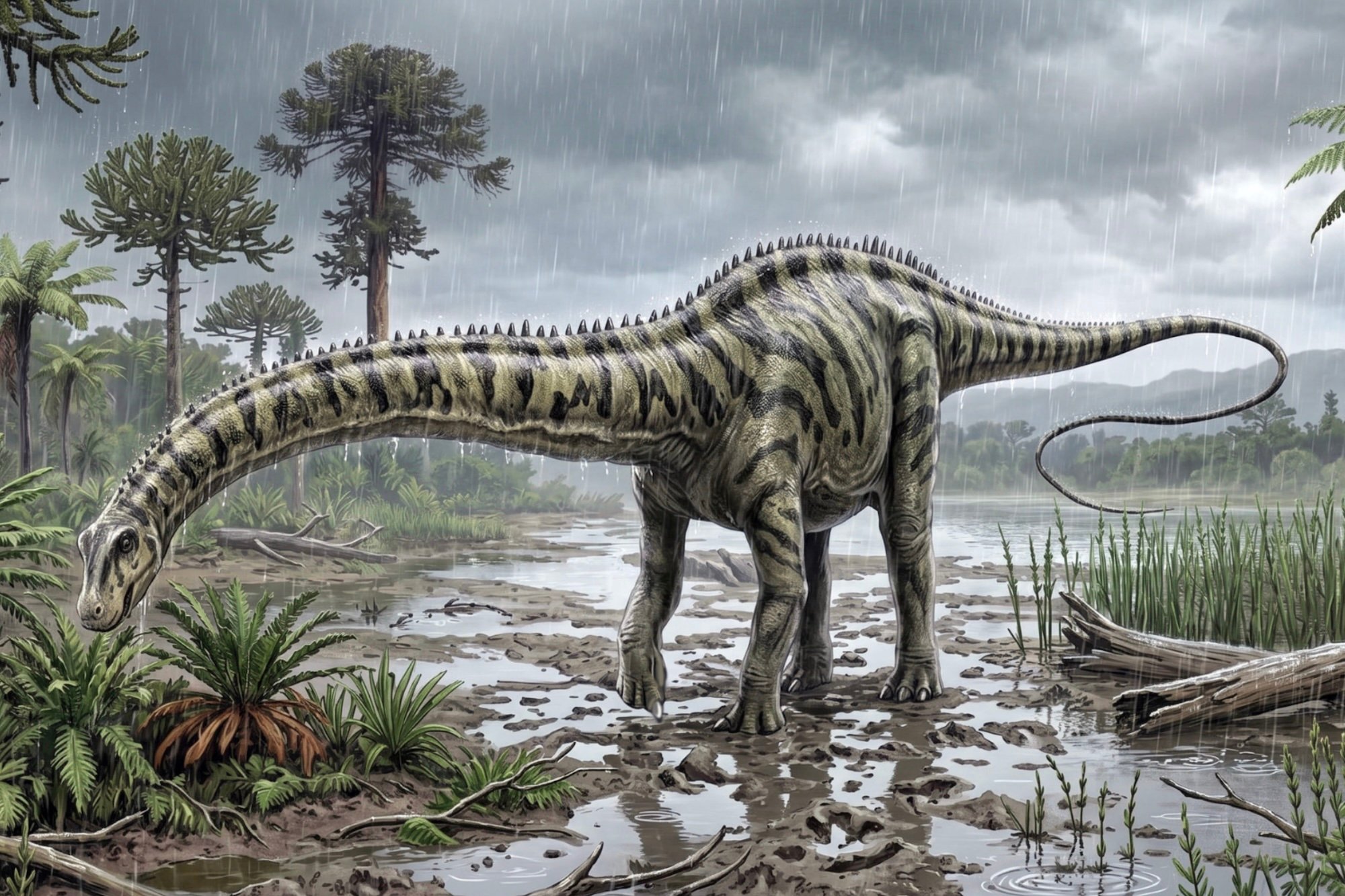
The newly described specimen belonged to a massive herbivore measuring approximately 25 meters (82 feet) in length, a scale directly comparable to its colossal North American counterparts. The excavation yielded 14 remarkably intact caudal (tail) vertebrae alongside specialized chevron bones—the V-shaped skeletal structures positioned beneath the vertebrae that protected major blood vessels and provided structural support for the creature’s immense, whip-like appendage.
To confirm the classification, an international research team led by Sergio Sánchez Fenollosa, a biodiversity and evolutionary biology graduate student at the Joint Paleontology Foundation Teruel-Dinópolis, deployed a multi-pronged scientific methodology. Researchers performed rigorous traditional comparative osteology, analyzing the minute morphological features and articular surfaces of the bones against established specimens. This anatomical work was subsequently paired with advanced phylogenetic analyses to map the evolutionary lineage of the Spanish specimen.
"As we looked more closely at the anatomy, we began to identify a combination of features characteristic of Diplodocus species," Sánchez Fenollosa explained in a statement. "Then, as we carried out different evolutionary analyses, they kept pointing in the same direction. With each new result, the picture became clearer: we were looking at a Diplodocus."
The data ultimately placed the Spanish specimen as a close taxonomic cousin of Diplodocus hallorum, one of the largest species within the genus. The fossils are now housed and publicly exhibited at the Aragon Museum of Paleontology, a premier facility located within the Dinópolis paleontological theme park and research complex in Teruel, roughly 200 miles east of Madrid.
A Century-Long Monopoly: The North American Morrison Formation
To appreciate the magnitude of the El Castellar discovery, it is essential to examine the historical baseline of Diplodocus research. First formally described and named in 1878 by pioneering paleontologist Othniel Charles Marsh during the height of the "Bone Wars," Diplodocus has long stood as a defining symbol of the Late Jurassic period, which spanned from 155 to 145 million years ago.
For nearly 150 years, every single undisputed fossil specimen belonging to the genus Diplodocus was retrieved from a single geological treasure trove: the Morrison Formation. Stretching across the western United States—with particularly dense fossil beds in states like Colorado, Wyoming, Utah, and Montana—the Morrison Formation served as the exclusive geographic stronghold for these colossal sauropods. Generations of paleontologists grew accustomed to viewing Diplodocus as a North American endemic, painting a biogeographical picture where massive sauropods were separated by vast oceanic barriers from their European and Gondwanan contemporaries.
The discovery in Teruel completely disrupts this paradigm. It proves that the ecological distribution of Diplodocus was far more cosmopolitan than previously theorized, prompting a sweeping re-evaluation of how Late Jurassic dinosaur populations traversed the globe.
Chronology of Pangea’s Breakup and Trans-Atlantic Land Bridges
The existence of a Diplodocus in what is now modern-day Spain offers vital clues about the tectonic and paleogeographic dynamics of the Earth approximately 150 million years ago. During the early Mesozoic Era, the Earth’s landmasses were united into the singular supercontinent of Pangea. However, by the Jurassic period (201.4 to 145 million years ago), tectonic forces began tearing Pangea apart, splitting it into two massive northern and southern landmasses: Laurasia and Gondwana.
As Laurasia further fractured, the nascent proto-North Atlantic Ocean began to open up, separating North America and Europe. Despite this widening oceanic gap, the geological record from the Late Jurassic indicates that the separation was not absolute or continuous. Temporary land bridges, island chains, and shallow epicontinental corridors periodically emerged due to fluctuating sea levels and tectonic uplifts.
The presence of a Diplodocus specimen in Spain dating to roughly 150 million years ago strongly suggests that these ephemeral land bridges served as active migration highways. Large, robust herbivores like Diplodocus—capable of consuming immense quantities of vegetation daily to sustain their massive bodies—likely utilized these transitory terrestrial pathways to roam freely between proto-North America and Western Europe. This continuous or semi-continuous gene flow explains how closely related, or even identical, sauropod lineages managed to establish populations on opposite sides of the developing Atlantic basin.
Insights into Iberian Mesozoic Ecosystems and Sauropod Diversity
Beyond continental-scale migration, the find provides an unprecedented window into the local paleoecology of the Iberian Peninsula during the Mesozoic Era (252 to 66 million years in duration). Spain, and the Teruel region in particular, has increasingly established itself as one of Europe’s most fertile grounds for dinosaur research.
Alberto Cobos, co-author of the study and managing director of the Joint Paleontology Foundation Teruel-Dinópolis, emphasized the broader implications of the discovery for European paleontology. "The Diplodocus from El Castellar was approximately 25 meters long, making it another of the giant sauropods of the Spanish Jurassic," Cobos noted.
Before this discovery, European Jurassic sauropod assemblages were often viewed as distinct or somewhat insular compared to the rich, well-documented ecosystems of the North American Morrison Formation. The identification of a classic North American taxon like Diplodocus in Teruel demonstrates that European ecosystems shared profound taxonomic similarities with North American biomes during the Late Jurassic. It indicates that environmental conditions, vegetation types, and ecological niches across these regions supported similar mega-herbivore adaptations.
Broader Implications and Future Research Directions
The confirmation of Diplodocus in Spain opens new avenues of inquiry for evolutionary biologists, paleogeographers, and vertebrate paleontologists alike. Researchers are now tasked with re-examining previously unclassified or fragmentary sauropod remains housed in European museums to determine if other North American genera—such as Apatosaurus, Brachiosaurus, or Allosaurus—might also be lurking unrecognized in European collections.
Furthermore, the methodology utilized by Sánchez Fenollosa and his team sets a rigorous new standard for cross-continental taxonomic identification. By combining detailed osteological comparison with robust phylogenetic modeling, modern paleontologists can more accurately navigate convergent evolution and morphological variation across geographically isolated populations.
As excavations continue in the rich sedimentary layers of the El Castellar municipality and the wider Teruel province, scientists remain hopeful that additional skeletal elements will emerge. These future finds could provide deeper insights into the specific behavioral ecology, sexual dimorphism, and precise migratory timing of these prehistoric titans. Ultimately, the unearthing of Spain’s first Diplodocus serves as a powerful reminder that the fossil record still holds monumental surprises, capable of rewriting established chapters of Earth’s deep history with the discovery of a single, well-preserved tail vertebra.