The Spanish verb decir, meaning "to say" or "to tell," occupies a central position in the Romance language’s lexicon. As one of the most frequently used verbs in daily communication, it serves as the primary instrument for reporting information, relaying messages, and facilitating social interaction. However, for learners and linguists alike, decir presents a formidable challenge. It is characterized by a high degree of irregularity that deviates significantly from standard conjugation patterns, making it a benchmark for proficiency in Spanish. According to frequency analyses of spoken Spanish, decir consistently ranks within the top twenty most utilized verbs, necessitating a rigorous understanding of its morphological variations across different tenses and moods.
Historical Context and Linguistic Evolution
The irregularities found in decir are not arbitrary; they are the result of centuries of phonetic evolution from its Latin root, dicere. As Vulgar Latin transitioned into the various Romance languages, high-frequency verbs often underwent "irregularization" due to constant use, which eroded standard endings in favor of more efficient, albeit complex, forms. In Spanish, this evolution produced a verb that behaves according to four distinct irregularity patterns: an e-to-i stem change, a g-insertion in the first-person singular, a strong j-preterite, and a syncopated future stem.
This evolution is a classic example of linguistic streamlining. While it creates a hurdle for contemporary students, these forms emerged to simplify the act of speaking for native populations over hundreds of years. The persistence of these forms in modern Spanish—despite the language’s general tendency toward regularization—underscores the verb’s indispensable role in the structure of the language.
A Chronology of Usage: From Present to Future
To understand the scope of decir, one must categorize its usage into standard chronological frameworks. The indicative mood serves as the baseline for objective communication, encompassing five primary tenses.
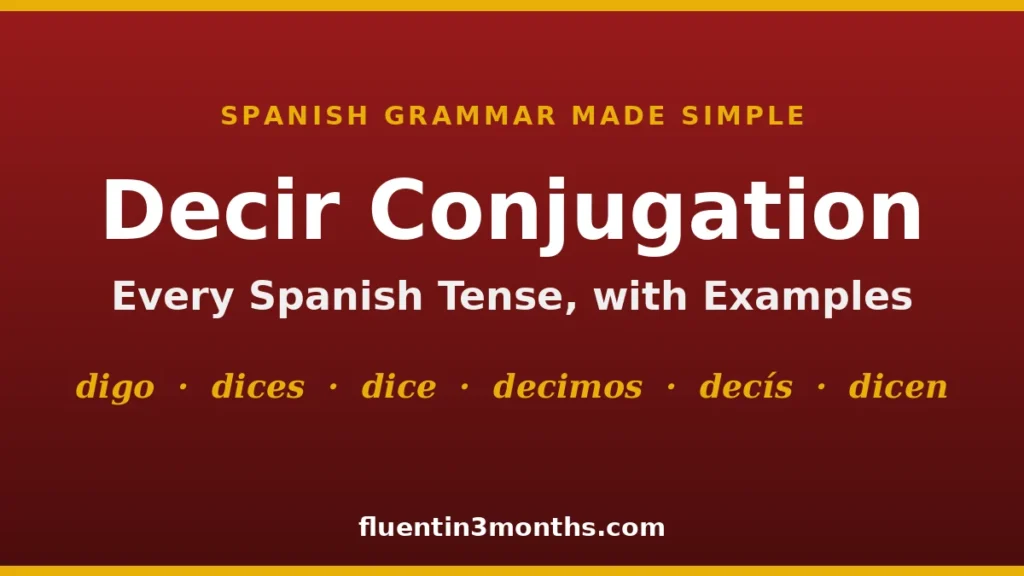
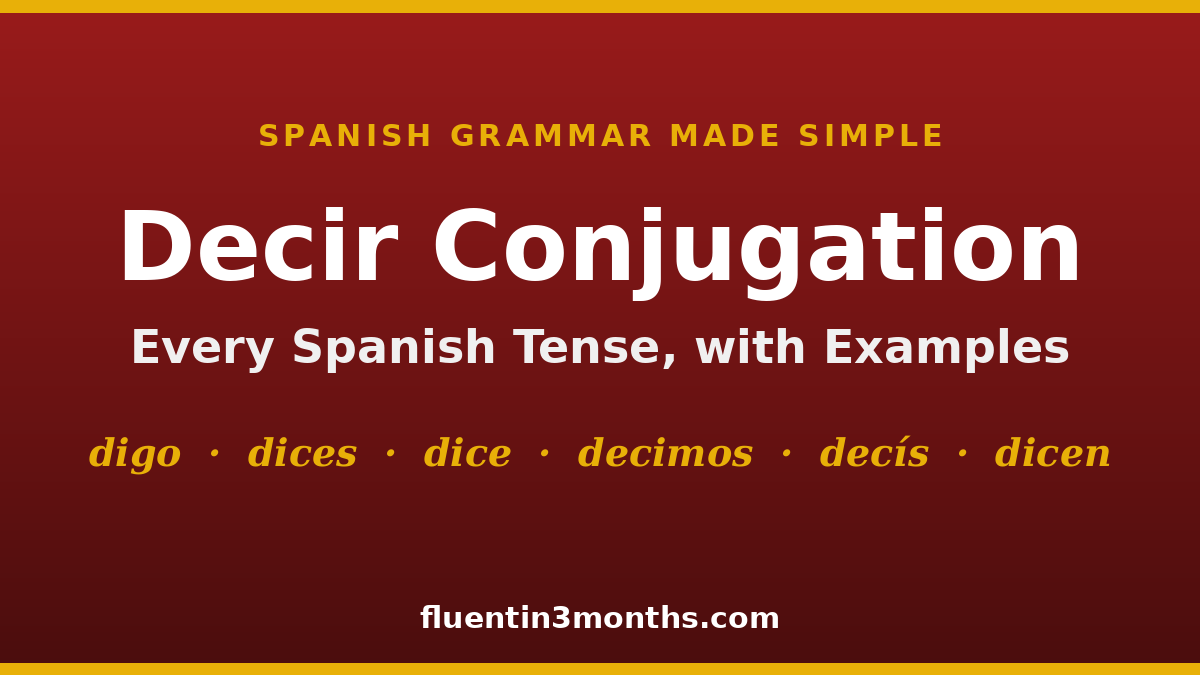
The present tense is the most immediate point of entry. The conjugation—digo, dices, dice, decimos, decís, dicen—is essential for real-time reporting. Linguists note that mastering these six forms is the single most effective way for a beginner to achieve conversational utility.
The past tense, however, requires a more nuanced approach. Spanish distinguishes between the preterite (the "preterite of completed action") and the imperfect (the "past of ongoing or habitual action"). The preterite of decir is highly irregular (dije, dijiste, dijo, dijimos, dijisteis, dijeron), reflecting its high-frequency status, whereas the imperfect remains regular (decía, decías, decía, decíamos, decíais, decían). This dichotomy is a critical marker of advanced fluency; misuse of these two tenses can significantly alter the temporal perception of a reported event.
Finally, the future and conditional tenses utilize a syncopated stem, dir-, rather than the full infinitive decir-. Forms such as diré and diría represent a departure from the standard addition of suffixes to the full infinitive, a feature shared by other high-frequency irregular verbs like hacer (to do/make).
Data and Frequency in Professional Communication
Quantitative analysis of Spanish language corpora suggests that decir is rarely used in isolation. It is frequently paired with the subordinating conjunction que. Data indicates that in over 85% of cases where decir is used to report a statement, it is followed immediately by que. Unlike English, where the word "that" can often be omitted ("He said he was tired" vs. "He said that he was tired"), Spanish almost universally requires the inclusion of que ("Dijo que estaba cansado"). Failing to include this particle is a common error among English-speaking learners that can lead to confusion in professional or formal settings.
Furthermore, a comparison between decir, hablar (to speak/talk), and contar (to tell a story/narrate) is essential for accurate communication. While decir is transactional—conveying a specific piece of information or a quote—hablar is process-oriented, focusing on the act of vocalizing language. Contar serves a narrative function, used when relaying a sequence of events, secrets, or jokes. Misplacing these verbs is a frequent source of ambiguity in translation and international business correspondence.
The Role of the Subjunctive Mood
Beyond the factual nature of the indicative, the subjunctive mood—the "mood of doubt and emotion"—is where the complexity of decir truly manifests. The present subjunctive (diga, digas, diga, digamos, digáis, digan) and the imperfect subjunctive (dijera/dijese) are vital for expressing commands, desires, or hypothetical scenarios.
The usage of the imperfect subjunctive, in particular, demonstrates the regional variation of the Spanish language. The -ra form (e.g., dijera) is overwhelmingly dominant in Latin American Spanish, while the -se form (e.g., dijese) maintains a stronger presence in formal European Spanish writing. Both are grammatically correct and interchangeable, but local context determines which is more "natural" to a native speaker.
Implications for Language Acquisition
The pedagogical challenge of decir has led to various schools of thought on language acquisition. Traditional curricula often insist on rote memorization of every possible conjugation table, including rare forms like the future subjunctive (dijere), which has largely fallen out of common use, surviving primarily in legal or archaic literary contexts.
However, modern communicative language teaching (CLT) advocates for a more surgical approach. By focusing on the "high-frequency pillars"—specifically the present indicative, the preterite, and the tú command form (di)—learners can achieve functional proficiency much faster. The inclusion of the irregular di command is a key milestone, as it is one of the shortest yet most essential imperative forms in the language.
Strategic Recommendations for Proficiency
Experts in linguistics suggest that the most effective way to internalize the irregularities of decir is through contextual immersion rather than isolated table-drilling. By utilizing spaced-repetition systems (SRS) to track these specific conjugations, learners can move the verb from short-term memory to long-term cognitive automation.
Moreover, the integration of decir into daily practice—specifically through the reporting of past events—helps solidify the "strong j" stem of the preterite. When learners begin to narrate their day using dije ("I said") or me dijo ("He/she told me"), they move beyond academic knowledge into true linguistic competence.
Broader Linguistic Impact
The study of decir is more than a grammar exercise; it is an examination of the mechanics of human communication. Because it serves as the bridge between thought and expression, its irregularity is a testament to the language’s history. It is a verb that demands attention, respect, and consistent application.
For professional interpreters and translators, the mastery of decir is non-negotiable. Whether drafting a legal document, conducting a medical interview, or facilitating a diplomatic dialogue, the correct application of its tenses ensures clarity, intent, and authority. As the global reach of the Spanish language continues to expand, the necessity of understanding the fundamental pillars of its verbal structure remains as vital today as it was centuries ago.
Ultimately, while the irregular nature of decir may appear intimidating at first glance, it provides a structured window into the logic of Spanish. By acknowledging the patterns, understanding the historical necessity of its irregularities, and focusing on the high-frequency forms, any learner can transform this linguistic hurdle into a cornerstone of their fluency. The ability to correctly "say" and "tell"—to properly employ decir—is, in many ways, the final step in moving from a student of the language to a fluent practitioner.