



Early last year, Ontario Premier Doug Ford appeared at a first ministers’ meeting wearing a navy baseball cap emblazoned with the phrase Canada is not for sale. At the time, the accessory was viewed as a piece of political theater, a plain-language retort to the mounting pressures of cross-border trade negotiations. Yet, eighteen months later, the sentiment has evolved from a rhetorical flourish into a defining challenge for the Canadian state. As Prime Minister Mark Carney recently stepped away from a high-stakes trade agreement with the United States—concluding that the proposed terms would fundamentally erode the nation’s sovereignty—the question of what it means to be an independent actor in a volatile global economy has moved from the boardroom to the public square.
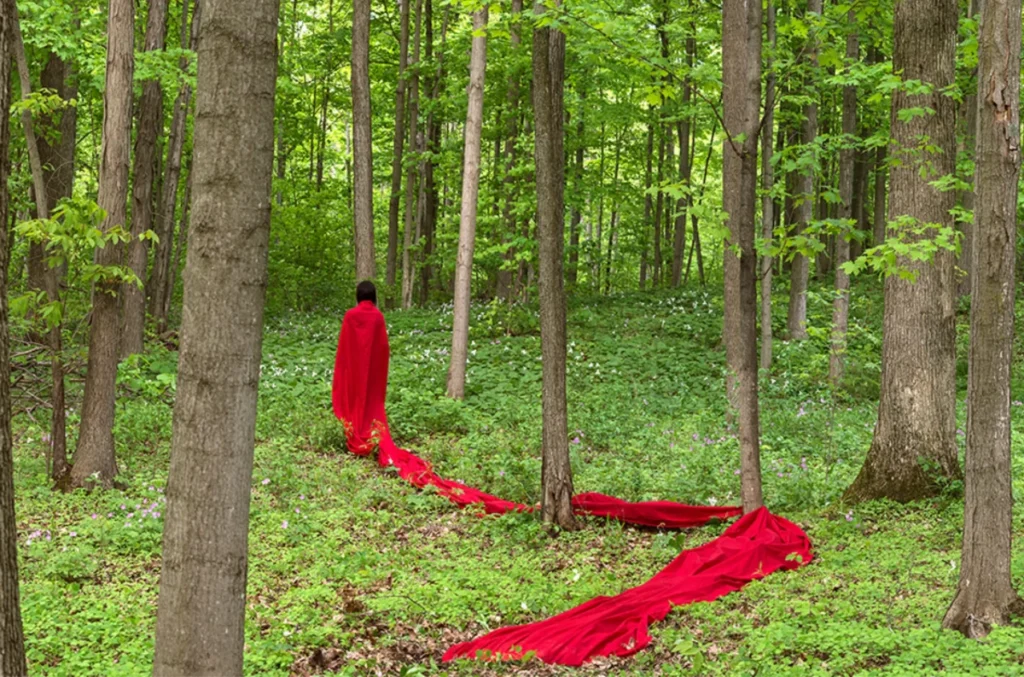
This shift in national mood provides the backdrop for a significant cultural intervention currently taking place in South Korea. OCAD University is presenting an exhibition titled Skennenkowa ken (Do You Carry Great Peace?) at the Canada Pavilion during the Gwangju Biennale. Featuring the work of three Kanien’kehaka artists and OCAD U alumni—Shelley Niro, Melissa General, and Hannah Claus—the exhibition offers a meditation on sovereignty that is both timely and historically grounded. By centering the Haudenosaunee Great Law of Peace, the exhibition invites a global audience to consider whether national strength is measured solely by economic leverage or by the ethical foundations upon which a society stands.
A Chronology of Sovereignty and Challenge
The discourse surrounding Canadian sovereignty has intensified significantly since 2023. The timeline of these events suggests a pattern of increasing friction between domestic priorities and international trade mandates:
- Early 2023: Premier Doug Ford’s symbolic declaration via the "Canada is not for sale" cap signals a hardening of provincial attitudes toward external interference in domestic markets.
- Late 2023: Negotiations regarding critical mineral supply chains and automotive manufacturing standards reach a stalemate, highlighting the fragility of Canada’s economic reliance on the United States.
- Mid-2024: Prime Minister Mark Carney formally withdraws from a proposed trade framework, citing concerns over the long-term impact on Canadian industrial autonomy.
- September 2024: The Gwangju Biennale opens, providing a platform for the OCAD U-led exhibition, which contrasts Western state-centric views of power with the Haudenosaunee philosophy of "good mind" governance.
Philosophical Foundations: The Great Law of Peace
At the heart of the exhibition is the Kaianere’kowa, the living constitution of the Haudenosaunee Confederacy. The title, Skennenkowa ken, translates to a daily greeting: "Do you carry great peace?" This is not a passive state of existence but an active, daily practice. Within the Haudenosaunee tradition, peace is a renewable resource, requiring constant maintenance through ethical decision-making, collective responsibility, and an awareness of the "seventh generation"—the impact of today’s choices on those yet to be born.
For the three featured artists, this philosophy is not a historical artifact but a lens through which to view current crises. Shelley Niro, Melissa General, and Hannah Claus utilize mediums ranging from photography to installation to address themes of land reclamation, language retention, and the central role of women in governance. Their work serves as a reminder that sovereignty is not merely a legal status recognized by the United Nations; it is a lived practice defined by one’s relationship to the environment and the community.
Economic Implications and Political Fault Lines
The withdrawal from recent trade agreements brings to the fore the reality of economic vulnerability. According to Statistics Canada, the United States remains Canada’s largest trading partner, accounting for approximately 75% of all Canadian exports. The decision to reject trade terms that threaten sovereignty is, by definition, a risk-mitigation strategy that carries significant short-term costs.
Analysts point to several potential "fault lines" that could emerge as the federal government navigates this new policy of resistance:

- Sectoral Vulnerability: Export-heavy sectors, particularly the automotive and energy industries, may face immediate supply chain disruptions.
- Regional Disparity: The economic impact of trade recalibration is rarely uniform. Central Canada, with its manufacturing base, may absorb different pressures than the resource-rich regions of the West.
- Fiscal Burden: Government spending will be tested as policymakers determine which industries require subsidies or transition support to weather the period of renegotiation.
The danger, as experts note, is that these internal pressures can lead to a fragmented national discourse. The exhibition at the Gwangju Biennale posits that the remedy for this fragmentation is a return to a "good mind"—the ability to maintain clarity and collective focus even when the economic climate is hostile.
The Role of Cultural Institutions
The presentation of this exhibition at the Gwangju Biennale is a deliberate choice. Gwangju, often referred to as the "cradle of Korean democracy," is defined by its history of resistance against authoritarianism during the 1980 Democratic Uprising. By placing Indigenous perspectives on sovereignty within this context, the organizers bridge the gap between local struggles for self-determination and the global discourse on human rights.
For OCAD University, the exhibition is a milestone in its 150th year. Founded in 1876, the institution has spent much of its history reflecting the Eurocentric educational paradigms of the Victorian era. The transition to an Indigenous-led exhibition that draws on a political tradition significantly older than the university itself represents a departure from traditional institutional narratives. It signals a move toward a more pluralistic definition of Canadian knowledge and cultural authority.
Official Responses and Institutional Perspectives
While the federal government has remained focused on the mechanics of trade policy, academic and cultural institutions have increasingly emphasized the importance of the cultural dimensions of sovereignty. Ana Serrano, President and Vice-Chancellor of OCAD University, and Ryan Rice, curator of the exhibition and Executive Director of Indigenous Art at Onsite Gallery, have framed the project as a necessary evolution of the Canadian identity.
"Sovereignty is not exhausted by the ability to decide," the curators noted in their project statement. "It lives in how power is used, especially over time and under pressure." This sentiment suggests that the state’s reaction to the current trade crisis is a litmus test for the country’s character. Can Canada assert its independence while maintaining the internal cohesion required to support its most vulnerable populations?
Broader Impact: A Call for Long-Horizon Thinking
The integration of Indigenous philosophies into the national conversation about sovereignty provides a vital contrast to the short-term, quarterly-results mindset of modern politics. As Canada faces the realities of an increasingly protectionist global environment, the lesson of the Skennenkowa—that true power lies in the health and continuity of the collective—takes on a practical, policy-oriented relevance.
The exhibition at the Gwangju Biennale challenges viewers to look beyond the immediate "crisis of the day." Whether through the lens of land rights or the stewardship of resources, the participating artists argue that a nation’s sovereignty is only as strong as its commitment to its own ethical, social, and cultural integrity.
As the federal government continues to navigate the complexities of international trade, the exhibition serves as a poignant reminder that the defense of a nation is not limited to the negotiating table. It is found in the decisions made in times of stress, the protection of the land, and the ability to act with a clarity that transcends the immediate political horizon. Ultimately, if Canada is to prove that it is "not for sale," it must demonstrate that it is, instead, anchored in principles that cannot be traded away.