



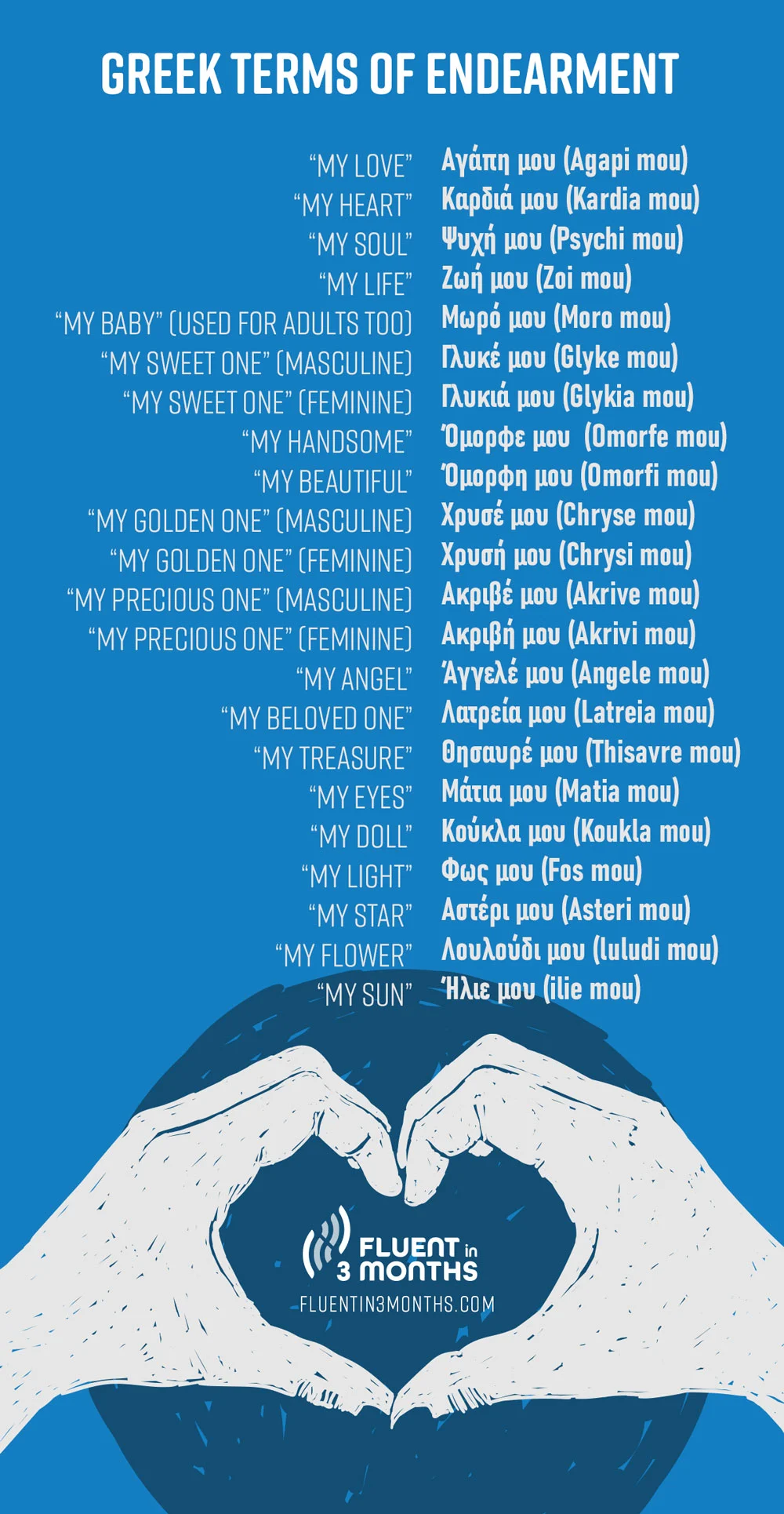
The Greek language, characterized by a continuous history spanning over 3,400 years, remains one of the most influential linguistic frameworks in Western civilization. Beyond its contributions to science, philosophy, and governance, the Hellenic tongue possesses a sophisticated system of endearments that reflect the deeply communal and emotive nature of Greek and Cypriot societies. In contemporary interpersonal relations, the use of terms such as "agapi mou" (my love) or "kardia mou" (my heart) serves as more than a mere greeting; these expressions function as vital social markers that reinforce familial bonds, romantic intimacy, and platonic solidarity. As global interest in the Greek language increases—fueled by tourism, the Greek diaspora, and digital language-learning platforms—understanding the nuances of these affectionate terms has become a point of focus for both linguists and cultural historians.
The historical trajectory of Greek affection can be traced back to the Classical period, where the distinction between various forms of love was first codified by philosophers. Unlike the singular English word "love," Ancient Greek identified at least eight distinct emotional states: Eros (romantic passion), Philia (deep friendship), Storge (familial affection), Agape (unconditional love), Ludus (playful love), Pragma (enduring commitment), Philautia (self-love), and Mania (obsessive love). This philosophical foundation continues to influence modern Greek speech patterns. While the Koine and Modern Greek periods have simplified some grammatical structures, the emotional precision remains. For example, the modern term "agapi mou" is a direct linguistic descendant of "agape," signifying a devotion that transcends mere physical attraction.
In the structural analysis of Modern Greek endearments, the possessive pronoun "mou" (my) plays a pivotal role. Linguistically, "mou" is an enclitic personal pronoun in the genitive case. When appended to a noun, it transforms a general concept into an intimate possession. A significant grammatical rule in Greek syntax dictates that "mou" must follow the noun it modifies. Consequently, "agapi mou" is the standard form, whereas "mou agapi" would be grammatically incorrect in an informal context. This placement emphasizes the object of affection before the possessor, a subtle linguistic nuance that reinforces the importance of the individual being addressed.
Supporting data from linguistic surveys indicates that the Greek diaspora, which includes approximately 7 million people worldwide, plays a significant role in the preservation and dissemination of these terms. In major Hellenic hubs such as Melbourne, New York, and London, endearments act as a linguistic "cultural glue." Sociolinguistic studies conducted among second and third-generation Greek immigrants reveal that even when fluency in the Greek language declines, terms of endearment are often the last linguistic elements to be abandoned. This phenomenon suggests that these words carry a heavy emotional and cultural weight that transcends basic communication.

The application of these terms is categorized by the nature of the relationship. In romantic contexts, Greek speakers utilize a variety of metaphors drawn from nature and anatomy. "Kardia mou" (my heart) and "Psychi mou" (my soul) are among the most frequently documented. The use of "Moro mou" (my baby) is particularly notable, as it is applied to adults within romantic partnerships, signifying a protective and nurturing intimacy. Furthermore, gender-specific adjectives such as "Glyke mou" (my sweet – masculine) and "Glykia mou" (my sweet – feminine) demonstrate the gender-inflected nature of the Greek language, where the ending of the adjective must agree with the gender of the person addressed.
Within the family unit—the cornerstone of Greek social structure—endearments are ubiquitous. The transition from formal titles to diminutive forms marks a shift in emotional proximity. For instance, while "mitera" is the formal word for mother, "manoula" (mommy) is the standard affectionate variant. Similarly, "pateras" (father) becomes "mampaka" (daddy). The integration of "mou" in these contexts—such as "gioka mou" (my little son) or "kori mou" (my daughter)—is not merely an indicator of biological relation but an expression of "storge," the instinctual love between parents and children. Observations from social workers and sociologists in Greece indicate that these verbal affirmations of affection are instrumental in maintaining the high levels of intergenerational cohesion characteristic of Mediterranean cultures.
Friendships in Greece and Cyprus are also defined by a high degree of verbal warmth. It is common for friends to address one another as "file mou" (my friend) or "filenada mou" (my female friend). In more casual or youthful settings, the term "koukla mou" (my doll) is frequently used among women, regardless of physical appearance, as a generic term of sisterhood or friendliness. These interactions highlight the "ludus" or playful aspect of Greek social life, where language is used to bridge the gap between acquaintances and intimates.
A unique feature of the Greek language is the use of diminutive suffixes to create endearing nicknames. This morphological process involves adding endings such as -aki, -itsa, -oulis, or -oula to a proper name or noun. For example, the name "Yiorgos" (George) becomes "Yiorgaki," and "Maria" becomes "Marioula." These suffixes serve to "soften" the name, conveying a sense of cuteness or smallness that implies affection. Interestingly, this practice extends to inanimate objects as well; a "spiti" (house) becomes a "spitaki" (cozy little house), reflecting a cultural tendency to view the world through a lens of personal connection and warmth.
From a broader perspective, the global interest in Greek endearments is reflected in the metrics of language-learning applications. Duolingo reported a significant surge in users studying Greek following the global pandemic, with many learners citing a desire to connect with heritage or prepare for travel to the Aegean. Educational experts suggest that the "emotional vocabulary" of a language is often what attracts learners most, as it allows for a deeper level of human connection than standard transactional phrases.
The implications of these linguistic habits extend into the realm of psychology. Psychologists specializing in cross-cultural communication note that the frequent use of endearments in Greek culture can lead to a "high-context" social environment. In such environments, the emotional tone of a conversation is often as important as the literal meaning of the words. For an outsider, the intensity of Greek endearments might seem overwhelming, but within the culture, it provides a sense of security and belonging.
Official responses from cultural institutions, such as the Center for the Greek Language (CGL), emphasize the importance of maintaining the integrity of these expressions. In various white papers, the CGL has noted that while the Greek language is evolving—incorporating English loanwords and digital slang—the core "language of the heart" remains remarkably stable. This stability is viewed as a testament to the enduring nature of Greek social values, which prioritize family and community above individualistic pursuits.
In summary, the use of endearments in the Greek language is a sophisticated cultural practice that bridges the gap between ancient philosophy and modern social dynamics. Whether through the use of the possessive "mou," the application of diminutive suffixes, or the selection of metaphors like "eyes," "stars," and "treasure," Greek speakers utilize a rich palette of linguistic tools to express affection. These terms are not merely "cute" additions to speech; they are the verbal manifestations of a cultural heritage that values emotional transparency and communal strength. As the Greek language continues to be spoken by millions around the globe, these terms of endearment remain a vital link to a history and a way of life that celebrates the human capacity for love in all its forms. The continued study and usage of these terms ensure that the "philoxenia" (hospitality/love of strangers) and "philotimo" (honor/love of honor) that define the Hellenic spirit will persist for generations to come.