

The integration of artificial intelligence into academic environments has long been characterized by a fundamental tension between technological capability and pedagogical integrity. Since the mainstream proliferation of generative AI models, students have rapidly adopted digital tools to assist with coursework, research, and exam preparation. However, the vast majority of these platforms were engineered for general-purpose productivity rather than academic instruction. Prioritizing speed, brevity, and direct output delivery, conventional chatbots frequently function as mere "answer bots," bypassing the cognitive friction essential to true learning.
This dynamic has left educational institutions in a difficult position. School districts, university administrators, and faculty members have responded to the proliferation of unvetted AI tools with reactive measures, ranging from strict usage bans and network-level blocking to the implementation of honor codes that fail to address the underlying reality: students continue to utilize AI outside the classroom. Without a purpose-built educational environment, institutions have faced a crisis of trust, unable to reconcile the potential benefits of generative technology with the undeniable risk of academic shortcutting.
To bridge this gap, Microsoft Corporation has officially rolled out the Study and Learn Agent, a first-party artificial intelligence capability integrated directly into Microsoft 365 Copilot. Generally available at no additional cost to existing Microsoft 365 Education customers, the platform is explicitly engineered for students aged 13 and older. Rather than functioning as a shortcut generator, the Study and Learn Agent is built around a single, foundational pedagogical principle: the learner must do the thinking. By utilizing guided conversational frameworks and interactive study modalities, the tool seeks to transform generative AI from a passive answer dispenser into an active, personalized digital coach.
The deployment of the Study and Learn Agent arrives at a critical juncture in educational technology. Over the past three years, ed-tech analysts and cognitive scientists have tracked an escalating reliance on automated solutions among secondary and tertiary students. Data compiled by educational research groups indicates that upwards of 70 percent of high school and university students regularly utilize some form of generative AI for homework assistance. Yet, surveys of educators reveal widespread concern that unrestricted AI access degrades critical thinking, writing proficiency, and long-term knowledge retention.

Recognizing these systemic challenges, Microsoft’s education division developed the Study and Learn Agent over a multi-year research and testing cycle, collaborating closely with learning scientists, classroom educators, and institutional technology leaders. The core development timeline prioritized security, administrative oversight, and pedagogical soundness above rapid commercial deployment.
In K-12 environments, the platform maintains strict administrative safeguards. Copilot Chat is disabled by default for student accounts, requiring explicit configuration and activation by an institution’s IT administrator via Microsoft Entra ID school credentials. Once permission is granted, students gain access to the Study and Learn Agent directly within the native Copilot application interface, eliminating the need for separate logins, third-party plug-ins, or supplementary software purchases. A comprehensive configuration video walkthrough has been published by Microsoft to assist district administrators in deploying the tool securely and in compliance with regional data privacy regulations.
At the heart of the Study and Learn Agent is a structural departure from standard open-ended text generation. While traditional chatbots accept a prompt and immediately output a completed essay, solved equation, or summarized text, the Study and Learn Agent is architected on established learning science principles designed to reinforce cognitive processing.
Grounded in four core research-based methodologies, the agent actively regulates its output to encourage student agency:
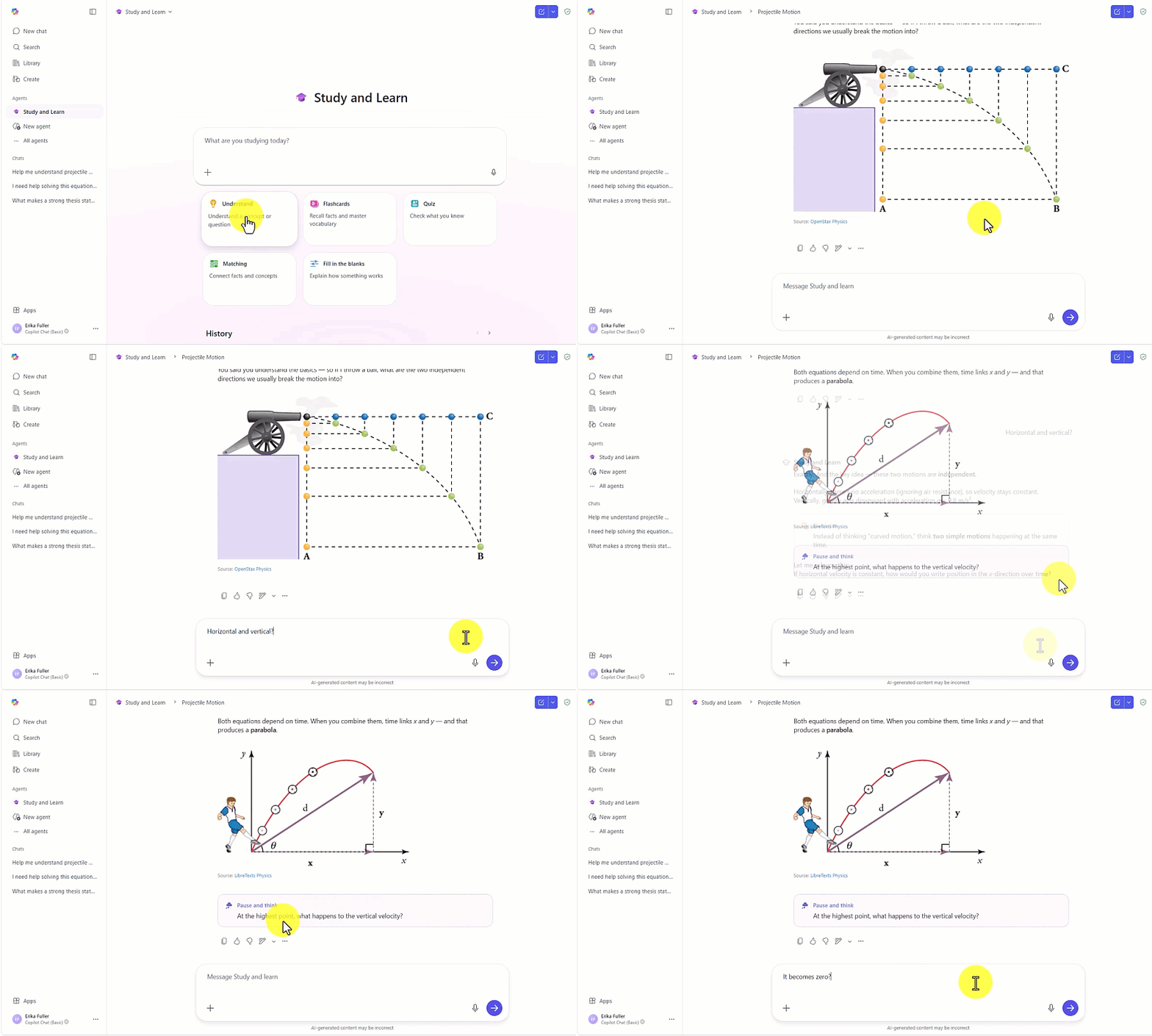
- Active Retrieval Practice: Instead of providing answers, the system prompts students to recall information from memory, generating real-time flashcards, targeted quizzes, and interactive matching exercises based on uploaded course materials.
- Scaffolding and Step-by-Step Guidance: When a student encounters a complex problem—such as a difficult calculus proof or a multi-step physics equation—the agent breaks the challenge down into manageable components, asking guiding questions that lead the student to discover the solution independently.
- Elaborative Interrogation: For writing and humanities assignments, the agent engages students in a Socratic dialogue, asking probing questions about their thesis statements, arguments, and source integration to sharpen their analytical writing skills.
- Multimedia and Conceptual Mapping: The platform integrates visual learning aids, searching for and displaying relevant diagrams, illustrations, and concept maps to help visual learners grasp abstract ideas across subjects like biology, chemistry, and history.
By shifting the operational paradigm from passive consumption to active engagement, the tool ensures that the heavy cognitive lifting remains with the student. Whether an individual is preparing for a mid-term examination, working through an intricate scientific concept, or refining a historical analysis, the agent dynamically adapts its responses to meet the student’s immediate developmental needs.

For educational leadership, school principals, and Chief Technology Officers, the adoption of new technology has historically been contingent upon institutional trust, data privacy, and administrative control. Industry analysts note that enterprise-grade security has become a non-negotiable requirement for school districts navigating federal and state privacy laws, such as the Family Educational Rights and Privacy Act (FERPA) and the Children’s Online Privacy Protection Act (COPPA).
The Study and Learn Agent addresses these institutional requirements by operating entirely within the established Microsoft 365 Education ecosystem. This integration ensures that student interactions are governed by enterprise-grade data protection, security protocols, and Microsoft’s rigorous responsible AI frameworks. Data processed within the environment is not utilized to train foundational commercial models, providing school boards with the legal and ethical assurances necessary to deploy AI at scale.
Furthermore, the introduction of the Study and Learn Agent aligns with a broader corporate strategy by Microsoft to construct a unified, education-specific AI ecosystem. Rather than offering a single, one-size-fits-all chatbot adapted from enterprise software, Microsoft has structured its educational AI offerings around the distinct roles within a school community. Alongside the Study and Learn Agent for students, the platform integrates closely with the Teach Agent, an administrative and pedagogical assistant designed to help educators draft lesson plans, differentiate instruction, and analyze classroom data.
Together, Teach and Study and Learn form a comprehensive, dual-sided AI architecture that addresses the daily workflows of both instructors and learners within a unified software interface.
Industry response to the rollout has been cautiously optimistic. Educational technology consultants have praised the platform’s focus on Socratic questioning over automated completion, noting that it provides a viable blueprint for ethical AI integration in classrooms. Teachers’ unions and academic associations, which have historically expressed skepticism toward generative technology, have similarly highlighted the value of administrative control mechanisms that empower IT departments to moderate student access safely.
However, implementation experts emphasize that technological deployment is only the first step. The long-term success of the Study and Learn Agent will depend heavily on professional development for educators and clear communication with parents regarding how the tool supports, rather than replaces, traditional instructional methods. School districts rolling out the software are encouraged to pair administrative activation with faculty workshops to help teachers incorporate AI-guided study sessions into their existing curricula.
The Study and Learn Agent is currently available globally within the Microsoft 365 Copilot application on web and desktop platforms for all education customers holding a qualifying Microsoft 365 Education license. At launch, the platform is fully optimized for English-language instruction in the United States, with expanded multilingual support scheduled to roll out over the coming weeks.
For IT administrators and school leaders seeking to implement the platform, the deployment process involves three primary steps: verifying existing Microsoft 365 Education licensing, accessing the Microsoft Entra ID administration portal to enable Copilot Chat for student accounts aged 13 and older, and reviewing configuration walkthroughs provided through Microsoft’s official education deployment channels.
As educational institutions continue to grapple with the disruptive potential of artificial intelligence, the introduction of purpose-built learning tools marks a significant evolution in the ed-tech landscape. By anchoring generative AI in cognitive science, data security, and pedagogical intentionality, Microsoft’s Study and Learn Agent offers a credible, scalable pathway for schools to embrace the future of learning without compromising academic rigor.