



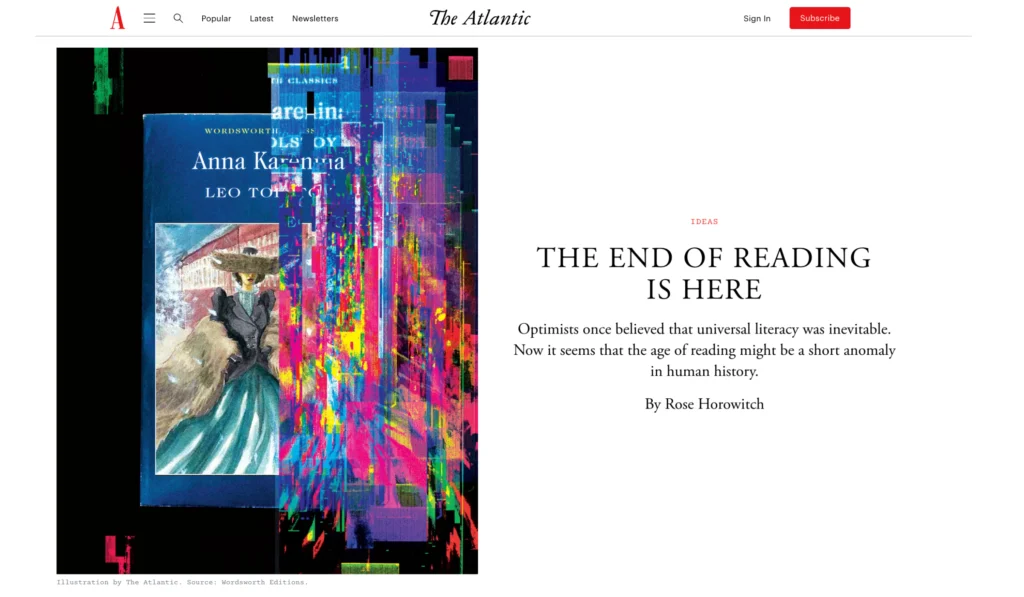
The modern era is witnessing an unprecedented cultural and cognitive shift away from deep reading and sustained textual engagement. Last week, journalist Rose Horowitch published a comprehensive feature in The Atlantic titled "The End of Reading is Here," sparking an intense global debate among technologists, educators, and cultural critics. Weighing in at over 8,500 words, Horowitch’s piece synthesizes a growing body of sociological and psychological research indicating that pervasive digital technologies, algorithmic distractions, and short-form media have precipitated a radical, rapid decline in reading habits across the industrialized world.
This warning builds upon a chorus of recent alarm bells sounded by cultural commentators, including British journalist James Marriott, whose upcoming book, The New Dark Ages, examines the looming threat of a post-literate society. As society increasingly pivots toward video-based platforms, social media feeds, and instantaneous digital stimuli, experts argue that the foundational technology of human civilization—literacy—is facing its most severe existential challenge since the invention of the printing press.
Main Facts and the Scope of the Reading Crisis
At the center of this cultural debate is a stark statistical decline in the time and attention individuals dedicate to reading books, long-form journalism, and complex texts. While digital devices have expanded access to information, they have simultaneously fragmented human attention spans, replacing the cognitive discipline required for deep reading with passive consumption.
According to data cited by researchers and cultural analysts, daily time spent reading for pleasure has plummeted significantly over the past two decades, particularly among younger demographics. Standardized testing and educational assessments from various international bodies reveal corresponding drops in reading comprehension, analytical depth, and the ability to synthesize lengthy, nuanced arguments.
The core inquiry dividing contemporary analysts is whether these trends represent a natural, benign evolution in communication technology—akin to the historical transition from print to radio, or radio to television—or whether they signal a dangerous erosion of human cognitive capacity. Critics like Horowitch and technology theorist Cal Newport argue unequivocally for the latter, asserting that reading is not merely one medium among many, but the foundational pillar upon which modern intellect, democracy, and self-awareness are constructed.
Historical Chronology of the Literacy Shift
To understand the magnitude of the current crisis, cultural historians examine the trajectory of literacy from antiquity to the digital age. The historical timeline highlights how deeply the written word has shaped human consciousness:
- Ancient Antiquity to the Middle Ages: The transition from oral traditions to written scripts fundamentally altered human memory, law, and governance. As detailed by media theorist Walter Ong in his seminal work Orality and Literacy, writing allowed societies to accumulate complex, abstract systems of thought that were impossible to maintain through oral recitation alone.
- The Print Revolution (15th Century): Johannes Gutenberg’s invention of the movable-type printing press democratized access to texts, fueling the Renaissance, the Scientific Revolution, and the Enlightenment. Literacy transformed from an elite privilege into a widespread civic tool.
- The Mass Media Expansion (20th Century): The advent of radio, television, and cinema introduced alternative forms of mass communication. Despite these additions, print journalism and book reading remained central to educational attainment and civic discourse.
- The Digital Disruption (Late 20th – Early 21st Century): The rise of the internet, smartphones, and algorithmic recommendation engines initiated a fundamental shift. Information consumption shifted from long-form, linear reading to hyper-linked, fragmented, and multimedia content.
- The Post-Literate Threshold (Present Day): Analysts suggest contemporary society is crossing a threshold into a "post-literate" era, where deep reading is increasingly abandoned in favor of continuous, low-friction digital stimulation.
Supporting Data and Cognitive Implications
The implications of declining literacy extend far beyond academic performance; they strike at the heart of human cognition. In a recent op-ed for The New York Times addressing cognitive fitness, experts underscored that the human brain adapts to the tools it uses most frequently. Just as physical inactivity leads to muscle atrophy, the neglect of deep reading results in the deterioration of sustained concentration, critical thinking, and empathy.
Walter Ong’s research demonstrates that abstract logic, human rights frameworks, scientific inquiry, and the very concept of an independent, self-reflective individual are conceptual outgrowths of a literate culture. When a population spends less time grappling with complex prose, its capacity for nuanced argumentation diminishes.
James Marriott’s exploration of this phenomenon in The New Dark Ages warns that a post-literate society risks losing the institutional memory and historical consciousness required to maintain complex democratic systems. Without the ability to read deeply and critically evaluate extensive arguments, citizens become increasingly vulnerable to misinformation, emotional manipulation, and ideological polarization.
Institutional and Expert Responses
The publication of Horowitch’s article and Marriott’s forthcoming work has prompted a wave of reaction from educators, psychologists, and technology analysts. While some techno-optimists argue that digital media fosters new forms of visual and interactive literacy, traditionalists and cognitive scientists contend that these formats cannot replicate the unique neural pathways stimulated by traditional reading.
Educational institutions worldwide are currently grappling with how to adapt curricula to combat declining attention spans. Many schools and universities are reintroducing mandatory silent reading periods, banning smartphones from classrooms, and emphasizing print-based textbooks over digital screens. However, institutional efforts often struggle against the overwhelming cultural tide of ubiquitous digital devices designed specifically to capture and monetize human attention.
Public intellectuals and technology theorists emphasize that individual agency must play a critical role in reversing this trend. Rather than waiting for systemic regulatory overhauls of the tech industry, cultural commentators suggest that individuals must proactively restructure their daily habits.
Proposing a Framework for Cognitive Health
Addressing the decline in advanced literacy requires a cultural and behavioral paradigm shift comparable to the public health campaigns launched in the late 20th century to combat physical inactivity and poor nutrition. Just as society learned to treat processed, high-calorie junk food with dietary caution, experts argue that highly distracting digital content must be viewed as cognitive junk food—enjoyed strictly in moderation, if at all.
To safeguard cognitive fitness and preserve the benefits of deep literacy, analysts recommend the following structured interventions:
- Intentional Information Diets: Establish clear boundaries around daily digital consumption, actively reducing time spent on algorithmic feeds, short-form video platforms, and superficial news aggregators.
- Dedicated Reading Schedules: Purposefully allocate non-negotiable blocks of time each day for reading physical books, long-form journalism, and substantive literature free from digital interruptions.
- Active Writing and Reflection: Cultivate the habit of daily journaling, essay composition, or analytical note-taking to reinforce the cognitive pathways associated with articulate expression and structured thought.
- Physical and Mental Balance: Treat cognitive maintenance with the same discipline applied to physical exercise, recognizing that mental endurance requires regular, rigorous training.
As Rose Horowitch observed in the conclusion of her Atlantic feature, society has inherited an astonishing wealth of intellectual history, wisdom, and narrative art. How contemporary civilization chooses to manage this immense cultural inheritance will determine whether the twenty-first century marks the dawn of a golden age of digital capability or the descent into a new dark age of intellectual regression. The tools for recovery are already available; the challenge lies in summoning the collective and individual will to use them.