


Artificial intelligence has officially crossed the threshold from a novelty experiment into the foundational infrastructure of modern education. According to the comprehensive findings of the newly published Microsoft AI in Education Special Report, a staggering 92 percent of students and education leaders, alongside 88 percent of educators, have already integrated AI tools into their day-to-day academic routines. Yet, as the initial novelty fades, school districts and higher education institutions face a much more complex challenge: shifting the focus from mere administrative productivity and speed to deep, cognitive engagement and critical thinking.
In response to this pedagogical evolution, Microsoft has announced a sweeping rollout of new AI-powered teaching capabilities and student-facing learning coaches built directly into Microsoft 365 Education. Informed extensively by feedback from the global Education Insiders Program, these innovations are designed to maintain institutional security, protect user privacy, and ground every digital interaction in established learning science. Rather than serving as automated answer engines that bypass intellectual effort, the newly introduced tools aim to guide students through problem-solving processes while simultaneously offering educators the structured professional development they have overwhelmingly demanded.
The Urgent Demand for Institutional Support and Training
The rapid, organic adoption of artificial intelligence across global classrooms has far outpaced formal institutional guidance, creating an urgent demand for structured training and professional development. Data from the 2026 Microsoft special report—which surveyed 3,345 respondents across K-12 and higher education institutions in the United States, the United Kingdom, Australia, Brazil, Japan, and Saudi Arabia—highlights a profound appetite for systemic support. The quantitative research, fielded between February 13 and March 9 by PSB Insights, reveals that 66 percent of educators and 52 percent of students desire monthly or quarterly AI training sessions. Furthermore, these stakeholders are actively calling for clearer, standardized policies regarding responsible utilization.

This data underscores a critical reality for educational policymakers: access to technology alone does not guarantee positive educational outcomes. Without targeted professional development and clear ethical frameworks, schools risk utilizing AI merely as a shortcut rather than an instrument for intellectual growth. Recognizing this gap, an overwhelming consensus has emerged among academic leaders. Approximately 87 percent of educators and education leaders, paired with 79 percent of students, now agree that mastering the effective and responsible use of artificial intelligence is an indispensable competency for future workforce readiness.
Shifting Paradigms: From Answer Engines to Interactive Learning Coaches
At the heart of Microsoft’s latest educational suite is a deliberate philosophical pivot: transforming generative artificial intelligence from a passive answer generator into an active, scaffolded learning coach. Scheduled to roll out to preview communities immediately before achieving general availability in the coming months, these tools are strategically engineered to preserve the cognitive heavy lifting required of students.
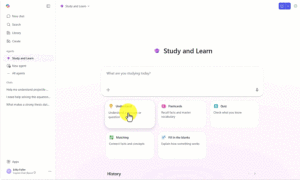
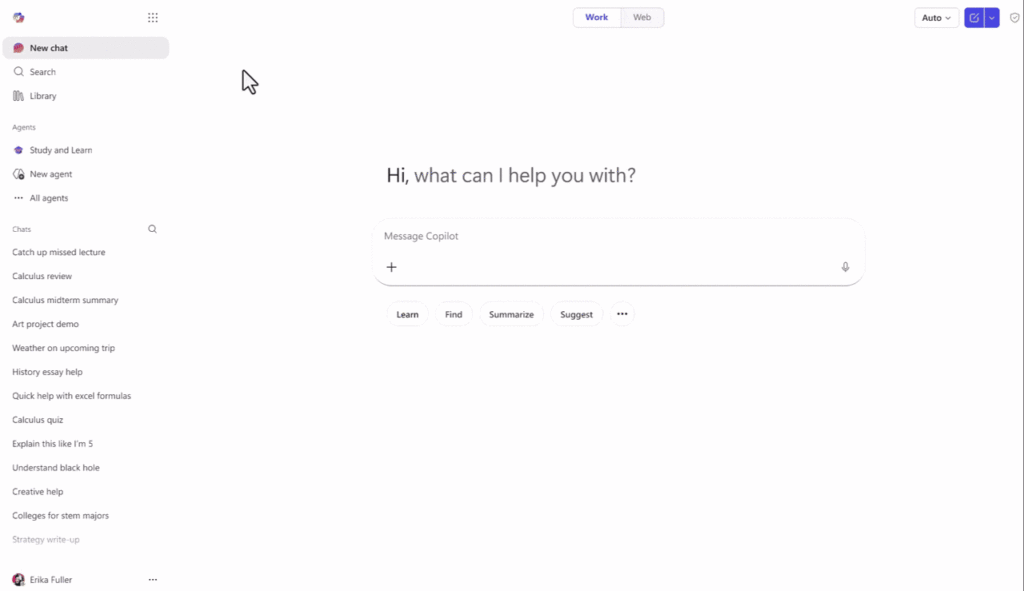
Chief among these innovations is the Study and Learn Agent, a learning-science-powered capability integrated into Copilot Chat at no additional cost for Microsoft 365 Education subscribers aged 13 and older. Rather than simply supplying solutions to complex inquiries, the Study and Learn Agent utilizes research-backed scaffolding techniques. It guides students through challenging concepts, assists in structuring written arguments, and provides interactive practice modules—including custom flashcards, quizzes, and matching exercises—to reinforce knowledge retention and foster independent analytical skills.
To ensure institutional compliance and local control, deployment of the Study and Learn Agent requires deliberate administrative action. IT department administrators must first enable Copilot Chat for K-12 student accounts, which subsequently provisions access to the study agent by default. Furthermore, upcoming updates will allow educators to assign specific Study and Learn modules directly through the Microsoft 365 Assignments interface, seamlessly blending AI-assisted coaching into traditional homework workflows.

Complementing the Study and Learn Agent is the introduction of Copilot Notebooks within the core Microsoft 365 Copilot application. This dedicated digital workspace allows students to aggregate disparate course materials—such as lecture slides, supplementary handouts, academic readings, and handwritten notes—into a single, secure environment. Students can query their curated sources directly, ensuring that AI assistance remains strictly bound to course-approved materials. Additionally, the platform features automated study guide generation, transforming dense reading packets into interactive review tools for self-testing and examination preparation.
Empowering Educators Through Professional Credentials and Global Frameworks
While student-facing tools dominate headlines, Microsoft’s announcement places an equally heavy emphasis on uplifting the teaching workforce. Educators frequently report feeling underequipped to navigate the rapid technological shifts transforming their classrooms. To bridge this knowledge gap, the technology corporation is expanding access to specialized professional learning ecosystems.
Central to this initiative is the Microsoft Elevate for Educators platform, which provides a centralized hub for community building, credential acquisition, and pedagogical capacity building. To establish global standards for digital competency, Microsoft has actively supported the AI Literacy Framework developed collaboratively by the European Commission, the Organisation for Economic Co-operation and Development (OECD), and CodeAI. This framework provides policymakers, curriculum developers, and classroom teachers with a standardized playbook detailing the precise competencies students should master by the conclusion of their formal schooling.
Building upon this international standard, Microsoft has partnered with the International Society for Technology in Education (ISTE) and the Association for Supervision and Curriculum Development (ASCD) to launch the AI Literacy for Educators credential pathway. This professional certification directly aligns with the broader AI Literacy Framework and feeds into the Expert tier of the Microsoft Elevate for Educators program, which is currently accepting applications from pioneering teachers and school administrators worldwide.

Streamlining Workflows and Ensuring Enterprise-Grade Security
To minimize friction in daily academic operations, Microsoft is integrating these new teaching and learning functionalities directly into the software suites educators and students already utilize. Upcoming updates will introduce Teach and Learn taskbar shortcuts on Windows-powered devices, granting users immediate, personalized access to their educational toolsets directly from the operating system taskbar.
For institutional leaders, school boards, and IT administrators, the deployment of these capabilities is anchored by robust enterprise-grade privacy and security protections. Educational institutions operate under stringent regulatory frameworks regarding data privacy, and the integration of artificial intelligence necessitates uncompromised compliance. By embedding these protections natively within Microsoft 365 Education, the platform enables school systems to execute institution-wide rollouts with heightened confidence, ensuring that student data remains secure while maintaining a consistent, trusted digital environment.
Chronology of Educational AI Integration
The rapid deployment of these tools represents the culmination of years of targeted experimentation and iterative development within the education technology sector:
- Early Experimentation Phase (2023–2024): Schools and universities grapple with the initial emergence of generative AI, largely characterized by informal student adoption and widespread academic integrity concerns regarding plagiarism.
- Institutional Acknowledgment (2025): Educators move past reactionary bans, recognizing the permanence of AI and demanding structured guidelines, institutional policies, and foundational training.
- February – March 2026: PSB Insights fields a comprehensive global study across six countries, revealing that 92 percent of educational stakeholders have actively utilized AI for school-related tasks.
- June 2026: Microsoft formally announces its suite of pedagogical AI capabilities, introducing the Study and Learn Agent, Copilot Notebooks, and enhanced educator credentialing pathways aligned with international standards.
Fact-Based Analysis of Broader Implications
The introduction of scaffolded, learning-science-driven artificial intelligence into mainstream educational ecosystems carries profound implications for the future of pedagogy and workforce development. By systematically shifting AI from an answer engine to a coaching mechanism, technology providers are addressing the legitimate pedagogical fear that digital tools might atrophy critical thinking skills. When deployed effectively, scaffolded AI can democratize access to personalized tutoring, offering individualized support to students who might otherwise struggle in overcrowded classrooms.

However, the successful integration of these systems depends heavily on equitable access to professional development. As highlighted by the Microsoft special report data, the primary barrier to effective AI utilization is no longer student resistance or hardware availability, but rather the pressing need for continuous educator training. Institutions that successfully invest in programs like Microsoft Elevate for Educators and adopt standardized frameworks such as the OECD-backed AI Literacy guidelines will likely bridge the digital divide more effectively. Conversely, under-resourced districts that fail to provide adequate teacher training risk exacerbating educational inequalities, leaving students unprepared for an increasingly automated global economy.
As the academic calendar transitions and institutions prepare for the upcoming school year, the trajectory of educational technology has reached a definitive crossroads. The focus has decisively shifted away from mere technological novelty toward sustainable, secure, and pedagogically sound integration. By aligning product development with rigorous learning science and educator feedback, the education sector is steadily building a framework where artificial intelligence acts not as a replacement for human intellect, but as an indispensable catalyst for lifelong critical thinking.