



Modern enterprise learning ecosystems have evolved from static repositories of compliance modules into highly sophisticated, data-rich intelligence engines. Today, learning platforms track every interaction an employee has with developmental content: completion rates, time-on-task, search queries, and the iterative process of failing and repeating assessments. With the integration of Artificial Intelligence, these platforms have gained the ability to synthesize these signals to predict skill gaps and career trajectories. However, as these systems become more deeply embedded in human resources architecture, a significant ethical and operational dilemma has emerged: at what point does data collected for developmental support transform into a permanent, potentially prejudicial, record used for performance evaluation?
The rapid adoption of these technologies has outpaced the development of robust internal governance frameworks. While learning leaders have long championed personalized development to replace the "one-size-fits-all" training model, the unintended consequence of this hyper-personalization is a pervasive, granular surveillance of the employee learning journey. As these learning environments increasingly sync with talent marketplaces and HR management systems, the privacy of the "unfinished" employee—one who is still learning and experimenting—is being compromised by default.
A Chronology of Data Integration
The evolution of the corporate learning landscape can be mapped through three distinct phases of data utilization. Historically, learning data was siloed. Between 2000 and 2015, Learning Management Systems (LMS) functioned primarily as warehouses for certification records. Compliance was the primary metric, and data was used almost exclusively for auditing purposes.
From 2015 to 2022, the industry saw the rise of the "Experience Platform," which shifted the focus toward learner engagement. Companies began tracking behavioral data—what users searched for, which videos they abandoned, and how often they logged in—to improve user experience.
Since 2023, the industry has entered the era of the "Connected Ecosystem." Through APIs and middleware, learning platforms now communicate directly with performance management software. A score on an AI-powered diagnostic test can now automatically update an employee’s competency profile in a talent marketplace. This transition has occurred largely without a uniform industry standard for data sovereignty, leaving many employees unaware that their learning behaviors are being utilized for high-stakes talent decisions.
Supporting Data and The Reality of Learning Analytics
Current market research from the Human Capital Institute suggests that over 65% of large enterprises now use some form of predictive analytics to map employee skills. However, the accuracy of these inferences remains a point of contention. Research indicates that behavioral proxies—such as the number of attempts taken to pass a module—are often poor indicators of long-term proficiency.
For instance, a study on adaptive learning platforms found that individuals who required multiple attempts to master a concept often demonstrated higher retention rates six months later compared to those who passed on the first attempt. Yet, when AI models interpret these "multiple attempts" as a lack of initial competency, the resulting data point is often logged as a negative metric in the employee’s digital footprint.
Industry analysts at firms like Gartner and Deloitte have noted that while AI-driven learning tools increase administrative efficiency by 30% to 40%, they also create "data shadows." These shadows consist of discarded drafts, failed assessments, and exploratory searches that were never intended to be part of an official personnel file.

Ethical Implications: The "Support-to-Decide" Framework
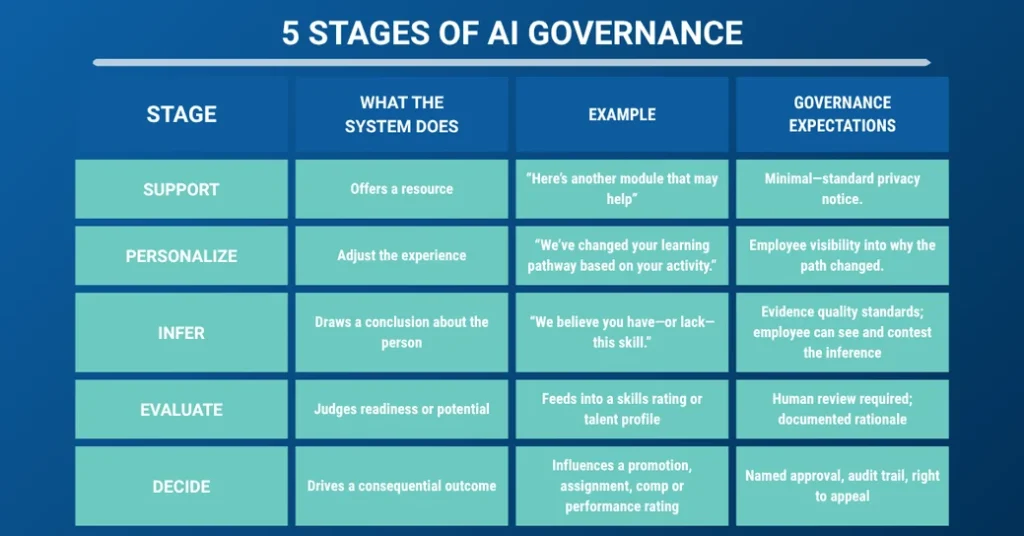
The central challenge for organizations is distinguishing between developmental support and evaluative judgment. To address this, industry experts have proposed a five-stage governance framework that aligns the level of data scrutiny with the consequence of the decision being made:
- Support: Recommendations for content. This stage requires minimal oversight as it is purely additive to the employee experience.
- Advise: Identifying learning paths. This requires transparency, ensuring employees understand why certain paths are recommended.
- Assess: Measuring proficiency. This requires standardized validation to ensure the data is accurate.
- Evaluate: Using data for performance reviews. This stage necessitates human oversight to interpret the context of the data.
- Decide: Making promotion or termination decisions. This requires full human accountability; a system-generated score should never be the sole basis for such a decision.
The core issue is that many vendors currently default to a "sync-all" configuration. In this model, data flows from the learning platform into the HR profile without a "human-in-the-loop" to provide context. If a manager reviews an employee for a promotion, they may see a "low proficiency" flag generated by an AI tool, unaware that the flag was triggered by an employee who was simply being curious and testing the limits of an advanced module.
Official Responses and Industry Standards
Professional organizations, including the Association for Talent Development (ATD), have begun to draft guidelines aimed at curbing the misuse of learning data. The consensus among ethics boards is that employees must have "data agency." This means that the flow of information from a learning tool to an HR system should be opt-in, rather than a background process.
Legal counsel for major corporations has also begun to weigh in, warning that the aggregation of behavioral data could inadvertently violate labor laws if used to discriminate based on learning styles or disabilities. If an AI tool flags an employee for taking "too long" to learn a skill, and that employee is later passed over for a promotion, the company faces significant liability. HR departments are now being advised to conduct "Data Impact Assessments" before deploying new AI-enabled learning vendors to ensure that behavioral data does not bleed into permanent performance records.
The Problem of the AI Tutor
Perhaps the most sensitive area of modern learning is the AI tutor. These tools are designed to simulate a safe, confidential environment where employees can ask "stupid" questions or express doubts about their career path. When an employee tells an AI, "I am struggling with this concept, and I don’t think I am ready for a leadership role," it is a vital moment of vulnerability that facilitates growth.
However, if that transcript is retained by the vendor and analyzed by an AI model to infer "low leadership potential," the psychological safety of the entire learning system collapses. If employees suspect that their candid inquiries are being cataloged, they will inevitably sanitize their interactions. This behavior—known as "gaming the system"—results in less honest learning and a degraded, performative experience that fails to actually develop the workforce.
Conclusion: The Mandate for Transparency
The future of corporate learning requires a paradigm shift from "collecting everything" to "collecting for a purpose." Organizations must distinguish between the documentation of achievements—such as certifications and completed courses—and the interpretation of process-based behaviors.
Learning leaders must take on a new responsibility: acting as the guardians of the employee’s "unfinished" state. This requires a rigorous audit of existing vendor contracts to ensure that data flows are transparent, controllable, and context-aware.
The ultimate test for any AI implementation is the "explainability" threshold. If a company cannot explain to an employee, in plain language, exactly why a piece of data was collected, how it was interpreted, and who has access to it, that data should not be collected at all. Technology should be a bridge to higher performance, not a digital cage that punishes employees for the natural, messy, and necessary process of growth. Preserving the freedom to struggle, change one’s mind, and admit ignorance is not just an ethical imperative; it is the fundamental requirement for a truly agile and resilient workforce.