



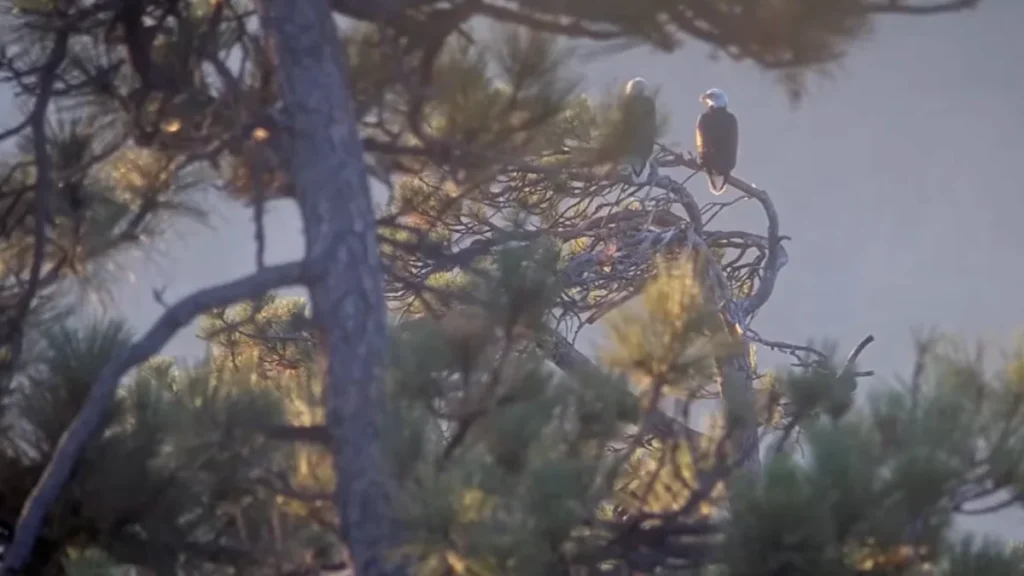
As the crisp air of autumn descends upon the mountainous terrain of Southern California, a quiet transition is underway in the high-altitude ecosystem of Big Bear Valley. Shadow, the internet-famous bald eagle who captured the hearts of millions through years of live-streamed domestic trials and triumphs, has been increasingly spotted in the company of a younger female eagle known as Kaydee. For wildlife biologists, conservationists, and the global community of bird enthusiasts who have tracked the region’s resident raptors for over half a decade, this nascent pairing marks a pivotal moment of renewal following a season defined by profound grief.
The relationship between Shadow and Kaydee remains in its early, formative stages. Following the tragic passing of Shadow’s longtime mate, Jackie, in August, observers have watched the landscape with heightened curiosity. Shadow and Kaydee were recently documented sharing the branches of the Roost Tree before taking flight together into the misty morning air above Big Bear Valley. According to updates from the Friends of Big Bear Valley (FOBBV), the organization that maintains the 24/7 webcams monitoring the local eagle population, Kaydee has been observed closing the physical distance between herself and Shadow, stretching her wings to display her primary flight feathers, and engaging in quiet vocalizations often described by researchers as soft chortles.
While these interactions hint at a growing familiarity, ornithologists emphasize that true pair-bonding is a deliberate and gradual process. The full bald eagle nesting season spans upwards of six months, a timeline dictated by courtship, nest renovation, incubation, and the eventual fledging of the young. FOBBV officially resets its observation calendar on September 1 of each year, with egg-laying typically commencing around January. Whether Shadow and Kaydee will successfully transition from casual companions to an established breeding pair remains to be seen, but their daily movements continue to be broadcasted globally, offering an unfiltered window into the resilience of wildlife.
Understanding Kaydee: The Next Generation
Kaydee, cataloged federally and locally under her band designation KD1, represents a new demographic entering the Big Bear Valley breeding pool. Hatched in 2022 in the Prado Basin roughly 70 miles away between Anaheim and Riverside, Kaydee is a product of Southern California’s rebounding raptor populations. Her banding was coordinated through the Orange County Water District as part of an ongoing, multi-agency initiative to monitor regional bald eagle distributions and health. Coincidentally, her biological parents share the names Lucky and Ricky—the same names as Jackie’s parents, though the two family lines are entirely distinct.
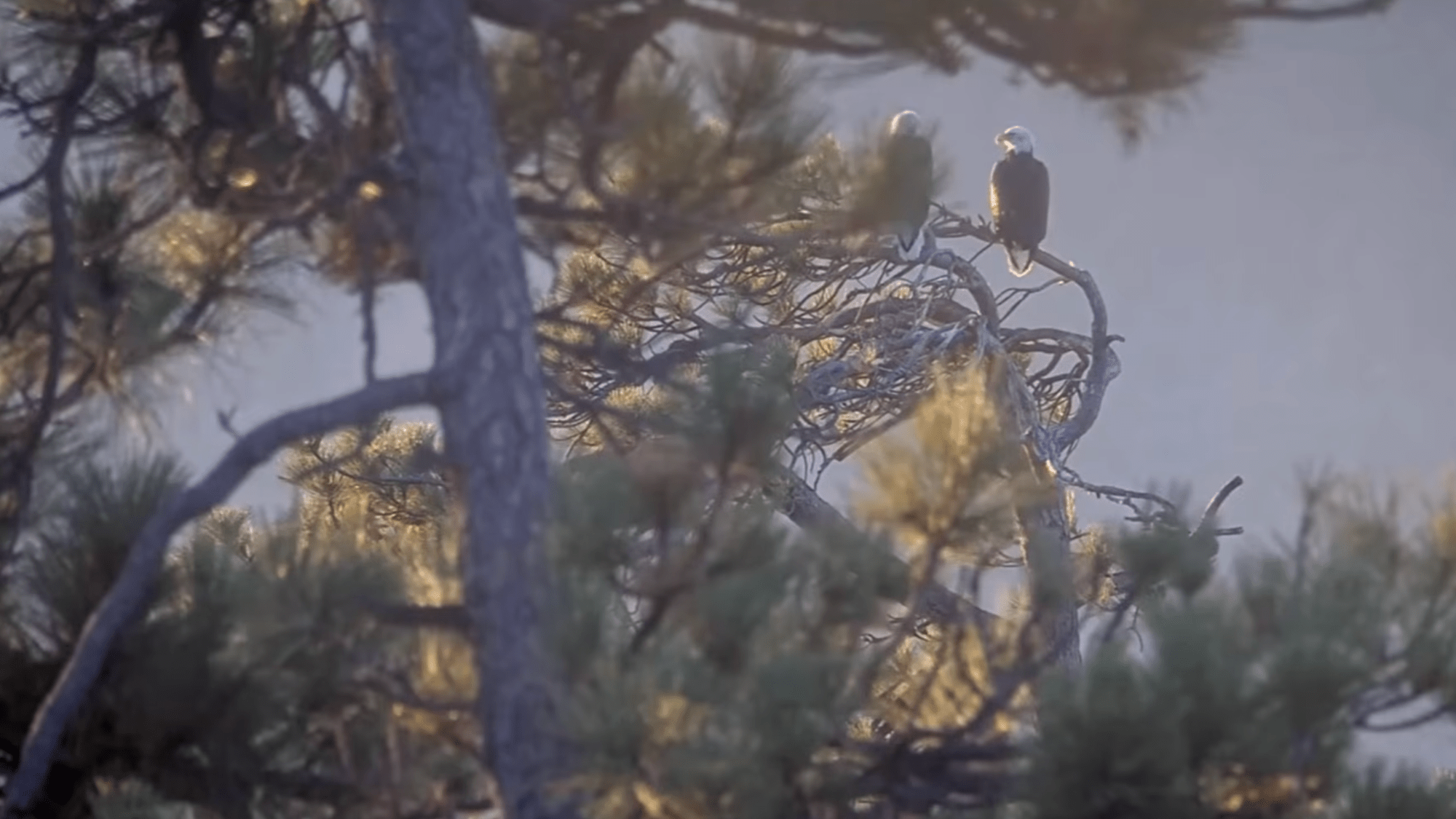
Now approaching five years of age, Kaydee has reached the developmental threshold where bald eagles typically begin seeking out mates and establishing territories. Distinctive physical markers, including a unique black smudge on her head—potentially a temporary artifact of tree sap, mud, or uncompleted juvenile feather molting—along with a lavender identification band bearing the alphanumeric code KD1 on her leg, have allowed researchers and birdwatchers to track her movements with precision. Her recent exploration of Shadow’s primary nesting site and her persistent presence near the veteran male signal natural behavioral maturation, though whether she possesses the temperament required to successfully raise chicks in the notoriously harsh Big Bear climate is a question only time can answer.
The Legacy of Jackie and Shadow
To fully understand the significance of Shadow’s current interactions, one must examine the monumental legacy he built with Jackie, his partner of seven years. Pairing up in 2018, Jackie and Shadow became global icons through the FOBBV livestream, which documented the raw, unvarnished realities of avian parenthood. Their tenure was marked by both success and heartbreak, serving as a live-streamed masterclass in natural history for millions of viewers.
The pair successfully produced and fledged multiple offspring, including Cookie and Simba in 2019, and Spirit in 2022. However, subsequent years brought intense environmental challenges. Unsuccessful nesting attempts in 2023 and 2024 tested the resilience of the pair. In 2025, a brutal late-winter snowstorm dumped up to two feet of snow on the nest, battering the structure with gale-force winds. Despite the punishing elements, two chicks, Sunny and Gizmo, survived.
The 2026 breeding season proved equally tumultuous. After an initial clutch of eggs was lost to ravens, Jackie laid a second clutch that hatched in April, resulting in two chicks named Luna and Sandy. The latter name was chosen to honor Sandy Steers, the former executive director of FOBBV, who passed away from cancer in February.
The Tragic Loss of Jackie

The narrative took a devastating turn in July 2026. On July 17, Jackie was discovered grounded and injured near Dana Point Park, California. Subsequent eyewitness video footage revealed that she had engaged in a fierce territorial altercation with two subadult eagles. While Jackie successfully defended herself by utilizing her talons and turning onto her back, the physical toll of the battle left her unable to achieve sustained flight.
Rescuers promptly transferred Jackie to the Ojai Raptor Center for emergency medical evaluation. Veterinarians diagnosed her with severe anemia, a condition that rapidly deteriorated during the first week of August. Despite intensive supportive care, including blood transfusions and constant monitoring, her packed cell volume plummeted to critical levels.
Jackie succumbed to her injuries in the early morning hours of August 10. A comprehensive necropsy conducted by state wildlife officials and veterinary pathologists revealed that her death was not attributable to a single trauma, but rather a constellation of compounding physiological failures. Pathologists identified severe anemia, disseminated blood clots within one wing and a kidney, alongside significant abnormalities in both her lungs and liver, concluding that the physical stress of the territorial defense and underlying health factors proved insurmountable.
Commemoration and Community Impact
The loss of Jackie prompted an outpouring of grief from the local community in Fawnskin and the millions of digital spectators worldwide who invested in her daily life. A primary memorial service was held on September 5 in Fawnskin, drawing local residents, wildlife advocates, and admirers. Additionally, a broader celebration of life titled "Wings Over Big Bear" has been scheduled for October 3 at the Bear Mountain Ski Resort. The event brings together representatives from FOBBV, the Yuhaaviatam of San Manuel Nation, and environmental organizations to honor Jackie’s ecological significance and the broader conservation efforts protecting Southern California’s apex predators.
Ecological Implications and Future Outlook
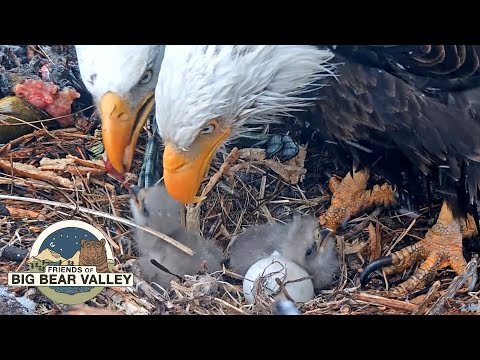
The introduction of a new subadult eagle into Shadow’s established territory highlights the dynamic and fluid nature of avian population structures. In the wild, the loss of a dominant breeding adult often results in a territorial vacuum, which can trigger aggressive competition among neighboring birds or prompt swift re-pairing. Shadow’s willingness to tolerate—and eventually integrate—Kaydee into his daily routine suggests a strong biological drive to maintain territory rather than abandon a prime nesting location.
Wildlife biologists note that while the public often views these animal interactions through an emotional lens, the biological reality is governed by survival, resource allocation, and territorial defense. The transition from Jackie to Kaydee underscores the resilience of the Big Bear ecosystem, where individual lives are transient, but the population endures.
As autumn progresses into winter, the eyes of the global conservation community will remain fixed on the live-streamed cameras overlooking Big Bear Valley. Whether Kaydee ultimately assumes the mantle of matriarch alongside Shadow, and whether the pair will successfully produce a new generation of eaglets when the breeding season officially peaks in January, remains one of nature’s compelling ongoing narratives. For now, the sight of two majestic bald eagles sharing the morning mist offers a powerful testament to continuity, adaptation, and survival in the wild.