





The cybersecurity landscape is undergoing a profound structural transformation, driven by the rapid enterprise adoption of cloud computing and emerging artificial intelligence paradigms. According to the Cloud Security Alliance (CSA) Top Threats to Cloud Computing Survey Report 2026, identity and access management (IAM) has officially usurped configuration errors to become the premier security concern for organizations operating in cloud environments. Furthermore, the 2026 findings mark a historic milestone in the biannual research series by introducing artificial intelligence-related vulnerabilities into the top-tier rankings for the very first time.
The comprehensive study, published by the CSA Top Threats Working Group, gathered empirical data and qualitative insights from 507 qualified cybersecurity professionals worldwide. Participants were asked to evaluate and rank 23 distinct cloud security issues based on prevalence, severity, and organizational impact. The resulting Top 11 index highlights a dramatic shift in industry anxiety, moving away from foundational infrastructure vulnerabilities toward threats targeting identity perimeters, software supply chains, interconnected application programming interfaces (APIs), and autonomous computational models.
This strategic evolution in threat perception underscores a broader maturity in how organizations approach cloud defense. While early cloud migrations focused heavily on securing underlying hypervisors, storage buckets, and virtual networking components—often grouping risks under broad umbrellas of misconfiguration—modern architectures are defined by distributed identity perimeters and decentralized machine learning workloads. Consequently, security teams must recalibrate their governance frameworks to address the realities of a perimeter-less enterprise.

Evolution of the Threat Landscape: A Comparative Analysis
To fully appreciate the gravity of the 2026 findings, industry analysts frequently look backward to evaluate the trajectory of the CSA’s preceding report, published in 2024. A cross-cycle comparison reveals sweeping adjustments in executive and practitioner priorities over a relatively brief twenty-four-month window.
In the 2024 survey, misconfiguration and inadequate change control reigned supreme as the primary hazard facing cloud tenants. Human error in provisioning storage buckets, leaving default administrative credentials active, or failing to enforce stringent infrastructure-as-code (IaC) guardrails dominated security discussions. However, by 2026, misconfiguration dropped to the No. 5 position. While still a persistent and dangerous vector, its relative standing fell as organizations successfully automated infrastructure deployment and implemented robust posture management tools.
Conversely, identity and access management climbed from the No. 2 spot in 2024 to seize the crown jewel of vulnerability rankings in 2026. This ascent reflects the reality that modern cyber attackers rarely need to crack underlying cryptography or exploit zero-day kernel vulnerabilities when they can simply compromise valid user credentials. Phishing, credential stuffing, session hijacking, and the abuse of overly permissive service accounts have become the preferred entry points for ransomware syndicates and nation-state actors alike.
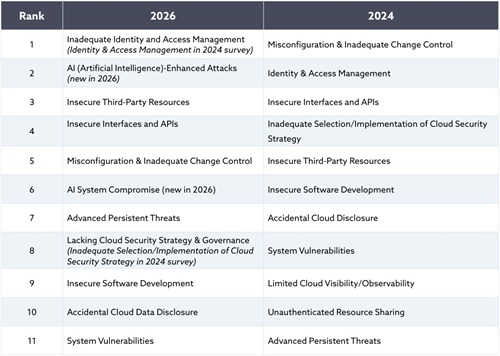
Another significant mover in the rankings is the category of insecure third-party resources, which escalated from No. 5 to No. 3. As modern enterprises increasingly rely on commercial software-as-a-service (SaaS) applications, open-source libraries, and external managed service providers, the software supply chain has expanded exponentially. A vulnerability or malicious injection in a single third-party dependency can instantly compromise thousands of downstream cloud tenants.
Simultaneously, Advanced Persistent Threats (APTs) experienced a notable surge, moving from No. 11 up to No. 7. This upward migration indicates that sophisticated threat groups are systematically optimizing their toolkits for cloud environments, shifting away from legacy on-premises lateral movement toward native cloud exploitation techniques, such as abusing cloud metadata services and persistence via compromised IAM roles.
The Debut of Artificial Intelligence Threats
Perhaps the most groundbreaking development in the 2026 report is the immediate, high-priority entry of artificial intelligence-related risks into the Top 11 index. For the first time in the history of the CSA Top Threats series, specific AI vulnerabilities crossed the threshold required to make the primary ranking, validating widespread industry concerns regarding the hurried deployment of generative AI and large language models (LLMs) in production environments.

The inclusion of AI risks reflects a dual-threat reality: organizations are grappling both with the security of AI infrastructure itself and with the weaponization of AI by cybercriminals. On one hand, enterprises are deploying complex AI pipelines, vector databases, and custom model endpoints that introduce novel attack surfaces—such as prompt injection, model inversion, data poisoning, and unauthorized access to sensitive training data. On the other hand, threat actors are leveraging automated AI agents to accelerate reconnaissance, synthesize highly targeted social engineering campaigns, and discover zero-day flaws at unprecedented speeds.
The CSA cautions that while the 2024 and 2026 charts provide a vivid illustration of changing priorities, the rows do not represent direct one-to-one mappings. Each survey cycle captures the relative position of security issues based on the prevailing threat intelligence and technological climate of that specific moment. Nonetheless, the sudden appearance of AI at the top of the ledger signals that algorithmic integration has officially transitioned from an experimental frontier to a critical enterprise attack surface.
Demographics and Methodology of the CSA Survey
The reliability of the Cloud Security Alliance’s findings stems from its rigorous methodology and the diverse expertise of its respondent pool. The Top Threats Working Group surveyed 507 verified security professionals, encompassing a balanced cross-section of industries, including financial services, healthcare, government, technology, and retail.

Respondents included Chief Information Security Officers (CISOs), cloud architects, compliance officers, risk management executives, and hands-on security engineers. This broad demographic ensures that the resulting rankings reflect not only theoretical academic concerns but also the gritty, day-to-day operational challenges faced by practitioners in the field.
Interestingly, the survey scores across the Top 11 threats were remarkably tightly grouped. The highest-ranked issue—identity and access management—secured a score of 7.95, while the eleventh-ranked issue still commanded a formidable 7.45 rating. This tight clustering demonstrates that modern security professionals do not view cloud risk as a matter of a single catastrophic flaw, but rather as an interconnected matrix of persistent challenges where multiple vectors demand simultaneous mitigation.
Notably, several classic infrastructure concerns fell entirely out of the Top 11 index for 2026. Issues that once dominated security headlines—such as denial-of-service (DoS) attacks, shared technology vulnerabilities, cloud service provider (CSP) data loss, unauthenticated resource sharing, and limited cloud visibility or observability—all ranked below the top tier this year. This displacement does not imply these risks have vanished; rather, it suggests that foundational cloud hygiene and hyperscaler infrastructure hardening have matured to a point where organizations feel more confident managing them, allowing attention to shift toward higher-level application, identity, and algorithmic threats.
Detailed Breakdown of the Top 11 Cloud Security Risks

While the complete analytical breakdown spans numerous technical and business dimensions within the official 2026 report, the overarching thematic structure highlights the following primary areas of concern:
- Identity and Access Management Failures: Encompassing weak authentication protocols, lack of multi-factor authentication (MFA), excessive permission grants, and poor credential lifecycle management.
- AI-Related Security Vulnerabilities: Covering risks unique to machine learning pipelines, prompt injection, insecure AI APIs, and data leakage through model outputs.
- Insecure Third-Party Resources: Addressing risks originating from vulnerable open-source code, unverified software supply chain dependencies, and compromised vendor integrations.
- API Insecurity: Focusing on broken object-level authorization, excessive data exposure, and lack of rate limiting across distributed microservices.
- Misconfiguration and Inadequate Change Control: Highlighting human error in resource provisioning, unpatched systems, and lax administrative policies.
- Data Breaches and Data Loss: Examining unauthorized exfiltration of sensitive workloads stored in cloud object storage or databases.
- Advanced Persistent Threats (APTs): Highlighting coordinated, stealthy campaigns by sophisticated nation-state or cybercriminal organizations targeting cloud architectures.
- Insufficient Logging and Monitoring: Addressing gaps in observability that delay the detection of lateral movement and compromise.
- Insecure Software Development Life Cycle (SDLC): Focusing on the failure to integrate security testing into agile, cloud-native development pipelines.
- Systemic Failures in Cloud Governance: Examining lack of centralized oversight, undefined responsibilities under the shared responsibility model, and compliance drift.
- Cryptographic Failures: Encompassing weak encryption keys, improper certificate management, and insecure data-in-transit protocols.
Implications for Enterprise Risk Management and Governance
The release of the CSA Top Threats to Cloud Computing Survey Report 2026 serves as an urgent call to action for executive management, board members, and technical leadership teams. As digital transformation initiatives push deeper into multi-cloud and hybrid environments, traditional perimeter-based security architectures are obsolete.
Organizations can no longer rely on perimeter defenses to protect corporate assets. Instead, security strategies must adopt a Zero Trust philosophy, treating every identity—whether human or non-human, such as an autonomous AI agent or an automated service account—as untrusted until continuously verified. Least-privilege access principles must be strictly enforced, limiting the blast radius of any single compromised credential.

Furthermore, compliance, risk, and information security personnel must align their governance frameworks with the realities highlighted by the CSA. By utilizing the specific technical analyses, real-world examples, and mapped CSA security controls provided in the full report, enterprises can systematically prioritize their risk mitigation budgets.
As artificial intelligence continues to reshape the enterprise landscape, organizations that fail to secure their AI pipelines and identity perimeters will find themselves uniquely exposed. The 2026 survey makes it abundantly clear: the future of cloud security is inextricably bound to how effectively organizations manage who—and what—they trust in the digital ecosystem.