

Mastering the nuances of birthday greetings in French requires more than a simple translation; it demands an understanding of regional linguistic variations, social etiquette, and the historical context of celebrations within the Francophone world. While the primary phrases remain consistent across much of the French-speaking population, the application of these terms—and the customs surrounding them—varies significantly between France, Quebec, and other international regions.
Linguistic Foundations: The Primary Greetings
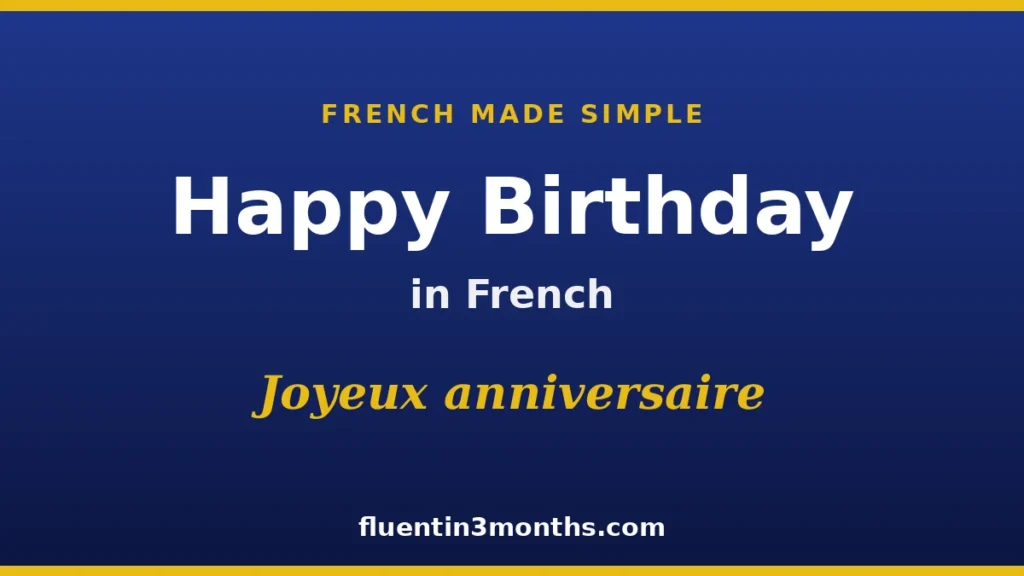
The most widely recognized and universally accepted method to wish someone a happy birthday in French is the phrase "Joyeux anniversaire." Alternatively, "Bon anniversaire" is used with equal frequency. From a linguistic perspective, "joyeux" functions as an adjective meaning "joyful" or "happy," while "anniversaire" serves as the noun for "anniversary" or "birthday."
Data regarding language usage patterns indicate that both expressions are functionally interchangeable in professional, formal, and casual settings. Unlike some languages where specific honorifics are required to convey birthday wishes, French relies on the existing social contract of the "tu" (informal) and "vous" (formal) address to establish the tone of the message. In casual, digitized communication—particularly among younger demographics and in text-based messaging—the term is frequently truncated to "anniv," a colloquialism that mirrors the English shortening of "birthday" to "b-day."
Chronology and Evolution of French Birthday Traditions
The celebration of birthdays as a social milestone has evolved significantly over the last century in France. Historically, religious name days ("la fête") held greater cultural prominence than individual birth anniversaries. This historical preference remains a critical point of distinction in Quebec, where the phrase "Bonne fête" is the standard, accepted way to wish someone a happy birthday.
In contrast, within Metropolitan France, "Bonne fête" is almost exclusively reserved for one’s name day—the day on the liturgical calendar associated with the saint for whom a person is named. For a traveler or an expatriate, failing to observe this distinction can lead to minor cross-cultural confusion. Therefore, when in France, the use of "Joyeux anniversaire" is the standard protocol to avoid ambiguity.
The musical accompaniment to these celebrations has also seen a distinct development. While the international English-language melody "Happy Birthday to You" is ubiquitous in France, it is often performed with French lyrics: "Joyeux anniversaire, nos vœux les plus sincères, que ces quelques fleurs, vous apportent le bonheur." Furthermore, a specific French song titled "Bon anniversaire," popularized by André Claveau in the 1950s, remains a staple in many traditional households. This composition is protected by copyright, distinguishing it from the public-domain status of the traditional melody.
Socio-Cultural Customs and Workplace Etiquette
Sociological observations of French birthday customs reveal that the "birthday person" often assumes an active role in the festivities. Unlike in many North American corporate cultures where colleagues might organize a surprise, it is common in many French professional environments for the individual celebrating their birthday to provide the refreshments—such as cakes or pastries—for their peers.
"La bise," the practice of greeting with cheek kisses, remains a complex element of social interaction. The number of kisses, which typically ranges from two to four depending on the geographic department, is subject to local regional norms. However, standard professional etiquette dictates that one should follow the lead of the host. In formal settings, a handshake remains the most neutral and appropriate gesture.
Regarding the timing of well-wishes, a segment of the French population adheres to the superstition that offering birthday greetings before the actual date is considered bad luck. While this is not a universal rule, it is a prevalent belief that reflects a broader cultural cautiousness regarding the sanctity of the birth date.
Phonetic Precision and Linguistic Flow
The efficacy of a birthday greeting in French is often determined by the speaker’s ability to navigate "liaison"—the phonetic phenomenon where a silent final consonant at the end of a word is pronounced to connect with the following vowel.
In the phrase "Joyeux anniversaire," the final ‘x’ in "joyeux" is linked to the ‘a’ in "anniversaire," producing a /z/ sound. Similarly, in "Bon anniversaire," the nasal ‘n’ at the end of "Bon" transitions smoothly into the subsequent vowel, effectively erasing the nasal quality of the initial word. Linguistic experts emphasize that these liaisons are not merely optional stylistic choices but are essential for the natural rhythm and flow of the French language. Native speakers prioritize the rhythmic grouping of these words over the artificial stress patterns often applied by non-native learners.
Analysis of Regional Implications
The disparity between "Bonne fête" in Quebec and France serves as a case study for the evolution of colonial language versus mainland development. The Quebecois usage is a direct result of historical linguistic preservation, where the term "fête" retained its broader meaning of "celebration" or "birthday." The Office québécois de la langue française formally recognizes this usage, affirming its status as standard Canadian French.
Conversely, the shift in France toward "Joyeux anniversaire" reflects a modernization of vocabulary to avoid the overlap with the religious name-day tradition. For the international communicator, the implication is clear: linguistic proficiency requires an awareness of the specific region in which the communication occurs. Using "Bonne fête" in Paris may be met with confusion, while using "Joyeux anniversaire" in Montreal is perfectly acceptable, though it marks the speaker as an outsider to the local idiom.
Practical Applications for Correspondence
When composing messages for cards or digital correspondence, the degree of intimacy is the primary driver of content. For professional or distant acquaintances, a simple, succinct greeting is preferred. For close family or intimate partners, the French language offers a vast lexicon of emotive adjectives—such as "affectueusement" (affectionately) or "avec toute mon amitié" (with all my friendship)—to augment the core birthday message.
The importance of the "tu/vous" distinction cannot be overstated in written correspondence. Using "tu" implies an established, close relationship. Utilizing "vous" ensures a respectful distance, which is particularly vital in business environments. Even in the context of a celebration, maintaining this boundary is considered a hallmark of social competence.
Broader Impact and Future Trends
As globalization continues to influence language, some of the rigid distinctions between regional greetings are softening. Digital media and the internet have facilitated a greater exchange of cultural idioms, leading to a higher awareness among younger generations of the regional variations between Quebec and France. However, the core customs—the birthday cake, the candles (souffler les bougies), and the communal singing—remain consistent pillars of the celebration.
For those engaging with the French-speaking world, the ability to navigate these customs successfully provides a significant advantage in social integration. It is recommended that one practice the pronunciation of these phrases in short, rhythmic bursts rather than focusing on the individual words. By mastering the phonetic flow and respecting the cultural customs of the specific region, the speaker can ensure their birthday wishes are received with the warmth and sincerity intended.
Ultimately, the act of wishing someone a "joyeux anniversaire" is an exercise in cultural diplomacy. It requires a balance of linguistic accuracy, social awareness, and an understanding of the historical traditions that underpin the French identity. By adhering to these guidelines, one can navigate the complexities of French birthday customs with confidence and poise.