




The rapid proliferation of artificial intelligence agents across enterprise environments has introduced unprecedented architectural complexities, leaving organizations vulnerable to fragmented visibility, siloed security protocols, and severe compliance risks. Addressing this growing industry-wide challenge, identity management giant Okta has spearheaded the formation of a high-profile coalition dubbed the Blueprint Alliance. Announced today, the initiative unites twelve major cloud computing, cybersecurity, database, and application vendors to establish a standardized, multi-vendor reference architecture designed to secure enterprise AI agents seamlessly from development through production.
The founding cohort of the Blueprint Alliance represents a massive cross-section of the modern enterprise technology stack. The twelve initial members comprise Amazon Web Services (AWS), CrowdStrike, Databricks, Docker, Google Cloud, Lovable, Okta, Proofpoint, Salesforce, ServiceNow, Wiz, and Zscaler. Additionally, major consumer and nonprofit entities including GE Appliances and World Central Kitchen have signed on to participate as strategic advisors, providing crucial end-user perspectives to ground the alliance’s technical frameworks in real-world operational realities.
The Genesis of the Multi-Vendor Agent Security Crisis
To understand the urgency behind the Blueprint Alliance, industry analysts point to the decentralized lifecycle of modern artificial intelligence agents. Unlike traditional software applications that are typically developed, hosted, and monitored within tightly controlled enterprise perimeters, AI agents operate with a high degree of autonomy and span disparate systems.

In a typical modern enterprise deployment, an AI agent might be initially constructed within a developer environment utilizing code repositories and specialized assistants. It may then be authenticated through an identity provider like Okta, assigned to execute tools hosted on AWS or Google Cloud, query data stored within Databricks lakes, interact with enterprise SaaS platforms like Salesforce or ServiceNow, and ultimately communicate via the Model Context Protocol (MCP).
This decentralized operational reality creates a massive visibility gap. Organizations frequently discover that an agent is created in one silo, authenticated through a second, granted access to tools across a third and fourth, and monitored by an entirely separate security platform that lacks holistic context. Consequently, security teams struggle to answer fundamental governance questions: Where are all active agents located? What specific capabilities do they possess? What are they currently doing in real time? And if anomalous behavior occurs, how can the enterprise respond rapidly and decisively?
Rather than dictating how developers should build their underlying AI models or applications, the Blueprint Alliance focuses squarely on governance and consistency across vendor boundaries. By shifting the focus from agent creation to cross-vendor control, the coalition aims to harmonize disparate security telemetries into a unified framework.
Chronology and Evolution of the Architecture
The roots of the Blueprint Alliance trace back to earlier standalone frameworks developed by Okta and its initial partners to address basic identity and access management challenges for automated systems. However, as generative AI evolved from experimental chatbots into autonomous agents capable of executing multi-step workflows, invoking external APIs, and modifying corporate databases, basic identity verification proved insufficient.
Recognizing that no single vendor possesses a monopoly over the enterprise AI stack, stakeholders began preliminary behind-the-scenes discussions to formulate an open, multi-vendor standard. These talks culminated in the formalization of the Blueprint Alliance and the release of its comprehensive foundational whitepaper.
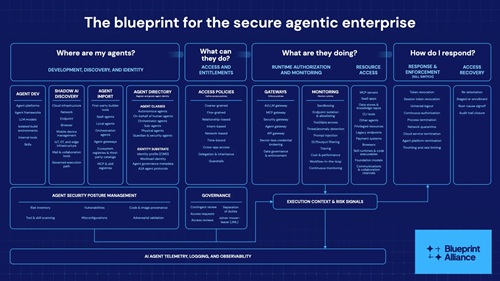
The architecture itself is structured around four core operational pillars, corresponding directly to the fundamental lifecycle questions every security operations center must address:
- Discovery and Inventory: Identifying where agents reside, including internal builds, imported SaaS agents, and locally running instances.
- Capability Mapping: Determining precisely what tools, APIs, databases, and other agents a given autonomous entity can access.
- Behavioral Monitoring: Tracking active operations, tracking interactions through Model Context Protocol servers, and logging telemetry data continuously.
- Incident Response: Establishing automated or manual mechanisms to revoke access, contain rogue behaviors, or terminate compromised execution streams.
Furthermore, the architecture extends deep into the software development lifecycle. The initiative’s guidelines incorporate code repositories, continuous integration and continuous deployment (CI/CD) environments, code assistants, tool registries, and command-line tools into the overarching governance perimeter. This ensures that security policies are applied proactively during development rather than reactively at the point of production deployment.
Leveraging Existing Standards and Interoperability
A cornerstone of the Blueprint Alliance’s technical strategy is avoiding proprietary lock-in by heavily leveraging existing, industry-accepted open standards and protocols. Rather than inventing entirely new telemetry pipelines from scratch, the architecture builds upon established frameworks to facilitate cross-vendor communication.

Key standards integrated into the reference architecture include the Model Context Protocol (MCP) for standardizing agent-to-tool interactions, the Open Cybersecurity Schema Framework (OCSF) for standardizing security telemetry and log formats, and the Shared Signals Framework (SSF) along with the Continuous Access Evaluation Profile (CAEP) for exchanging real-time risk intelligence across distinct vendor ecosystems.
Through these protocols, the alliance aims to achieve true interoperability. For instance, if a cybersecurity platform like CrowdStrike or Wiz detects an anomalous risk condition or behavioral deviation in an AI agent, that telemetry data can be instantly communicated via SSF/CAEP to Okta or an access broker, which can immediately revoke permissions or isolate the agent before lateral movement or data exfiltration occurs.
Although the initial launch announcement outlined the conceptual framework and high-level architecture rather than specific performance benchmarks or turnkey cross-vendor integrations, founding members have committed to building and publishing reference integrations as the initiative progresses. Lovable, a founding member specializing in developer tools, published a complementary developer-focused brief emphasizing the urgent necessity of inventorying locally running agents alongside cloud-hosted deployments.
Strategic Recommendations and Phased Implementation
Acknowledging the immense operational friction organizations face when attempting to overhaul enterprise security stacks, the Blueprint Alliance whitepaper advocates for a measured, phased implementation strategy.

Security leaders are advised against attempting to deploy every available control, telemetry collector, and automated response playbook simultaneously. Instead, the alliance recommends starting with foundational capabilities, focusing first on unified logging, comprehensive agent discovery, and baseline telemetry collection. Once visibility is established across development and production environments, organizations can gradually layer on granular access controls, automated containment policies, and advanced behavioral monitoring.
The reference architecture is now publicly available for community use and adoption. The Alliance has announced plans to continuously refine the framework based on real-world integration testing and feedback from incoming participants, though specific timelines for individual vendor product integrations remain unannounced.
Broader Industry Impact and Implications
The formation of the Blueprint Alliance marks a critical maturing phase for enterprise artificial intelligence adoption. As businesses transition from static, human-guided AI implementations to fully autonomous multi-agent ecosystems, traditional perimeter-based security models are proving structurally inadequate.
By fostering unprecedented collaboration among bitter commercial rivals—such as AWS and Google Cloud, or CrowdStrike and Okta—the alliance demonstrates a shared recognition that security fragmentation represents an existential threat to enterprise AI growth. If successful, the initiative will lower the barrier to entry for secure AI deployment, giving Chief Information Security Officers (CISOs) the confidence to authorize autonomous agents without sacrificing regulatory compliance or operational oversight.

However, analysts note that the ultimate success of the Blueprint Alliance will depend heavily on execution. Translating high-level architectural blueprints into friction-free, out-of-the-box interoperability across twelve distinct technology giants will require sustained engineering commitment and a willingness to prioritize open standards over proprietary platform lock-in.
As enterprise technology leaders digest the newly published architecture, the market will be watching closely to see how quickly founding members can deliver tangible, interoperable integrations that move the needle from theoretical frameworks to practical, everyday defense.