

The study of animal intelligence has long been dominated by vertebrate-centric metrics, often favoring creatures with backbones, social structures, and familiar evolutionary lineages. However, a groundbreaking new study published in the journal Current Biology has shattered traditional boundaries of comparative psychology. Researchers have documented California two-spot octopuses utilizing mirrors to locate targets they could not see directly. This milestone marks the first time mirror-guided behavior has been scientifically verified in an invertebrate species.
The findings challenge longstanding assumptions regarding cognitive evolution. Because humans and cephalopods diverged on the evolutionary tree roughly 500 to 600 million years ago—predating the rise of the first dinosaurs—any shared intellectual capacities are the result of convergent evolution. Rather than inheriting a common cognitive toolkit, octopuses have independently developed advanced problem-solving mechanisms that rival those of certain vertebrates. This discovery forces neurobiologists, ethologists, and evolutionary scientists to reconsider how complex thought arises in nature and expands the definition of what constitutes intelligent life on Earth.
Anatomical Marvels and Evolutionary Divergence
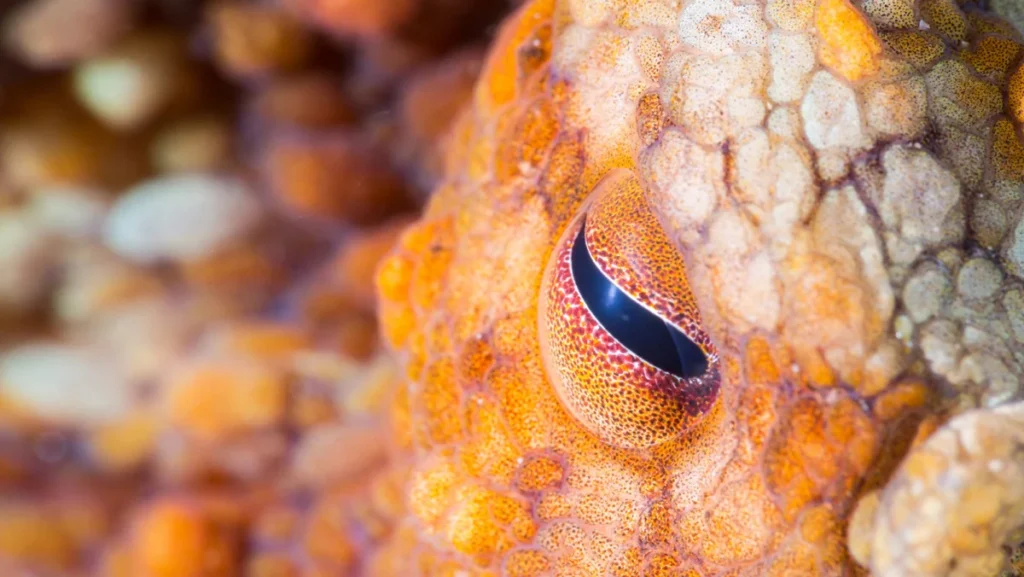
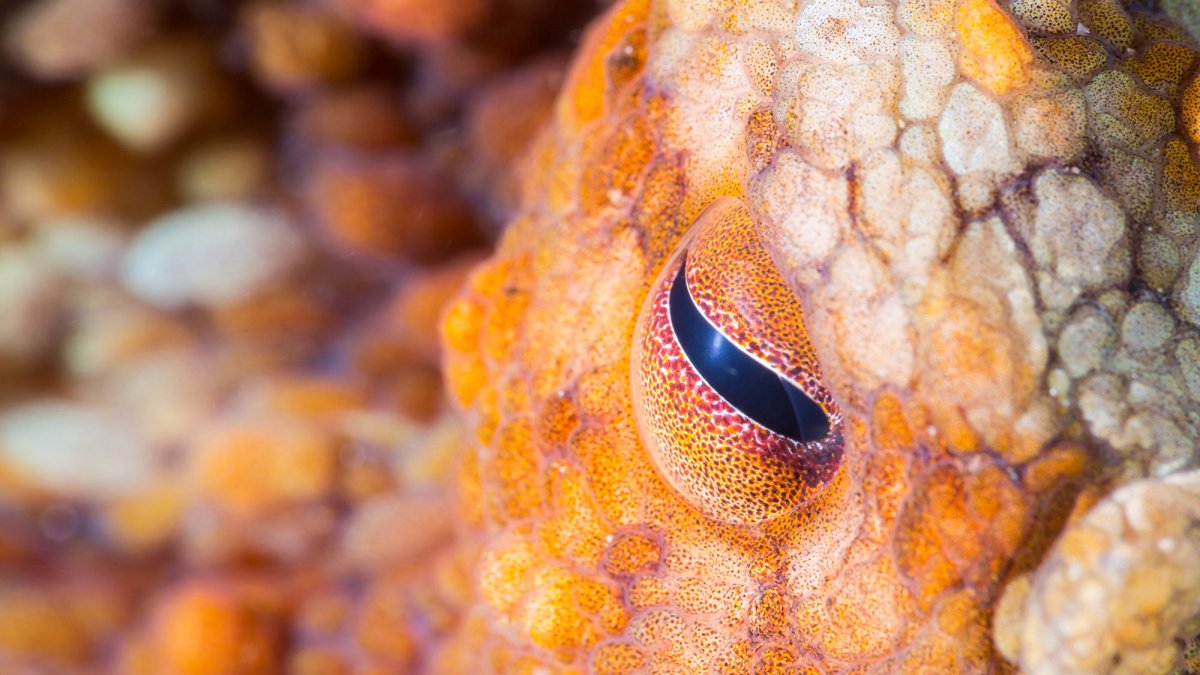
To understand the magnitude of this cognitive feat, one must examine the extraordinary biology of the octopus. Often likened to creatures of science fiction due to their truly alien-appearing anatomy, octopuses possess decentralized nervous systems. A significant portion of their neurons resides directly in their arms, allowing each limb to function with a degree of autonomous dexterity. Furthermore, they lack bony skeletons entirely, possessing only a hard, chitinous beak. This anatomical trait enables them to squeeze through any aperture larger than their beak.
Compounding these bizarre traits, octopuses can perceive light and environmental stimuli through specialized cells in their skin, effectively seeing with their entire bodies. Their sensory and motor integration operates entirely differently from vertebrates, which rely on a centralized spinal column and brain structure. Despite these vast physiological differences, both humans and octopuses exhibit a capacity for complex multitasking and spatial navigation.
The investigation into octopus mirror use was spearheaded by Dr. Mary Kieseler during her doctoral research at Dartmouth College, in collaboration with a multidisciplinary team of marine biologists and behavioral scientists. The team sought to bridge a critical gap in invertebrate research by determining whether octopuses possess the foundational cognitive architecture required to understand reflection, a prerequisite for advanced self-awareness and spatial reasoning.
Chronology of the Experiment: From Habituation to Testing
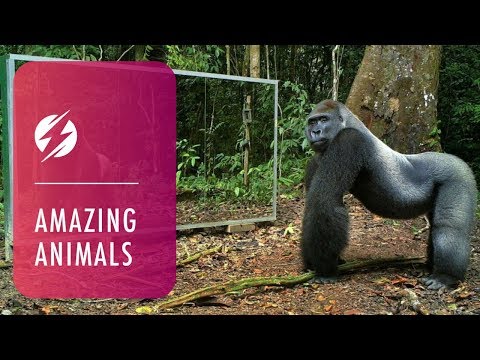
Designing an experiment to test mirror comprehension in cephalopods presented unique logistical and behavioral challenges. Traditional mirror tests for self-recognition typically involve applying a visual mark to an animal’s forehead—a location it cannot see without a reflection—and observing whether it investigates the mark upon viewing the mirror. Great apes and elephants frequently pass this test, while companion animals like dogs generally fail, relying instead on olfactory cues.
Applying this standard to an octopus is virtually impossible. An octopus’s skin is densely populated with chemoreceptors and mechanoreceptors, meaning it would physically feel any applied mark before needing a mirror to discover it. Additionally, marking a soft-bodied marine animal underwater introduces severe methodological variables. Consequently, Dr. Kieseler and her colleagues pivoted to a functional approach: evaluating whether octopuses could use mirrors as tools to locate hidden objects.
The experimental process required a meticulously structured chronology to ensure the animals experienced no distress.
Phase One: Habituation (Weeks 1 to 3)
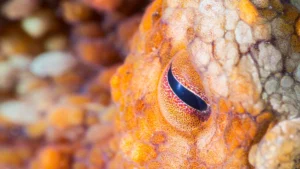
When animals encounter mirrors in unfamiliar settings, their initial reaction is often fear or aggression, perceiving the reflection as a rival or predator. To mitigate this, the research team gradually introduced mirrors into the home tanks of the California two-spot octopuses—named for the iridescent blue, eye-like spots situated beneath their actual eyes.

The researchers monitored the octopuses until they displayed complete behavioral neutrality toward their reflections. The definitive benchmark for habituation was achieved when the animals began feeding comfortably in front of the glass. In the wild, octopuses of this species avoid feeding in the direct presence of conspecifics to minimize competition and predation risks. Observing them calmly consume prey while facing their reflections signaled that the mirror was no longer perceived as a social threat.
Phase Two: Spatial Training (Weeks 4 to 6)
Once habituated, the subjects underwent baseline training to understand the spatial mechanics of a reflection. Researchers placed a live crab inside a transparent glass jar—a container the octopuses already knew how to manipulate and open—and positioned it around a corner, entirely out of direct line of sight. The sole visual indicator of the crab’s location was its reflection in a nearby mirror.
Initially, every subject exhibited an instinctive response: they swam directly toward the mirror, attempting to reach the crab through the glass. Upon reaching the barrier and realizing the physical space behind the glass was empty, the octopuses redirected their search. Across multiple iterations, each subject required between 10 and 12 trials to consistently bypass the mirror and navigate directly to the hidden jar, successfully associating the visual reflection with a real-world location.
Phase Three: The Definitive Trial (Weeks 7 to 9)
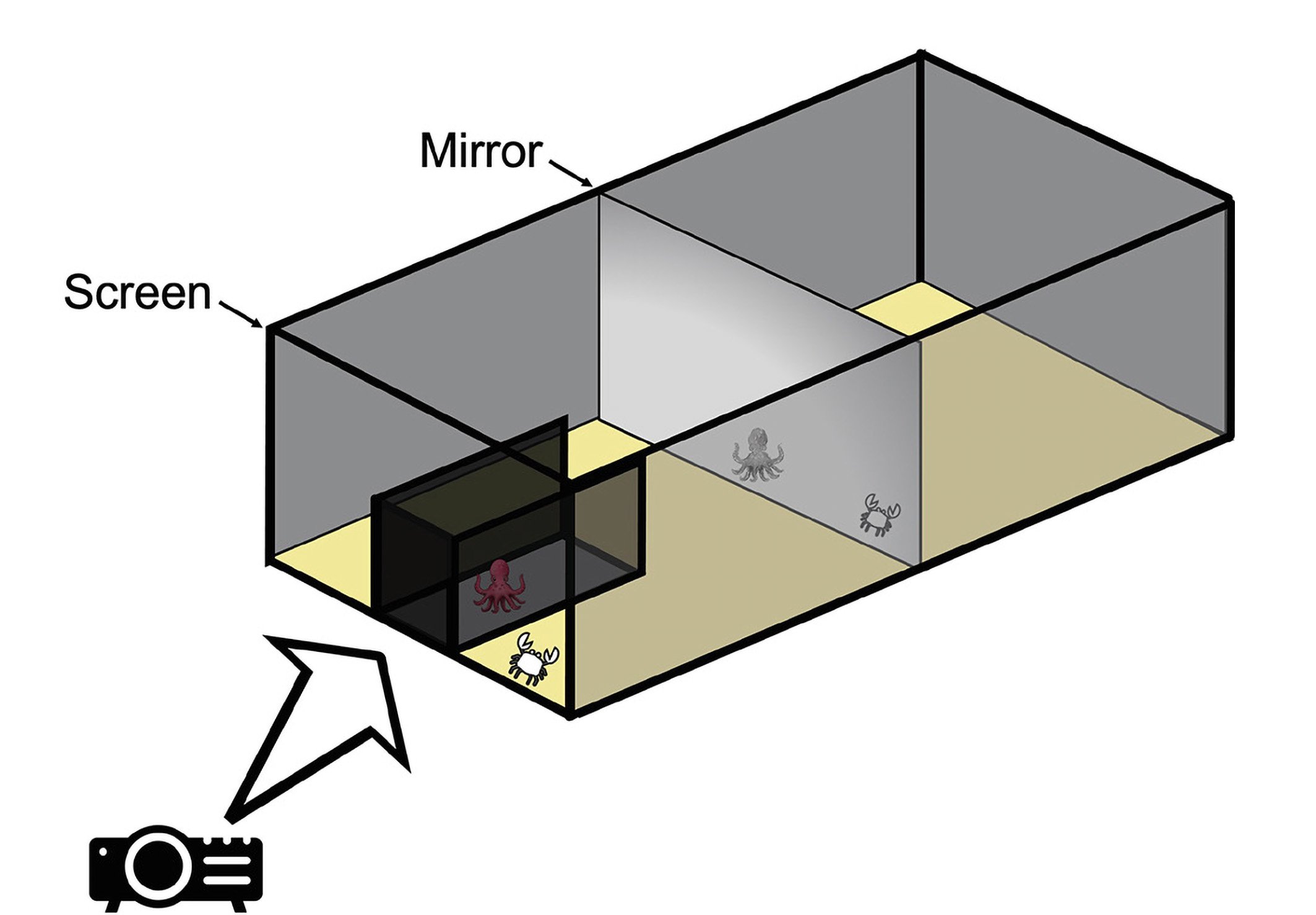
With baseline training complete, the researchers raised the stakes by introducing a controlled testing apparatus. Each octopus was placed inside a small, three-sided containment box positioned at one end of a large experimental aquarium. The open side of the box faced a full-width mirror spanning the entire wall of the tank.
Rather than using a live crab, which could emit chemical scents detectable by the octopus’s acute chemoreceptors, the team projected a moving virtual crab onto a screen positioned on the wall opposite the mirror. The virtual crab was visible to the occupant of the box only as a reflection. To secure a real food reward dropped from an overhead compartment, the octopus had to exit the containment box, turn away from the mirror, and travel to the correct side of the tank matching the reflection.
Quantitative Results and Statistical Significance
The empirical data gathered from the trials yielded statistically significant results. Across dozens of standardized trials, the California two-spot octopuses selected the correct side of the tank approximately 70 percent of the time. Rigorous statistical analysis confirmed that this success rate far exceeded random chance, proving that the animals were intentionally using the mirror’s reflection to deduce the location of the target.
An unexpected behavioral pattern emerged during the trials. Rather than exiting the box through conventional pathways and walking along the aquarium floor, several octopuses devised an innovative spatial shortcut. In 59 percent of the correct trials, the subjects simply climbed straight up and over the side wall of the containment box, scaling the vertical barrier to reach their destination more efficiently. Notably, one subject executed this vertical maneuver on its very first trial without prior prompting.
Implications for Three-Dimensional Cognition and Intelligence
Dr. Kieseler, now a postdoctoral researcher at the University of Fribourg in Switzerland, emphasizes that behaviors like vertical wall-climbing reveal profound insights into how cephalopods perceive their surroundings.
"Their understanding of their environment seems to be more three-dimensional than ours," Dr. Kieseler explains. "We cannot just walk up a wall. The octopuses can."
This advanced spatial awareness is deeply rooted in their ecological niche. In the wild, California two-spot octopuses inhabit complex marine environments where survival depends on ambushing prey from hidden vantage points while evading agile predators. Navigating this dynamic three-dimensional habitat requires a sophisticated internal map of the physical world. The same spatial cognition utilized for scaling coral reefs and rock faces appears to enable them to process reflected light and utilize mirrors as practical tools.
Furthermore, the study serves as a critical reminder within the scientific community regarding anthropocentric biases in evaluating intelligence. Historically, comparative psychology has measured cognitive capacity using metrics derived from mammalian behavior—specifically primates and domesticated species. This framework has frequently fostered the assumption that anatomical divergence correlates with diminished mental capability.
By demonstrating mirror-guided problem-solving in an invertebrate with an entirely alien neural architecture, the research challenges the notion that complex cognition is an exclusive domain of vertebrates. It suggests that nature can arrive at high-level intelligence through completely separate evolutionary trajectories. As behavioral researchers continue to probe the depths of cephalopod psychology, findings like these expand our comprehension of what intelligent life can look like, proving that brilliance in the animal kingdom often manifests in ways humanity is only beginning to understand.