


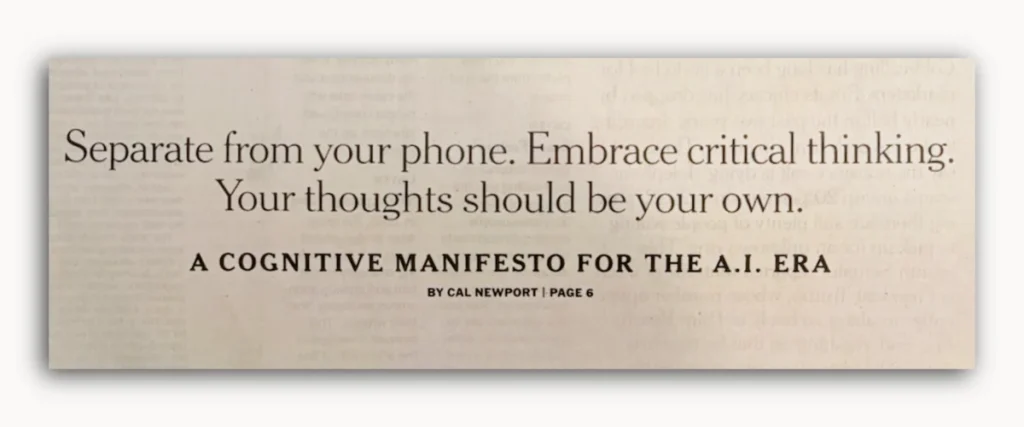
Ten years after its initial publication, Cal Newport’s influential book, Deep Work: Rules for Focused Success in a Distracted World, continues to resonate in an increasingly fragmented digital landscape. Marking the decade milestone since its 2016 release, Newport has issued a stark warning in a recent New York Times essay, articulating that the very problems the book sought to address have not only persisted but have significantly worsened, pushing humanity to the brink of losing its capacity for profound thought. His assessment culminates in a compelling call for a societal "revolution in defense of thinking."
The Genesis of Deep Work
When Deep Work first arrived on shelves in 2016, it was Newport’s second mainstream hardcover book exploring ideas related to productivity and professional success. Its predecessor, So Good They Can’t Ignore You: Why Skills Trump Passion in the Quest for Work You Love, had achieved modest success, leading to tempered expectations for the follow-up. This environment of lower pressure, Newport reveals, afforded him the freedom to delve deeply into the conceptual intricacies of distraction and focus that genuinely captivated him, writing the book largely for his own intellectual exploration.
At its core, Deep Work posited a radical idea for its time: many knowledge work organizations systematically undervalued the power of sustained, undistracted focus. Newport was convinced this oversight presented a substantial competitive advantage for individuals and entities willing to deliberately cultivate it. He envisioned his work as a kind of Moneyball for the "cubicle class," applying an analytical, counter-intuitive approach to optimize an overlooked resource—cognitive focus. Beyond the economic imperative, Newport also anchored his arguments in a philosophical conviction: the act of deep thinking, he argued, was fundamental to the post-Paleolithic human experience, serving as the wellspring of our most significant innovations, deepest satisfactions, and even moments of transcendence.
This fusion of economic pragmatism and philosophical depth distinguished Deep Work from much of the existing productivity literature. Contemporary readers might have anticipated a narrative replete with a harried executive’s tale, followed by a regurgitation of statistics on interruptions, and then a series of easily digestible, non-challenging tips, all delivered in a conversational tone and buttressed by carefully curated, if not fabricated, case studies. However, Deep Work defied these conventions. Newport’s approach was notably more rigorous and idiosyncratic. A recent re-reading of the text highlights its eclectic narrative, which frequently diverged from the corporate knowledge sector. He drew inspiration from philosophers of religion, profiled a blacksmith employing ancient forging techniques, detailed the practices of memory champions, and explored chavruta, the Jewish tradition of paired Talmudic or Torah study. Instead of opening with the familiar trope of a frustrated executive, Newport chose to begin with Carl Jung’s struggles to liberate himself from the intellectual orbit of Sigmund Freud. This deliberate and personal curation of sources and ideas lent the book an unusual authenticity and intellectual heft.
A Resounding Success and Delayed Vindication
This unconventional approach proved remarkably resonant. Deep Work quickly found a receptive audience, a testament to its articulation of a fundamental truth about the increasingly problematic state of work in the mid-2010s. The book went on to sell over two million copies and was translated into more than forty-five languages, establishing itself as a foundational text in the realms of productivity, personal development, and the future of work. Its success also provided a retrospective vindication for Newport’s earlier work; So Good They Can’t Ignore You subsequently gained traction, quietly selling over half a million copies and solidifying Newport’s reputation as a thought leader.
The book’s influence extended beyond mere sales figures. It sparked widespread discussions in corporate boardrooms, academic circles, and among individual professionals grappling with the escalating demands on their attention. Organizations began to experiment with "deep work blocks," "no-meeting days," and policies aimed at reducing digital noise. The concept of "deep work" entered common parlance, becoming a benchmark for focused intellectual effort.
The Worsening Crisis: 2016 to 2026
Despite the book’s profound impact and the increased awareness it generated, Newport’s recent assessment paints a grim picture of the intervening decade. In his New York Times essay, published on March 27, 2026, he directly addresses the question of how the landscape of focus has evolved since Deep Work‘s publication. His answer is unequivocally pessimistic: "The problems I focused on in Deep Work, and in my writing since, have been getting steadily worse. In 2016 my main concern was helping people find enough free time for deep work. Today I think we’re rapidly losing the ability to think deeply at all, regardless of how much space we can find in our schedules for these efforts."
This deterioration, Newport argues, is attributable to several converging factors that have intensified the assault on human attention.
- Workplace Distractions: The proliferation and widespread adoption of instant messaging platforms like Slack and low-friction digital meeting solutions such as Zoom have fundamentally altered the rhythm of knowledge work. The expectation of immediate responses, the constant flow of notifications, and the omnipresence of virtual meetings have fragmented attention, making sustained focus an increasingly rare commodity. Studies from reputable research firms indicate that the average knowledge worker now spends over 60% of their day responding to emails and messages or attending meetings, leaving minimal time for concentrated, creative tasks. This "hyperactive hive mind" culture, as Newport terms it, has become the default operating mode for many organizations.
- Social Media’s Transformation: In 2016, social media, while already pervasive, was still largely viewed with a degree of admiration for its connective potential. Over the past decade, however, it has undergone a significant evolution, morphing into what Newport describes as an "addictive TikTok-ified slurry of optimized brain rot." Platforms have refined their algorithms to maximize engagement, often at the expense of user well-being, fostering short attention spans and an insatiable craving for novel, rapidly consumable content. Research from psychology departments consistently highlights the links between excessive social media use, decreased attention spans, and rising rates of anxiety and depression among users, particularly younger demographics.
- The Rise of AI and Intellectual Shortcuts: The emergence of sophisticated Artificial Intelligence tools presents a new and insidious threat to deep cognition. While AI offers powerful capabilities for automation and efficiency, Newport warns that it also provides "quick-fix short-cuts to whatever intellectually engaging work activities remain." By offloading complex tasks that once required significant human thought and problem-solving, AI risks atrophying cognitive muscles, diminishing the perceived need for deep analytical engagement. If humans increasingly rely on AI to perform the demanding intellectual heavy lifting, the inherent human capacity for such work may gradually erode.
The Economic and Societal Implications of Cognitive Decline
The implications of this steady decline in the ability to think deeply are far-reaching, affecting not only individual well-being but also societal progress and economic vitality.
- Innovation and Problem Solving: Deep thinking is the bedrock of true innovation. Complex challenges, from scientific breakthroughs to intricate policy solutions, demand sustained, uninterrupted cognitive effort. A society losing its capacity for deep work risks stagnating, unable to generate the novel ideas and nuanced solutions required to address global issues.
- Economic Productivity: While superficial metrics might suggest increased productivity due to rapid communication and automation, the quality and originality of output may suffer. An economy reliant on shallow work may find itself less competitive in the long run, unable to foster the high-value intellectual capital that drives sustainable growth. Research indicates that context switching, a common byproduct of constant distraction, can reduce productivity by up to 40% and increase error rates.
- Mental Health and Well-being: The constant barrage of information and the perpetual state of partial attention contribute significantly to mental fatigue, stress, and burnout. Individuals struggling to maintain focus often report higher levels of anxiety and a decreased sense of accomplishment, even when busy. Reclaiming deep work is not just about productivity, but about restoring a sense of control and fulfillment in one’s professional and personal life.
- The Future of Human Cognition: Newport’s most profound concern is the long-term impact on human cognitive capacity itself. If the environment consistently disincentivizes deep thought, and if technology offers ubiquitous alternatives, humanity risks a permanent shift towards a shallower mode of processing information, potentially altering the very fabric of human intelligence.
A Call to Arms: The Revolution in Defense of Thinking
Confronted with this escalating crisis, Newport argues that merely advising individuals to read Deep Work or to practice personal strategies for focus is no longer sufficient. While he still encourages engagement with the book’s principles, he believes a more robust and collective response is urgently required. He advocates for a "revolution in defense of thinking," a societal movement aimed at recalibrating our relationship with technology and restoring the value of sustained cognitive effort.
While the New York Times essay’s specific action points were not detailed in the provided excerpt, Newport’s broader body of work and his philosophical stance allow for the inference of several concrete actions such a revolution might encompass:
- Advocacy for Deep Work Environments: This would involve pushing for corporate and educational policies that actively protect and promote periods of uninterrupted focus. Examples include designated "deep work" blocks free from meetings and digital communication, "no-email Fridays," or the creation of physical spaces designed for concentration.
- Technological Minimalism and Intentionality: Beyond individual digital detoxes, this pillar would advocate for a societal re-evaluation of our default relationship with technology. It would encourage conscious design of digital tools that respect user attention rather than exploiting it, and promote widespread adoption of practices like scheduled digital breaks, turning off non-essential notifications, and segmenting device usage.
- Educational Reform for Attention Training: A revolution in thinking would necessitate pedagogical changes, teaching younger generations the skills of sustained attention, critical analysis, and information synthesis in an increasingly distracting world. This could involve incorporating mindfulness practices, fostering reading comprehension of complex texts, and reducing reliance on screen-based learning tools that promote shallow engagement.
- Corporate Responsibility and Policy Shifts: Companies would be encouraged to adopt communication protocols that prioritize asynchronous interaction over real-time demands, reducing the burden of instant responsiveness. This includes policies that discourage constant monitoring of communication channels outside of core working hours and foster a culture that values thoughtful output over performative busyness.
- Individual Empowerment and Cognitive Resilience: At the personal level, the revolution would encourage individuals to actively cultivate practices that build cognitive resilience, such as structured daily routines, deliberate practice of challenging skills, regular periods of reflection, and the intentional engagement with demanding intellectual material. It’s about reclaiming agency over one’s own mind.
Newport’s conclusion in his Times op-ed encapsulates the urgency and personal commitment driving this call to action: "I’m done ceding my brain — the core of all that makes me who I am — to the financial interests of a small number of technology billionaires or the shortsighted conveniences of hyperactive communication styles. It’s time to move past fretting about our slide into the cognitive shallows and decide to actually do something about it."
This sentiment underscores a pivotal moment. The decade since Deep Work was published has seen an undeniable acceleration in the challenges to human focus. Newport’s call for a "revolution" is not merely an academic observation but a deeply personal and societal plea to safeguard one of humanity’s most vital assets: the capacity for deep, meaningful thought. The success of such a revolution will determine not only the future of work but potentially the very trajectory of human intellectual evolution in the digital age.