



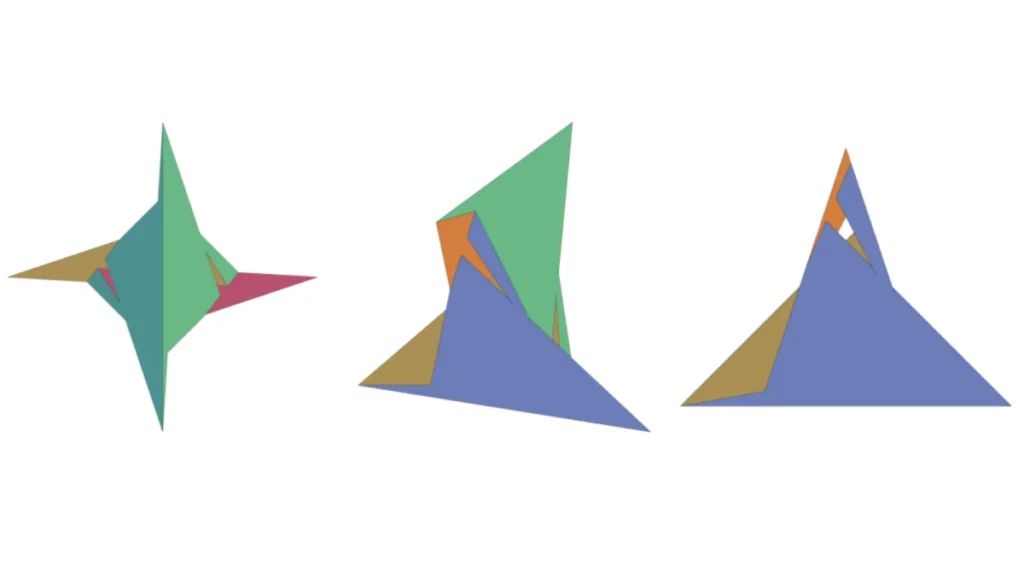
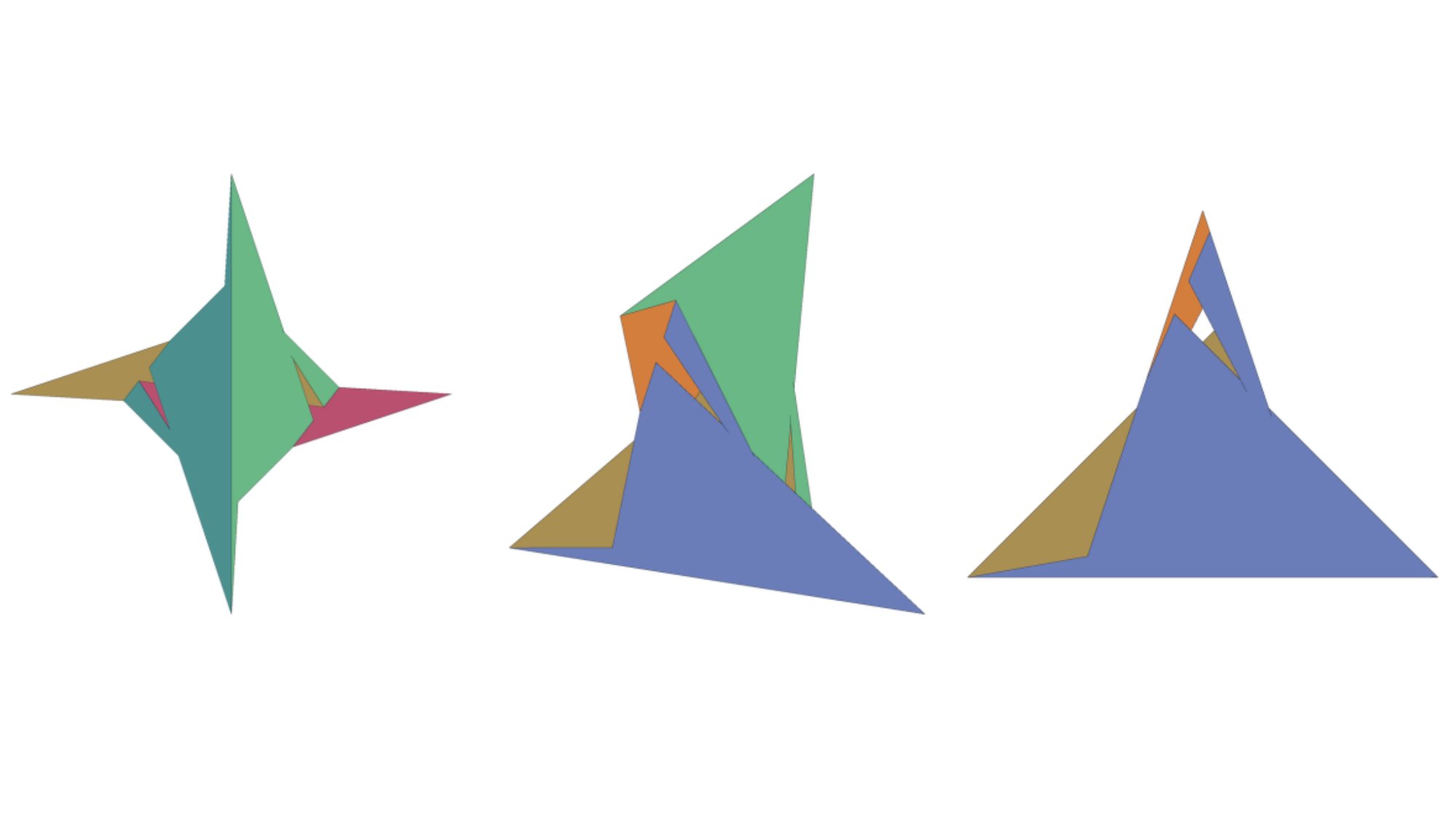
Mathematics has long been perceived as a fixed, immutable system where foundational truths were settled centuries ago by ancient Greek scholars. Yet, the discipline continues to yield unexpected surprises. In a recent pre-print study uploaded to the arXiv repository, independent researcher Ruslan Mizhaev has introduced a groundbreaking three-dimensional geometric shape to the scientific community: the genus-3 polyhedron. This bizarre, highly interconnected toroidal polytope challenges our conventional understanding of spatial relationships, featuring eight flat faces, 26 edges, 24 vertices, and three distinct central holes.
While everyday geometry deals with familiar, predictable objects like cubes, spheres, and pyramids—shapes governed by simple symmetry and regular structures—Mizhaev’s creation belongs to an esoteric subfield known as toroidal topology. The discovery has quickly generated intense discussion among topologists, graph theorists, and computational mathematicians worldwide, highlighting how much remains undiscovered within the realm of pure spatial mathematics.
Main Facts of the Discovery
The newly defined genus-3 polyhedron is an extraordinary exercise in spatial connectivity and combinatorial topology. According to Mizhaev’s preliminary research paper, the structure comprises exactly eight polygonal faces arranged in such a manner that every single face shares an edge with every other face.
To visualize this feat of geometry, it helps to compare it to conventional multi-sided objects. In standard polyhedrons, certain faces are isolated from others by intervening surfaces. However, the genus-3 polyhedron achieves a rare level of mutual adjacency across its 26 straight edges and 24 vertices. Specifically, 20 pairs of faces share a single edge, while eight other face pairs share two distinct edges. At every single vertex where the structure’s lines converge, exactly three faces meet.
Perhaps the most visually striking feature of the object is its genus rating. In topology, the "genus" of a surface corresponds to the number of holes it possesses—a donut or a coffee mug handle represents a genus-1 object, a figure eight has a genus of two, and Mizhaev’s shape contains three distinct, interlocking loops or perforations. This classification places the shape firmly within the category of toroidal polytopes, a specialized class of polyhedrons that double as toruses. Despite its radical complexity, Mizhaev demonstrated that the entire structure can be easily mapped, constructed, and replicated by other mathematicians using straightforward integer coordinates.
Background Context: The Evolution of Polyhedral Topology
To appreciate the significance of the genus-3 polyhedron, one must understand the historical lineage of non-standard spatial shapes. For centuries, geometry was dominated by the Platonic solids—the tetrahedron, cube, octahedron, dodecahedron, and icosahedron—which adhere to strict rules of symmetry and face uniformity. Even as mathematics expanded into Descartes’ coordinate systems and non-Euclidean geometries, researchers rarely strayed into shapes with complex internal topology.
The landscape shifted significantly in the 20th century with the exploration of toroidal polyhedrons. A major milestone occurred in 1977 when Hungarian mathematician Ákos Császár discovered the Császár polyhedron, a non-self-intersecting toroidal polyhedron with 14 faces, 21 edges, and seven vertices. Famously, every one of the Császár polyhedron’s faces shares a border with every other face, meaning there are 21 edge-sharing pairs among its 14 faces. Shortly before that, the Szilassi polyhedron—discovered by Lajos Szilassi in 1977—showcased a similar all-adjacent property with seven hexagonal faces and 21 edges, forming a toroidal shape with a single hole.
These historical discoveries proved that standard rules of Euler characteristic equations could be stretched and adapted when applied to surfaces with higher topological complexity. However, finding new variants with unique genus ratings and specific adjacency constraints remains exceptionally rare. Mizhaev’s genus-3 polyhedron extends this lineage, providing a fresh template for exploring how faces, edges, and vertices interact when multiple holes are introduced into a closed, flat-faced polygonal system.
Chronology of the Research
The path leading to the public disclosure of the genus-3 polyhedron follows the modern academic pipeline, heavily reliant on collaborative preprint servers and open-access digital networks.
In September 2026, Ruslan Mizhaev finalized his theoretical framework describing the coordinates, symmetry groups, and adjacency matrices of the shape. On September 28, 2026, the pre-print study titled detailing the geometry of the genus-3 polyhedron was officially uploaded to arXiv, an open-access archive for scholarly articles in physics, mathematics, computer science, and related fields.
Shortly after its appearance on the preprint server, the discovery caught the attention of science journalists and mathematics communicators. Prominent science publications, including New Scientist, profiled the research in early October 2026, bringing the obscure toroidal polytope out of specialized academic circles and into mainstream public awareness.
Because the study currently exists as a pre-print, it has not yet undergone the rigorous, multi-month peer-review process required for publication in a traditional, peer-reviewed mathematical journal. However, the mathematical community has already begun independent validation efforts, utilizing the integer coordinates provided in Mizhaev’s paper to render 3D digital models and verify the shape’s combinatorial properties.
Supporting Data and Mathematical Implications
While the average person encounters geometry primarily through physical architecture or basic computer-aided design, research into high-genus polyhedrons serves deeper theoretical functions. The implications of Mizhaev’s work stretch across several distinct mathematical domains:
- Combinatorial Topology: By mapping how eight faces can universally interconnect across a three-hole surface, the study offers new data points for understanding the limits of surface embedding and map coloring theorems on non-orientable or high-genus manifolds.
- Graph Theory: The vertices and edges of the genus-3 polyhedron form a dense planar-like graph embedded in a toroidal space. Analyzing the connectivity of these nodes provides insights into network routing, structural integrity, and spatial optimization problems.
- Three-Dimensional Modeling: The ability to define the shape using simple integer coordinates means that computer scientists and material engineers can easily generate these complex geometries for algorithmic testing, stress-testing software, and manufacturing exploratory structures.
Although it remains an open question whether structures resembling the genus-3 polyhedron naturally occur in biological systems, chemical lattices, or crystalline formations, mathematicians note that theoretical models often precede practical applications. Complex topological configurations frequently find later use in nanotechnology, metamaterials design, and quantum physics.
Official Responses and Academic Reactions
The unveiling of the genus-3 polyhedron has elicited a mix of fascination and caution from the broader academic community. Because independent researchers occasionally publish novel mathematical theories outside of traditional university systems, peer verification is treated as an essential next step.
Prominent mathematicians specializing in topology and polytope theory have expressed cautious optimism regarding Mizhaev’s findings. Initial open-source coding tests performed by community mathematicians indicate that the coordinate set provided in the arXiv pre-print accurately constructs a closed, non-self-intersecting polyhedral surface with the claimed properties.
"Discovering a new member of the toroidal polytope family is always a notable event in geometry," noted a computational topology researcher not directly involved with the study. "The primary challenge with shapes of this complexity is ensuring that all edge intersections, face planarity requirements, and topological invariants hold up under strict mathematical scrutiny. If Mizhaev’s coordinates and adjacency proofs withstand formal peer review, this shape will rightfully earn a permanent place in topology textbooks alongside the Császár and Szilassi polyhedrons."
Broader Impact and Future Outlook
The introduction of the genus-3 polyhedron underscores a fundamental truth about scientific inquiry: the universe of abstract thought is virtually infinite. Even in foundational fields like geometry—where scholars have mapped shapes for millennia—new dimensions of complexity remain hidden just beneath the surface, waiting for the right combination of spatial reasoning and computational tools to be uncovered.
As the pre-print undergoes broader peer review in the coming months, mathematicians plan to test the structural boundaries of Mizhaev’s shape. Researchers will explore whether similar algorithms can generate higher-genus variants, potentially uncovering a vast, uncharted family of polyhedrons featuring four, five, or even more central holes.
Whether the genus-3 polyhedron ultimately transitions from a theoretical curiosity into a functional blueprint for advanced materials or computer algorithms, its immediate value lies in expanding human imagination. It stands as a vivid reminder that mathematics is not merely a catalog of settled answers, but an ongoing expedition into the architecture of space itself.