
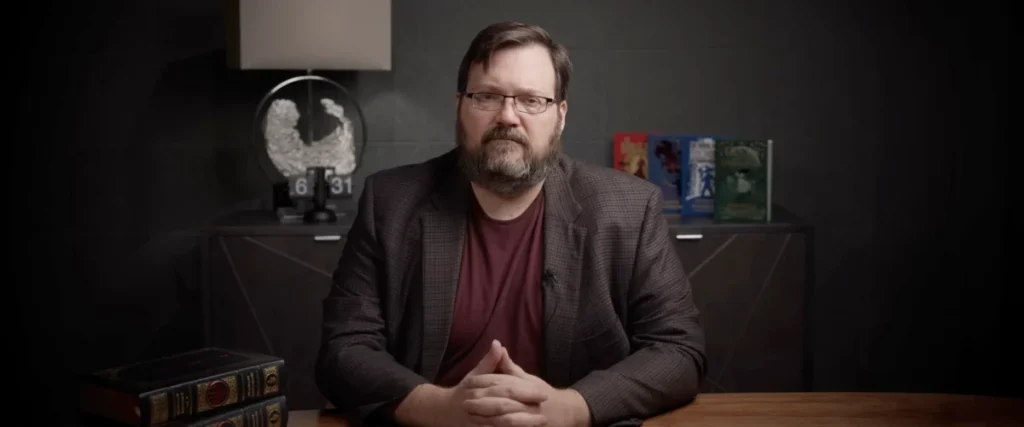
Late last year, acclaimed fantasy novelist Brandon Sanderson delivered a seminal address titled "The Hidden Cost of AI Art" at Dragonsteel Nexus, the annual conference organized by his media company. The talk, which resonated deeply within the creative community and beyond, presented a nuanced yet firm stance against the prevailing trends in generative artificial intelligence, particularly concerning its application in artistic endeavors. Sanderson, known for his prolific output and innovative storytelling in universes like the Cosmere, acknowledged the technological fascination surrounding AI while articulating a profound unease regarding its implications for human creativity.
The Dragonsteel Nexus and Sanderson’s Platform
Dragonsteel Nexus serves as the primary gathering for fans of Brandon Sanderson’s expansive literary works, offering a unique platform for community engagement, announcements, and discussions directly from the author himself. Held amidst a period of rapid technological advancement and escalating debates surrounding artificial intelligence, Sanderson’s decision to dedicate his keynote to "The Hidden Cost of AI Art" underscored the urgency and gravity of the issue for creators. As one of the most successful and influential fantasy authors of his generation, Sanderson’s views carry significant weight, not only among his dedicated fanbase but also within the broader literary and artistic industries grappling with AI’s transformative potential. His approach, characterized by a desire to understand rather than merely condemn, provided a framework for a more introspective examination of art’s fundamental value.
Deconstructing the "Hidden Cost": Beyond Common Objections
Sanderson initiated his address by acknowledging the intriguing nature of large language models and generative AI, stating, "The surge of large language models and generative AI raises questions that are fascinating, and even if I dislike how the movement is going in relation to writing and art, I want to learn from the experience of what’s happening." This open-mindedness, however, did not dilute his clear disapproval of AI-generated art, which he described as causing his "stomach to turn."
Rather than dwelling on frequently cited concerns such as intellectual property infringement, the economic displacement of artists, or the lack of genuine "soul" in algorithmic creations—issues that have dominated much of the public discourse—Sanderson sought a more fundamental, personal understanding of his discomfort. While these common objections are valid and form the bedrock of many legal and ethical challenges against generative AI companies, Sanderson delved deeper, ultimately dismissing them as the primary reason for his visceral reaction. He posited that while these are important facets of the debate, they do not fully capture the profound "hidden cost" he perceives.
The Transformative Journey of Creation: Art as a Process
Sanderson’s core argument pivoted on the transformative impact of the creative process on the artist themselves, rather than solely on the resulting product. Drawing from his own struggles with early, unsuccessful book manuscripts, he articulated that the true value of art lies in the journey of its creation. He explained, "Maybe someday the language models will be able to write books better than I can. But here’s the thing: Using those models in such a way absolutely misses the point, because it looks at art only as a product."
He elaborated on the profound personal satisfaction derived from the arduous task of bringing a creative vision to fruition. Reflecting on the completion of his first novel, despite its eventual failure to be published, Sanderson described it as a moment of "sweet, beautiful, and transcendent" accomplishment. "I was holding that manuscript, thinking to myself, ‘I did it. I did it,’" he recounted. This personal anecdote powerfully illustrated his conviction that the act of creation fundamentally changes the artist, fostering growth, resilience, and a unique sense of achievement that cannot be replicated by delegating the process to an algorithm. The "hidden cost," therefore, is the forfeiture of this profound human experience—the learning, the struggle, and the ultimate triumph of personal creation.
Art as Deep Human Communication: A Complementary Viewpoint
Complementing Sanderson’s focus on the artist’s internal transformation, the commentary accompanying his talk introduced another critical dimension: art as an act of profound human communication. This perspective posits that art serves as a form of "telepathy," where an artist uses a tangible medium—be it prose, paint, or sound—to transmit a complex internal cognitive state from their mind to that of their audience. This exchange, deeply rooted in shared human experience and empathy, establishes a unique connection between creator and consumer.
From this viewpoint, the notion of engaging with a book written by a language model or a film generated by a prompt becomes "intrinsically absurd, if not anti-human." Such creations, while potentially mimicking human artistic output, lack the essential element of genuine human intent and experience. They are described as a "quixotic simulation of love," offering an imitation of connection without the authentic human spark that gives art its meaning and resonance. This perspective reinforces the idea that the "cost" of AI art extends beyond the creator to the audience, potentially diminishing the depth and authenticity of cultural engagement.
The Broader Landscape of Generative AI in 2023
Sanderson’s address occurred against a backdrop of unprecedented acceleration in generative AI capabilities throughout 2023. The year witnessed the widespread public release and rapid refinement of powerful large language models like OpenAI’s ChatGPT and Google’s Bard (now Gemini), alongside advanced image generators such as Midjourney V5, Stable Diffusion XL, and DALL-E 3. These tools demonstrated an astonishing ability to produce text, images, and even audio and video with remarkable speed and quality, often indistinguishable from human-made content to the untrained eye.
This technological surge triggered a flurry of activity and concern across creative industries. Numerous artists, writers, and illustrators voiced fears of job displacement, particularly in entry-level or highly commoditized creative roles. Data from various sources indicated a significant shift in creative workflows; for instance, a 2023 survey by the Artists’ Guild found that over 60% of professional artists expressed concern about AI’s impact on their livelihoods, with 20% already reporting a decrease in commissions due to AI alternatives. The market for generative AI tools itself saw explosive growth, projected to reach billions of dollars within the next few years, signaling a substantial economic reorientation.
Legal challenges also mounted rapidly. Copyright lawsuits were filed against major AI developers by prominent artists and authors, alleging that their copyrighted works were used without permission to train these powerful models. Cases brought by authors’ guilds and individual writers against companies like OpenAI and Anthropic highlighted the complex legal quagmire surrounding data provenance and fair use in the context of AI training. These disputes underscored a critical question: who owns the output of AI when its training data is derived from human-created works?
Defining Art in the Age of Machines: Agency and Resistance
Perhaps the most potent message from Sanderson’s talk was his conclusion, a powerful assertion of human agency in the face of technological determinism. He argued that if art is fundamentally human, then it is humanity’s prerogative to define it. "That’s the great thing about art – we define it, and we give it meaning," he declared. His statement served as a rallying cry against the often-perceived inevitability of AI’s encroachment into creative domains.
Sanderson’s assertion, "The machines can spit out manuscript after manuscript after manuscript. They can pile them to the pillars of heaven itself. But all we have to do is say ‘no,’" struck a chord with many weary of what he termed "nihilistic passivity" in contemporary AI commentary. This prevalent narrative, characterized by authors laying out grim scenarios of AI’s destructive potential and then offering no path forward, fosters a sense of helplessness. Sanderson’s message, by contrast, was one of empowered resistance, reminding individuals and communities that they possess the ultimate authority to determine what they value as art and, by extension, how they choose to shape their cultural future. It suggested that the whims of tech giants like Sam Altman or Dario Amodei, while influential, do not unilaterally dictate the definition of human artistic expression.
Implications for the Creative Industries and Society
Sanderson’s insights, coupled with the broader discussions surrounding generative AI, carry significant implications for the future of creative industries and society at large.
Legal and Ethical Frameworks: The ongoing legal battles over copyright and intellectual property rights for AI-generated content and AI training data will be crucial in shaping the economic landscape for creators. Clearer regulations are needed to protect artists’ works while fostering innovation. Ethical guidelines are also paramount to address concerns around attribution, authenticity, and the potential for misuse or manipulation of AI-generated content.
Economic Models and the Future of Work: While some roles may be automated, the demand for human creativity, curation, and unique vision is likely to persist, albeit in evolved forms. Creators may increasingly leverage AI as a sophisticated tool for assistance, ideation, or mundane tasks, allowing them to focus on the higher-level conceptual and emotional aspects of their work. New economic models might emerge, valuing human-verified or human-enhanced AI content at a premium, or shifting focus towards live experiences, bespoke creations, and direct artist-fan engagement.
Philosophical Questions on Creativity: The rise of generative AI forces a re-evaluation of fundamental questions: What truly constitutes creativity? Is it merely the production of novel combinations, or does it require consciousness, intent, and lived experience? Sanderson’s argument leans heavily towards the latter, emphasizing the intrinsic human value of the creative process. This debate will continue to shape how societies perceive and value artistic endeavors.
The Future of Fandom and Connection: For creators like Sanderson, whose work fosters deep fan communities, the authenticity of human authorship is paramount. Audiences often connect not just with a story, but with the human mind behind it. The potential erosion of this trust, should AI-generated content become indistinguishable or even pervasive, could fundamentally alter the relationship between creators and their public. Maintaining transparent provenance and allowing audiences to opt for human-created experiences will be vital.
In essence, Brandon Sanderson’s address at Dragonsteel Nexus served as a powerful call to action, urging both creators and consumers to actively define and safeguard the essence of human art. It highlighted that while technology provides new capabilities, the ultimate decision on what constitutes meaningful creation—and what "hidden costs" we are willing to bear—remains firmly in human hands. The ongoing dialogue, enriched by perspectives like Sanderson’s, will be critical in navigating the complex interplay between technological progress and the enduring value of human ingenuity.