


As corporate leaders look toward the 2027 fiscal horizon, a fundamental tension has emerged within the global workforce: the mounting disparity between the sheer volume of required organizational change and the human capacity to absorb it. Employees are currently tasked with mastering generative artificial intelligence, navigating rapid shifts in operational workflows, and upskilling for roles that did not exist half a decade ago, all while maintaining peak performance metrics. While these individual expectations are manageable in isolation, their cumulative effect has created a crisis of capacity, threatening to stall the very innovation organizations are desperately trying to cultivate.
The Evolution of Organizational Change: A Historical Context
To understand the current strain on workforce capacity, one must examine the rapid acceleration of enterprise change over the last decade. In 2016, the average worker navigated roughly two planned organizational changes per year. According to 2025 research from Deloitte, that figure has surged to 10. This five-fold increase in structural, technological, and procedural disruption has left a significant portion of the global workforce feeling destabilized.
Approximately 66% of employees report feeling overwhelmed by the relentless pace of change, with nearly half of the workforce expressing apprehension that they will be rendered obsolete by the speed of technological adoption. This anxiety is not unfounded; the PwC 2026 Global AI Jobs Barometer indicates that the skill requirements for roles highly exposed to AI are evolving more than twice as fast as those in roles with minimal AI integration. As the shelf-life of a specific skill set continues to shrink, the burden of "continuous reskilling" has shifted from a professional development goal to an existential workplace requirement.
Defining the Capacity Problem
In the corporate learning and development (L&D) sector, the prevailing assumption has long been that if an organization provides sufficient access to content, employee performance will naturally follow. However, contemporary analysis suggests this premise is flawed. The problem is no longer a scarcity of information; generative AI has democratized the creation of training modules, simulations, and real-time performance support. The current bottleneck is a scarcity of human bandwidth—specifically time, attention, and the mental energy required to synthesize new information into sustained practice.
Capability, or the ability of an individual to execute a required task, is distinct from capacity, which is the organizational and personal environment that allows that execution to occur. When employees are forced to complete training programs while simultaneously meeting existing performance quotas and navigating organizational shifts, the learning process often becomes a source of friction rather than an enabler of growth.
The Shift Toward Targeted Intervention
The focus for 2027 must transition from the mass deployment of curricula to the surgical application of "least-burdensome interventions." Personalization in learning is currently often misapplied as a way to create unique content pathways for every employee. A more effective strategy, according to industry analysts, is to personalize based on the gap between current capability and the specific performance requirement.
This analytical approach mandates that L&D leaders act as diagnosticians rather than just content creators. Before launching a training initiative, leaders must determine if the "performance problem" is truly a skill gap or a systemic failure. Often, what is presented as a need for training is actually a failure in workflow design, unclear leadership expectations, or outdated technological infrastructure. By bypassing unnecessary training in favor of process improvements, organizations can preserve employee energy for high-impact capability building.
Psychological Safety and Resilience as Strategic Assets
The integration of psychological safety and resilience into the learning agenda is no longer a human resources "wellness" initiative—it is a business imperative. Data suggests that in environments where employees fear the consequences of failure or feel pressured to already possess the answers to emerging challenges, capability gaps become obscured. If staff members cannot admit what they do not know, the organization cannot accurately identify where training or support is needed.
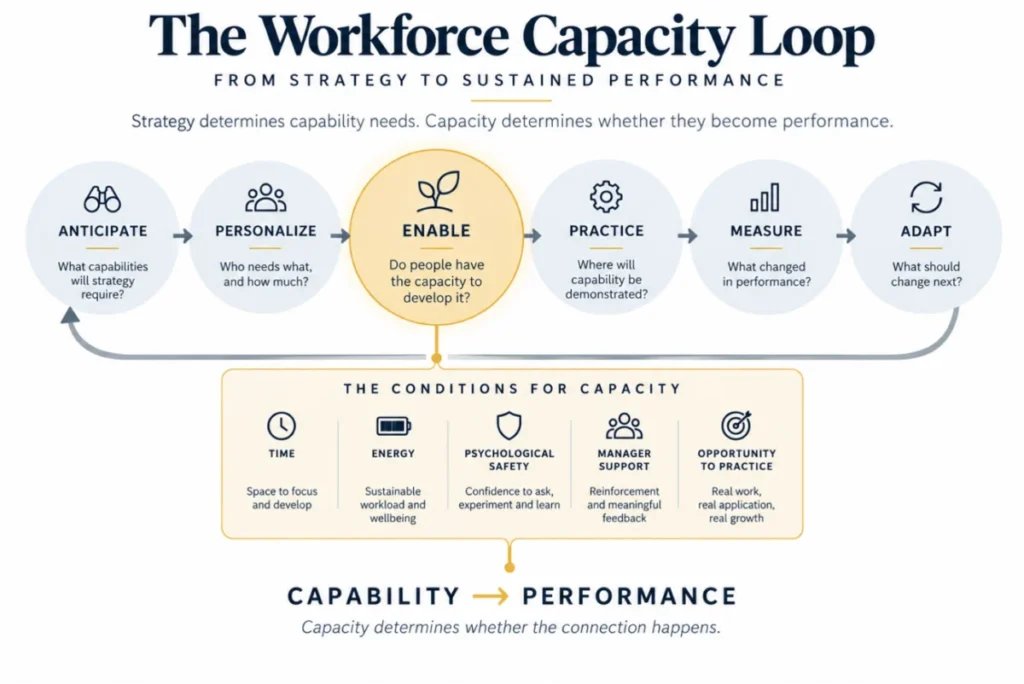
Furthermore, the concept of resilience is being recalibrated. Historically, resilience was often framed as an employee’s ability to "endure" change. Modern organizational psychology suggests that this approach is unsustainable. When workers are expected to absorb 10 significant enterprise changes per year, the burden must be managed by the organization’s structural design. If a learning initiative fails, management must evaluate the context: Was there time to practice? Was there managerial reinforcement? Did the workflow support the new behavior? If these conditions are not met, even the most robust training program will result in a net loss of capacity.
Reimagining Development Beyond the Classroom
The traditional model of continuous training—characterized by frequent, standalone courses—is facing significant scrutiny. The PwC 2026 analysis underscores that even entry-level roles now demand high-level human capabilities such as strategic judgment, empathy, and complex problem-solving. These traits are rarely mastered through passive learning; they require authentic practice, mentorship, and embedded feedback loops.
The most forward-thinking organizations are now prioritizing "learning in the flow of work." This involves using AI not to produce more content, but to provide just-in-time guidance that allows an employee to perform a task correctly without needing to memorize the underlying knowledge. This approach treats learning as a means to an end, rather than a cumulative requirement. By reducing the cognitive load on employees, companies can close capability gaps without the "training fatigue" that currently plagues many global enterprises.
The Workforce Capacity Loop
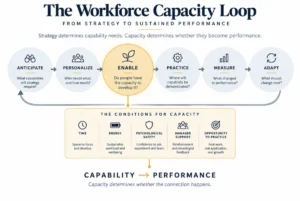
A new framework, the Workforce Capacity Loop, has emerged as a guide for 2027 strategic planning. The loop begins with a clear assessment of strategic business needs, followed by an identification of the specific capabilities required to meet those needs. Crucially, the loop includes an "enable" phase that functions as a gatekeeper. Before an initiative is deployed, leaders must verify that the conditions for success—time, psychological safety, and access to practice—are firmly in place.
Industry experts note that while the temptation to over-invest in learning platforms remains high, the most successful firms in 2027 will likely be those that demonstrate the discipline to build less. A reduction in the number of training programs, when replaced by more effective performance support and streamlined workflows, represents a strategic win.
Implications for the Future of Work
The evidence suggests that the next phase of corporate growth will not be driven by who has the largest library of training courses, but by who best manages the human energy required to implement change. As organizations enter the latter half of the decade, the primary differentiator will be the ability to balance the rapid acquisition of skills with the necessity of maintaining a stable, capable, and resilient workforce.
Executives who treat human capacity as a finite, non-renewable resource will be better positioned to navigate the coming years of technological disruption. The mandate for 2027 is clear: learn to distinguish between what the organization can technically provide and what its employees can reasonably absorb. In an era where information is abundant, the preservation of the human element is the ultimate competitive advantage.