



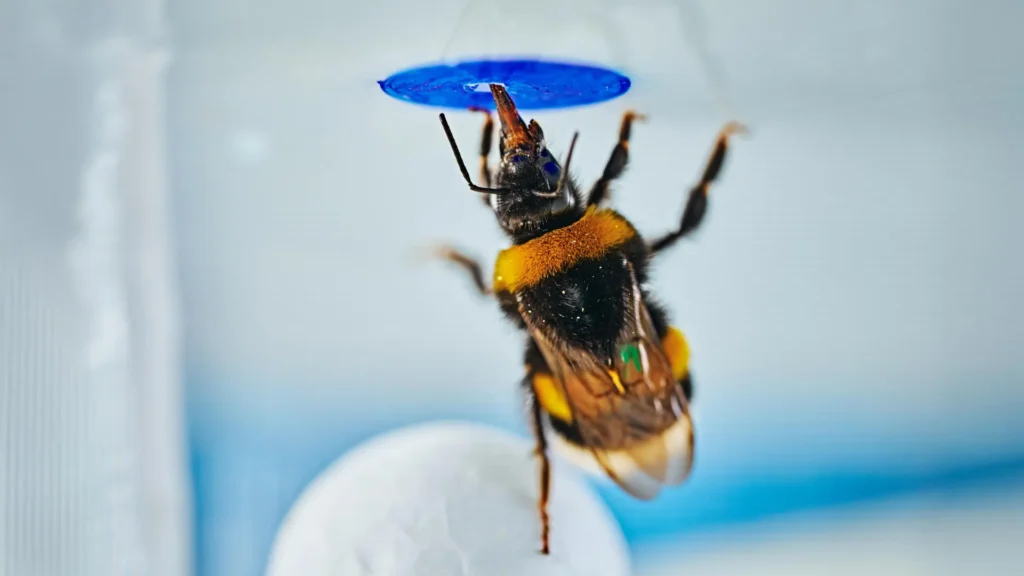
In a landmark study published in the journal Science on June 4, 2026, researchers have provided definitive evidence that bumble bees (Bombus terrestris) possess the capacity for complex, spontaneous problem-solving. This discovery disrupts a long-standing paradigm in cognitive science, which has historically maintained that the ability to combine objects in novel ways to achieve a goal—an act of insight—was a trait restricted to humans and select large-brained vertebrates, such as primates and corvids.
The study, conducted by a multi-institutional team from the University of Oulu, the University of Helsinki, and the University of Turku, presents a rigorous behavioral analysis of how insects navigate challenges for which they have no prior training. By successfully executing an "insect version" of the classic Wolfgang Köhler box-and-banana experiment, the researchers have forced a significant re-evaluation of how neurobiological architecture facilitates cognitive flexibility.
The Experimental Framework: A New Challenge for Bombus terrestris
The experiment was designed to test whether bumble bees could utilize an object as a tool to reach an otherwise inaccessible reward without being taught the necessary sequence of actions. The researchers established a controlled, transparent arena where the bees were introduced to a blue artificial flower known to contain a sucrose solution.
The chronological progression of the experiment was as follows:
- Familiarization Phase: Bees were trained to associate the blue flower with a food reward and were separately introduced to a small ball, which they could move but which had no inherent value or function.
- The "Novel Challenge" Stage: Researchers relocated the blue flower to the ceiling of the arena, placing it beyond the flight path of the bees.
- Observation Phase: Observers recorded the movement patterns of the bees as they attempted to bridge the spatial gap between their current position and the elevated reward.
The results were statistically significant. Naïve bees—those with no previous training on tool usage—demonstrated a goal-directed sequence: they identified the ball, rolled it directly beneath the elevated flower, and used it as a platform to climb upward, thereby gaining access to the reward. This sequence occurred without the insects receiving external guidance or reinforcement.
Rigorous Controls and Scientific Validation
To ensure the validity of these findings, the research team implemented a series of stringent control experiments. A primary concern for behavioral biologists in such studies is the risk of "accidental success" or "trial-and-error" learning, where the subject arrives at a solution through random movement rather than cognitive insight.
The team utilized "blinded" conditions in their advanced testing phase. In these iterations, the reward was hidden from the bees’ direct line of sight. Despite the lack of visual stimuli, the bees continued to maneuver the ball to the target area with remarkable efficiency. This effectively ruled out simple visual guidance or phototaxis as the primary drivers of the behavior.
"By analyzing the bees’ behavior across unusually stringent control experiments, we could show that they were not simply reacting to visual stimuli or moving the ball randomly," explained lead author Akshaye Bhambore. The researchers calculated the "path efficiency" of the bees, finding that successful subjects moved in directed, purposeful trajectories rather than erratic patterns often associated with exploratory search behavior.
Historical Context and Cognitive Evolution
The debate regarding animal intelligence has evolved significantly since the early 20th century. In 1917, German psychologist Wolfgang Köhler famously observed chimpanzees stacking wooden crates to reach bananas suspended from the ceiling of their enclosure. Köhler argued that this demonstrated "insight"—the sudden realization of how to use objects as tools to solve a novel problem.
For over a century, this behavior was considered a benchmark of higher-order cognitive processing, generally attributed to the complex prefrontal cortices found in mammals. The Oulu-Helsinki-Turku study, however, suggests that the neural machinery required for such problem-solving is not exclusive to large brains.
"For over a century, spontaneous object-based problem-solving has mostly been studied in vertebrates," noted senior author Olli Loukola. "Our study suggests insects may belong in that conversation too." This finding adds to a growing body of literature that demonstrates insect intelligence is far more sophisticated than previously assumed. Previous studies have documented bumble bees engaging in social learning, where they observe and mimic the tool use of peers, and adapting their foraging strategies to shifting environmental variables.
Neurobiological Implications
The implications of this study extend into the field of neurobiology, specifically concerning the scaling of cognitive power. With a brain mass of only a few milligrams, the bumble bee manages to achieve behavioral outputs that require high-level spatial awareness, memory retention, and the ability to link disparate concepts (the flower reward and the movable object).
While the researchers are careful to emphasize that these results should not be anthropomorphized, they do suggest a paradigm shift. "We are not claiming that bees think like humans," Loukola stated. "But our findings show that miniature brains can generate flexible solutions to novel problems in ways we are only beginning to understand."
The research highlights the efficiency of the insect nervous system. Rather than requiring a massive volume of neurons, the bees appear to utilize a highly optimized neural network capable of performing complex computations. This efficiency is of particular interest to robotics and artificial intelligence researchers, who seek to develop "edge computing" solutions that mimic biological systems by performing high-level tasks with minimal energy and processing power.
Reactions and Future Directions
The scientific community has noted the study’s impact, particularly the methodological rigor applied to the "naïve" status of the test subjects. By using bees that had never interacted with the ball in the context of a puzzle, the researchers avoided the confounding variable of latent learning.
However, the findings also prompt new questions:
- Neural Correlates: Which specific regions of the insect brain are activated during these "insight" moments?
- Ecological Drivers: Does this problem-solving ability serve an evolutionary advantage in natural settings, or is it a byproduct of general learning mechanisms?
- Universality: Are these cognitive abilities common across other Hymenoptera species, such as ants or wasps?
Future research is expected to focus on the neural mapping of these behaviors. If insects can solve "box-and-banana" style problems, it raises the possibility that the foundations of logic and spatial reasoning are more deeply embedded in the evolutionary tree than once believed.
Broader Scientific Impact
The study of Bombus terrestris serves as a sobering reminder of the limitations of human-centric intelligence metrics. By observing the insects’ ability to perform highly efficient sequences of actions, researchers are forced to confront the reality that intelligence is not a linear spectrum with humans at the peak, but a multi-faceted set of adaptations tailored to environmental demands.
As the scientific community digests these findings, the focus will likely shift toward reconciling the "miniature brain" constraint with the "complex solution" output. Whether through advanced sensory integration or a previously unidentified form of neural plasticity, the bumble bee has solidified its place as a critical model organism for studying the fundamental mechanics of problem-solving.
In conclusion, the work of Bhambore, Akmeşe, and their colleagues provides a robust evidentiary foundation for the existence of cognitive flexibility in insects. By stripping away the requirement for a large brain to facilitate insight, the study expands the horizon of intelligence research, suggesting that the basic building blocks of complex thought are more accessible and widely distributed across the animal kingdom than traditional biological models have historically allowed.







