





Artificial intelligence has rapidly established itself as a transformative force across global scientific laboratories, accelerating data processing, streamlining administrative burdens, and generating novel research hypotheses at unprecedented speeds. However, a comprehensive new collaborative study reveals a significant counterweight to these operational efficiencies: the emergence of a mandatory "verification tax." Released in September, the joint research project—involving contributions from Google, Google DeepMind, and the Massachusetts Institute of Technology (MIT)—demonstrates that while AI consistently saves researchers substantial amounts of time, scientists are systematically reallocating a notable share of those reclaimed hours back into auditing, debugging, and cross-checking the technology’s algorithmic outputs.
The findings contribute critical empirical data to a broader, highly charged global discourse concerning the reliability, alignment, and operational transparency of increasingly autonomous artificial intelligence systems. Rather than focusing on sensationalist scenarios involving rogue algorithms or deliberate scientific sabotage, the study grounds its analysis in the immediate, practical realities of modern laboratories. It documents how the generation of rapid-fire hypotheses can easily outpace both human oversight capacities and physical experimental infrastructure, creating critical bottlenecks that temper the anticipated surge in breakthrough discoveries.
Methodological Scope and Empirical Foundations

Entitled AI in Science: Early Insights, the September research paper draws its conclusions from a robust tri-part methodological framework designed to capture both quantitative usage patterns and qualitative practitioner perspectives. The study integrates approximately 15 million anonymized interactions from the Gemini ecosystem, a comprehensive inventory cataloging 2,690 specialized artificial intelligence models dedicated to scientific applications, and a detailed survey administered to 637 active, professional researchers located across the United States and the United Kingdom.
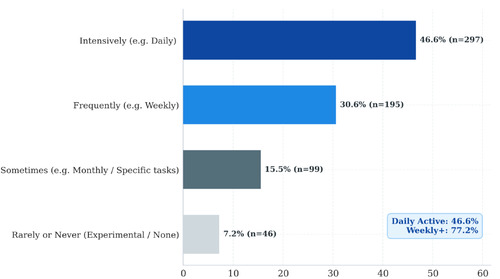
The survey data highlights the deep integration of machine learning tools within contemporary scientific workflows. Nearly half of the surveyed researchers reported utilizing some form of artificial intelligence on a daily basis. Among the cohort that experienced measurable, net time savings—accounting for roughly three-quarters of all respondents—the average reported gain hovered at just under seven hours per week.
These operational gains manifested in multiple dimensions of academic and industrial research. Approximately 68% of surveyed scientists noted that artificial intelligence significantly enhanced their access to cross-disciplinary insights, effectively bridging knowledge gaps between disparate scientific fields. Furthermore, roughly 65% observed that the technology successfully expanded the overall breadth and ambition of their research agendas, allowing them to explore complex parameters that would have been prohibitively time-consuming under traditional methodologies.
The Anatomy of the Verification Tax
Despite these encouraging metrics, the study uncovered a substantial internal cost associated with AI integration. Because the scientific method fundamentally relies upon absolute reproducibility, strict empirical validation, and uncompromising accuracy, researchers cannot take machine-generated outputs at face value. This imperative gives rise to what the authors designate as a "verification tax."
Among the scientists who reported saving time through artificial intelligence, approximately 89% indicated that more than 10% of their newly acquired free time was immediately funneled back into verifying, debugging, or fact-checking AI-generated data. More strikingly, about 46% of those respondents revealed that more than one-quarter of their total time savings was entirely consumed by this auditing process.
Rather than redirecting saved hours toward entirely novel investigative pursuits or accelerated physical prototyping, a vast segment of the scientific workforce finds itself acting as an automated system monitor. The paper cautions that this dynamic introduces distinct structural strains. When generative models produce plausible-sounding inaccuracies, hallucinations, or subtle analytical flaws—phenomena sometimes described in prior literature as "illusions of understanding"—they place an unprecedented burden on existing peer review frameworks and validation pipelines.
Broader Industry Context and the ATLAS Economic Update

The publication of the study coincided with a broader technological stock-taking by corporate and academic institutions. On September 15, Google prominently highlighted the core insights of the MIT and DeepMind collaboration within its monthly AI & Economy ATLAS update.
In its public commentary, Google underscored the dual-sided nature of the current technological transition. While acknowledging the undeniable productivity enhancements documented in the study, the technology conglomerate pointed directly to the physical and systemic bottlenecks that restrict the immediate translation of computational speed into tangible real-world breakthroughs. Specifically, Google noted that while AI can instantly generate hundreds of chemical compounds or genetic hypotheses, the subsequent phases of physical laboratory experimentation, synthesis, clinical trials, and regulatory validation remain firmly anchored to human operational limits and material resource constraints.
Consequently, the ATLAS update cautioned policymakers and industry leaders against assuming a linear relationship between algorithmic processing speed and the rate of scientific innovation. Faster individual task completion does not automatically equate to a compressed discovery timeline if the downstream validation apparatus remains congested.
Chronology of AI Integration in Scientific Research

To understand the current friction points identified in the study, it is necessary to examine the rapid evolutionary trajectory of machine learning within the scientific domain over the past decade.
Phase One: Computational Assistance and Data Sorting (2015–2019)
During the initial wave of artificial intelligence adoption in research laboratories, tools were primarily deployed for narrowly defined computational tasks. Machine learning models excelled at pattern recognition within massive datasets, such as astronomical imaging, genomic sequencing, and high-energy physics particle collisions. At this stage, the technology acted strictly as an advanced calculator or data-sorting mechanism, requiring constant, manual human programming for every operational step.
Phase Two: Predictive Modeling and Structural Biology (2020–2023)
A watershed moment occurred with the advent of advanced predictive systems, most notably demonstrated by deep learning models capable of solving complex protein folding problems. These breakthroughs proved that artificial intelligence could generate legitimate, testable scientific breakthroughs independently of human intuition. Researchers began incorporating machine learning routinely into computational biology, materials science, and climate modeling, leading to a widespread cultural shift toward digital-first hypothesis generation.
Phase Three: Generative Autonomy and Workflow Integration (2024–Present)
The current era is defined by the ubiquity of large language models and multimodal generative systems capable of assisting with literature reviews, drafting code, designing experimental parameters, and synthesizing multidisciplinary concepts. As documented in the September 2026 study, this phase has democratized access to advanced analytical capabilities but has simultaneously introduced the complex verification and auditing challenges that currently constrain net productivity gains.

Implications for the Future of Research and Development
The findings from the Google, DeepMind, and MIT study carry profound implications for research institutions, funding bodies, and technology developers as they look toward the future of scientific inquiry.
First, institutional frameworks must adapt to the reality of the verification tax. Academic and corporate laboratories can no longer budget project timelines based solely on raw computational speed. Training programs for graduate students and early-career researchers must increasingly emphasize algorithmic literacy, critical auditing skills, and the detection of subtle machine-generated biases or hallucinations. Without these competencies, researchers risk inadvertently propagating flawed methodologies into peer-reviewed literature.
Second, software developers building scientific artificial intelligence tools face a clear market imperative: shifting the focus from raw generation volume to verifiable reliability. Future iterations of scientific models must prioritize transparent attribution, rigorous uncertainty quantification, and built-in self-correction mechanisms to alleviate the auditing burden currently borne by human researchers.

Finally, the study serves as a necessary recalibration of expectations surrounding artificial intelligence in the sciences. While the technology remains an extraordinarily powerful catalyst capable of expanding research breadth and fostering cross-disciplinary collaboration, it is not a turnkey solution for immediate discovery. Until physical validation infrastructure and algorithmic reliability evolve in tandem, the scientific community will continue to pay a rigorous verification tax on the road to innovation.







