



As artificial intelligence agents transition from experimental novelties to core enterprise operations, a fragmented security landscape has emerged as a primary vulnerability for global organizations. Addressing this critical blind spot, identity management leader Okta has spearheaded the formation of the Blueprint Alliance, an unprecedented coalition uniting twelve heavyweight cloud, data, security, and application vendors. This newly established collaborative framework is engineered to construct an open, multi-vendor reference architecture designed to secure autonomous AI agents across complex enterprise environments.
The complexity of modern enterprise infrastructure often means that a single AI agent is created within one system, authenticated through another, retrieves data and operational tools from multiple external sources, and is ultimately monitored by an entirely separate security platform. This fragmented operational lifecycle creates severe governance challenges, leaving organizations vulnerable to data exfiltration, unauthorized privilege escalation, and unpredictable agent behavior. The Blueprint Alliance seeks to resolve these systemic issues by establishing a unified security model that transcends individual vendor boundaries, shifting the industry’s focus away from how agents are built toward how they can be consistently governed, monitored, and contained.
Founding Members and Strategic Advisory

The formation of the Blueprint Alliance brings together a formidable roster of technology leaders spanning the entire enterprise software and infrastructure stack. The twelve founding member organizations comprise Amazon Web Services (AWS), CrowdSight, Databricks, Docker, Google Cloud, Lovable, Okta, Proofpoint, Salesforce, ServiceNow, Wiz, and Zscaler. To ensure that the architecture addresses real-world operational challenges, major enterprise end-users GE Appliances and World Central Kitchen have signed on to participate as strategic advisors, providing crucial practitioner insights into the daily realities of deploying and managing autonomous systems at scale.
This cross-industry coalition bridges traditional competitive divides, reflecting a growing consensus that AI security cannot be solved in silos. Because enterprise AI agents routinely interact with internal application programming interfaces (APIs), Model Context Protocol (MCP) tools, databases, and third-party software-as-a-service (SaaS) applications, security protocols must be universally understood across every layer of the technology stack. The participation of cloud hyperscalers alongside specialized cybersecurity and data platform vendors ensures that the resulting reference architecture will be adaptable to diverse enterprise architectures, whether running on-premises, in hybrid environments, or across multi-cloud deployments.
The Four Pillars of the Blueprint Architecture
At the core of the Alliance’s technical initiative is a comprehensive reference architecture designed to bring order to agentic workflows. The framework organizes enterprise agent security around four fundamental operational questions: Where are my agents? What can they do? What are they doing? How do I respond? These inquiries translate directly into actionable security controls covering asset discovery, permission mapping, real-time behavioral monitoring, and automated incident response.
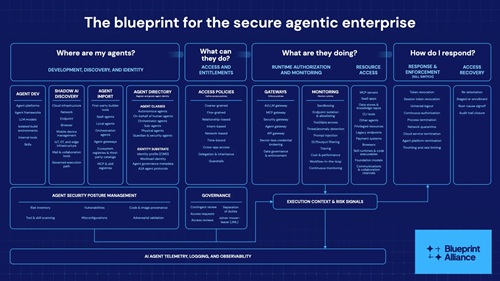
The architecture extends far beyond runtime environments, encompassing the entire software development lifecycle. According to the Alliance’s foundational whitepaper, the framework explicitly addresses development-related systems, including agent frameworks, code repositories, continuous integration and continuous deployment (CI/CD) pipelines, code assistants, tool registries, MCP servers, and command-line interfaces. By capturing these components, the architecture ensures that visibility and access controls are established during the initial development phase and maintained seamlessly as agents transition into production environments.
Furthermore, the framework accommodates the diverse origins of enterprise AI assets. Organizations frequently grapple with a heterogeneous mix of internally developed custom agents, pre-packaged agents imported through SaaS platforms, and lightweight agents running locally on developer machines. The Blueprint Alliance architecture provides a standardized taxonomy to inventory, authenticate, and govern this sprawling digital workforce under a single operational umbrella.
Cross-Vendor Interoperability and Open Standards
A central objective of the Blueprint Alliance is to achieve seamless interoperability, allowing security telemetry and control commands to flow unobstructed between disparate products from different vendors. To accomplish this, the initial architecture leverages several established open standards and communication protocols. These include the Model Context Protocol for agent-to-tool interactions, the Open Cybersecurity Schema Framework (OCSF) for standardizing security telemetry, and the Shared Signals Framework (SSF) along with the Continuous Access Evaluation Profile (CAEP) for exchanging real-time risk intelligence across platforms.

By utilizing these open standards, the architecture enables one component of an enterprise technology stack to detect an anomalous risk condition—such as an agent attempting unauthorized data extraction or exhibiting erratic execution paths—and instantly transmit that intelligence to another control point capable of taking immediate corrective action. Depending on the enterprise implementation, automated responses could range from revoking specific API tokens to entirely containing and isolating an agent whose operational parameters have deviated from established baselines.
While specific cross-vendor performance benchmarks and proprietary implementations were not detailed in the initial launch announcement, member organizations have committed to building, testing, and publishing reference integrations as the initiative matures. This iterative approach allows the security community to validate interoperability in real-world scenarios, ensuring the framework remains robust against evolving threat vectors.
Chronology of Enterprise AI Security and Coalition Formation
The genesis of the Blueprint Alliance reflects the rapid acceleration of enterprise AI adoption over the preceding several years. Throughout 2023 and 2024, organizations rushed to deploy generative AI models and early autonomous agents to drive productivity, largely prioritizing rapid deployment over centralized governance. This gold rush mentality resulted in widespread shadow AI usage, where business units integrated third-party AI tools and autonomous workflows without the knowledge or oversight of corporate security teams.

By 2025, security researchers and enterprise Chief Information Security Officers (CISOs) began reporting a surge in sophisticated attacks targeting AI agents, including indirect prompt injection, unauthorized tool usage, and systemic API abuse. In response, individual technology vendors began developing proprietary guardrails and point solutions. However, these siloed offerings often exacerbated integration friction, forcing enterprises to stitch together incompatible security tools from competing vendors.
Recognizing that fragmentation was weakening overall enterprise posture, discussions among leading cloud and security vendors intensified in late 2025 regarding the necessity of a unified standard. Okta’s preliminary security frameworks served as the foundational springboard for these discussions, ultimately culminating in the formal establishment of the Blueprint Alliance in early 2026. By shifting from unilateral product features to a collaborative reference architecture, the coalition aims to shortcut years of market confusion and establish an interoperable baseline for agentic security.
Expert Analysis and Strategic Implications
Industry analysts view the formation of the Blueprint Alliance as a watershed moment for enterprise artificial intelligence. As businesses increasingly delegate complex, multi-step workflows to autonomous agents—such as executing financial transactions, managing customer data records, and modifying software codebases—the potential impact of a security breach escalates dramatically. An unmonitored agent compromised by an attacker can cause cascading operational damage across multiple interconnected enterprise systems within seconds.

The Alliance’s pragmatic, phased recommendations offer a sustainable roadmap for resource-constrained security teams. Rather than demanding that organizations overhaul their entire technology stacks overnight, the Alliance’s whitepaper advises enterprises to begin with foundational capabilities such as unified logging, comprehensive telemetry, and complete agent discovery. Once visibility is established, organizations can progressively layer on advanced automated controls and real-time remediation protocols.
Nevertheless, significant implementation hurdles remain. Achieving true interoperability across competing commercial platforms historically requires sustained collaboration, strict adherence to standards, and a willingness among vendors to prioritize ecosystem health over proprietary lock-in. The inclusion of foundational cloud giants alongside specialized security vendors provides strong momentum, yet the ultimate success of the Blueprint Alliance will depend on how rapidly participating members deliver functional, production-ready integrations.
As the initiative progresses, the Blueprint Alliance intends to expand its membership base, invite broader community feedback, and continuously update its reference architecture to counter emerging threat methodologies. For enterprise technology leaders navigating the complex transition toward autonomous operations, the Alliance provides a much-needed collaborative anchor, transforming chaotic agent security into a structured, governable discipline.







