



Research sponsored by the Association for Talent Development (ATD) highlights a critical shift in corporate priorities: the primary objective for talent development programs in Fortune 500 companies is no longer just skill acquisition, but demonstrable business impact. According to the study, 96 percent of CEOs surveyed identify business impact as their leading success metric, with Return on Investment (ROI) ranking as the secondary priority. This data underscores a fundamental mandate for human resources and learning leaders: to justify program funding, learning initiatives must transcend traditional metrics and integrate directly into the organizational bottom line, focusing on output, quality, cost, and time efficiency.
The Evolution of Learning Metrics
Historically, the evaluation of training programs relied heavily on participant reactions and knowledge retention—metrics often referred to as "Level 1" and "Level 2" in instructional design. However, the modern business environment, characterized by rapid technological disruption and hyper-competition, has forced a pivot toward "Level 4" (Impact) and "Level 5" (ROI).

The methodology underpinning this shift is rooted in a logic model that traces its origins to the 19th century, later refined by industrial psychologist Raymond Katzell in 1952. While Don Kirkpatrick popularized the basic evaluation steps in the mid-20th century, the contemporary application of these metrics has been significantly advanced by the ROI Methodology. This framework provides a rigorous, 12-step pathway designed to translate soft skills and training outcomes into hard financial data, satisfying the scrutiny of CFOs and skeptical stakeholders who demand evidence that learning investments are "worth it."
A Chronology of the Value Chain
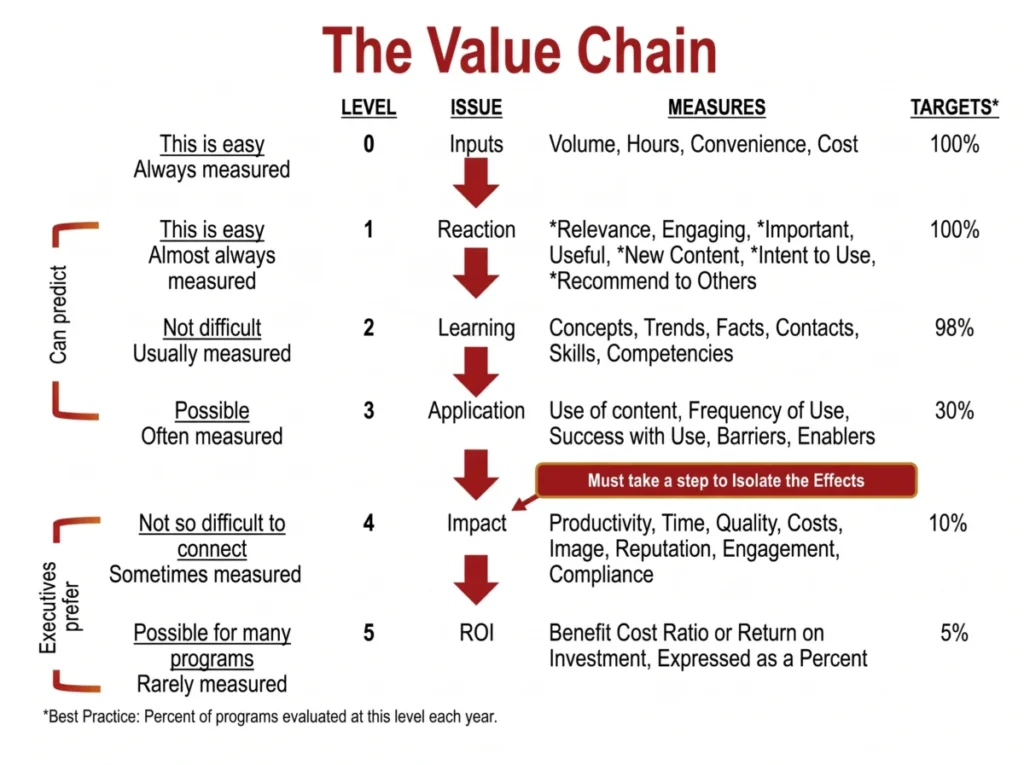
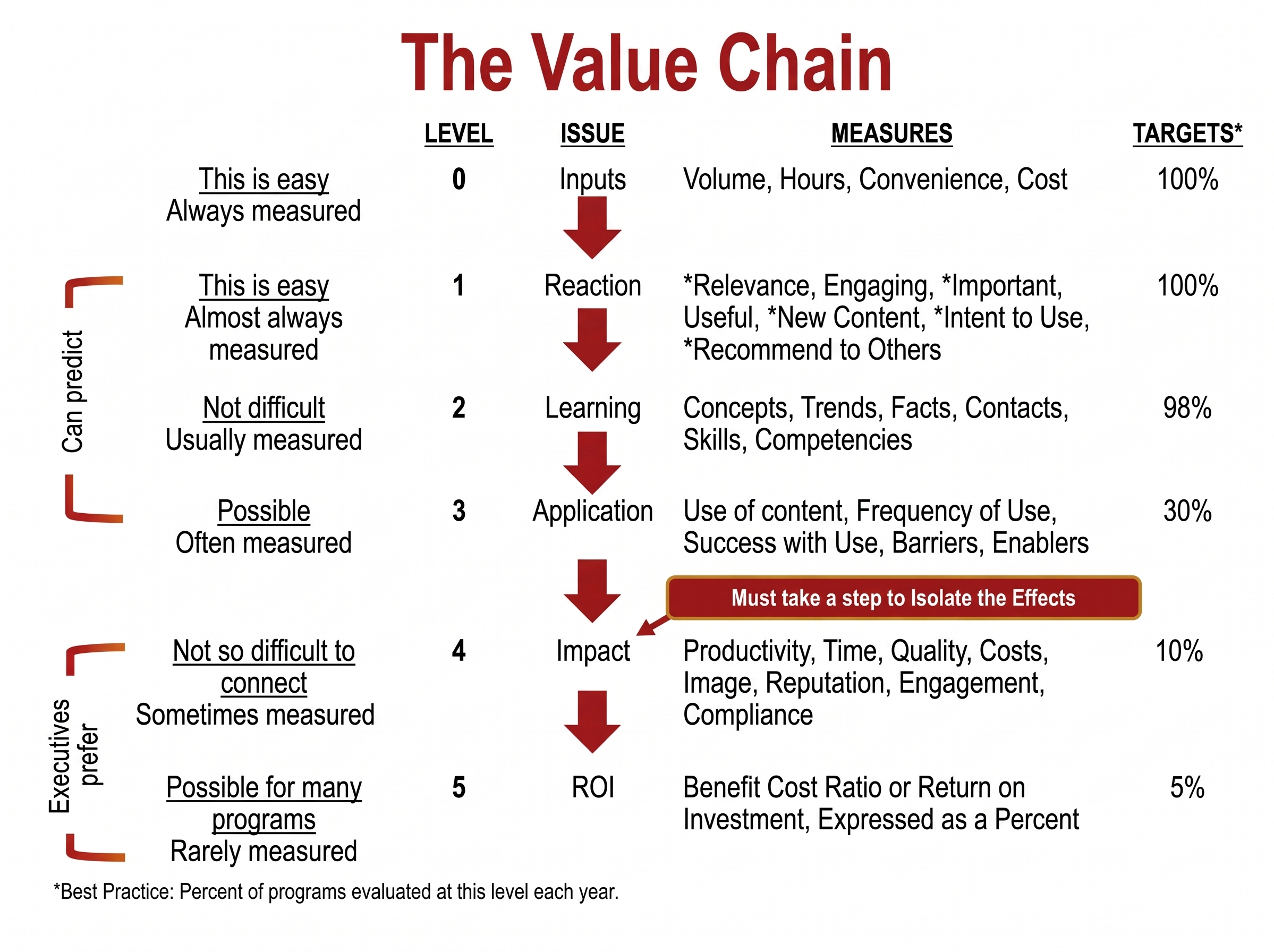
To understand how organizations successfully pivot to impact-driven development, one must examine the value chain of project evaluation. The process follows a structured sequence of data acquisition:
- Input (Level 0): The foundational phase involving the number of participants, time allocation, and direct/indirect costs.
- Reaction (Level 1): Gauging participant commitment, relevance, and perceived value. An adverse reaction at this stage is often a precursor to total program failure.
- Learning (Level 2): Measuring the specific acquisition of knowledge and skill enhancement.
- Application (Level 3): Tracking the implementation of new skills in the workplace, including the frequency of use and identifying operational barriers or enablers.
- Impact (Level 4): The direct consequence of application on business performance indicators, such as reduced cycle times or improved quality outputs.
- ROI (Level 5): The conversion of impact data into monetary value compared against total program costs.
This progression suggests that impact is the "why" of any professional development program. Without a clear link between a learning intervention and a specific business problem, the initiative risks becoming an isolated activity rather than a strategic asset.

Strategic Design and the Twelve-Step Methodology
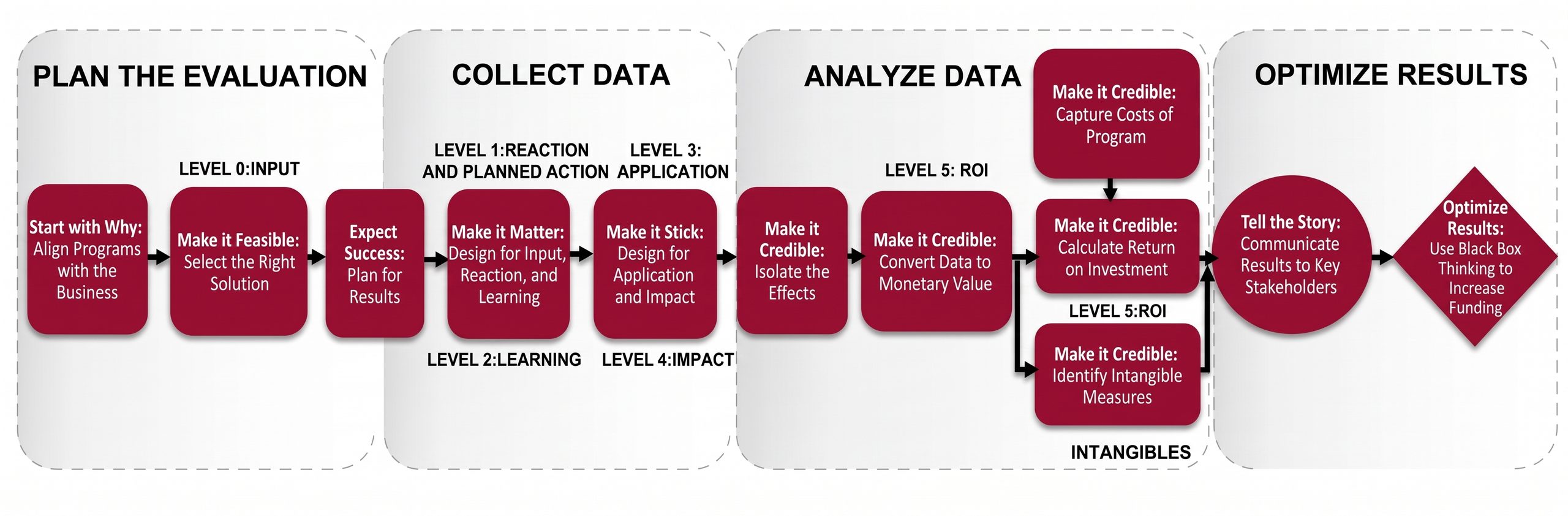
The ROI Methodology has emerged as the global gold standard, currently utilized by over 10,000 organizations. It is not merely a post-program evaluation tool; it is a design framework. By initiating the planning phase with the "end in mind"—the business outcome—organizations ensure that every element of the curriculum is tethered to a measurable objective.
Phase One: Designing for Results
The initial three steps involve alignment, solution validation, and expectation management. Practitioners are tasked with identifying the specific business measure that signifies a successful resolution to a problem or the capture of an opportunity. If a requested program cannot be tied to a specific business metric, the methodology encourages a re-evaluation of the intervention’s necessity.
Phase Two: Data Collection and Credibility
Steps four and five focus on gathering data through traditional methods, supplemented by action plans that track real-world application. The real test of the methodology, however, lies in steps six through ten, which focus on the credibility challenge. Isolating the program’s effects from external variables—such as market shifts or leadership changes—is a rigorous process that allows practitioners to defend their findings before a CFO.

The methodology adheres to a "conservative principle": when in doubt, exclude data from the ROI calculation. This approach ensures that when a positive ROI is reported, it is beyond reproach. Intangible measures, which cannot be reliably converted to currency, are still captured, as they provide critical qualitative context to the quantitative ROI.
Analysis: The Financial Implications for Talent Leaders
The implications of this shift are profound for human capital professionals. When a talent development program demonstrates a clear benefit-cost ratio, it transforms the HR department from a cost center into a strategic partner.
Data from the ROI Institute suggests that when executives see a direct correlation between learning and financial performance, they are more inclined to increase funding for future development. This creates a positive feedback loop: better data leads to better investment, which leads to improved business outcomes, further cementing the credibility of the talent development function.
However, the methodology does not come without challenges. The requirement to isolate the effects of training from other organizational variables requires sophisticated data analysis. Critics of rigid ROI measurement argue that some forms of learning, particularly leadership development or cultural transformation, have long-term benefits that do not always manifest in a single fiscal year. To address this, the 12-step model incorporates "storytelling" in step eleven, using the combination of quantitative ROI and qualitative intangibles to build a comprehensive, narrative-driven case for the program’s success.
Official Stance and Industry Response
Industry experts at the ATD and various global consulting firms suggest that the "business-first" approach is no longer optional. As organizations continue to face economic volatility, "nice-to-have" training programs are often the first to be cut. By aligning with the ROI Methodology, training leaders secure their programs against budget volatility.
The twelve guiding principles of this methodology—which include standardized data collection, unbiased adjustment for error, and transparency in reporting—provide a framework that mirrors the rigor of financial accounting. This discipline is essential for earning a seat at the table during executive leadership meetings.
Broader Impact and Future Outlook
As we look toward the future of workforce development, the integration of design thinking and business metrics will likely become the standard. The move away from "smile sheets" (reaction-based surveys) toward performance-based evaluation signifies a maturation of the learning and development industry.
For organizations struggling to justify their talent budget, the path forward is clear: start with the business measure, ensure the solution addresses the root cause, and apply a disciplined, conservative approach to calculating the financial return. By shifting the focus from "what we are teaching" to "what business result we are achieving," talent leaders can ensure their initiatives remain resilient, relevant, and highly valued by the C-suite.
Ultimately, the ROI Methodology serves as a bridge between the classroom and the boardroom. Whether in a Fortune 500 company or a non-profit organization, the fundamental truth remains: when learning is treated as a business investment rather than an administrative expense, the entire organization benefits from increased efficiency, better quality of output, and a more highly skilled, purpose-driven workforce. As highlighted in recent literature, such as The Business Case for Learning: Using Design Thinking to Deliver Business Results, those who master this alignment will continue to lead their industries in an increasingly complex and competitive global marketplace.