
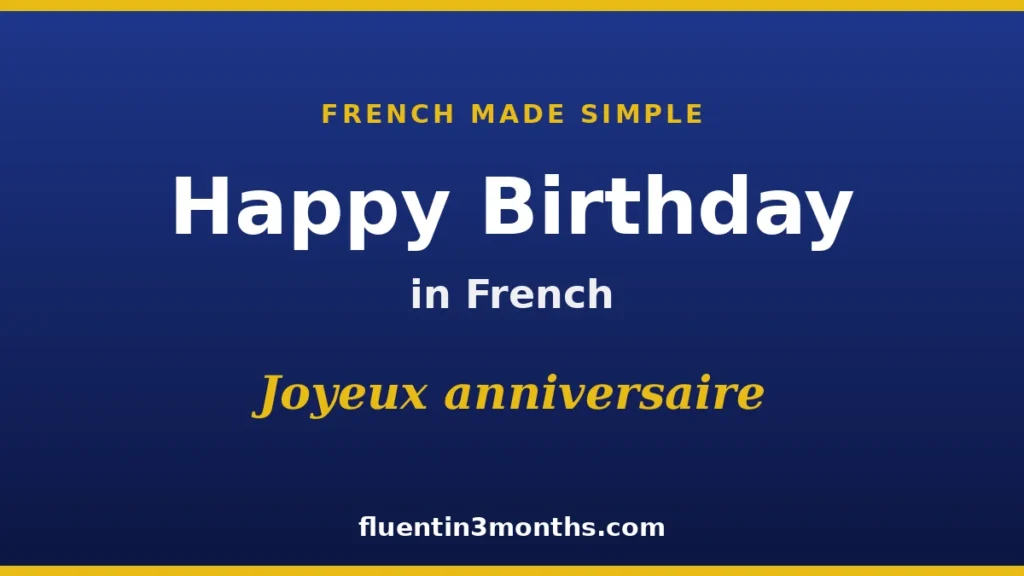
The French language offers a variety of ways to commemorate personal milestones, with "Joyeux anniversaire" and "Bon anniversaire" serving as the standard pillars of celebration. While these phrases appear straightforward to the casual observer, they are deeply embedded in a linguistic and cultural framework that spans continents and social registers. Understanding the nuances of these expressions requires more than a simple translation; it necessitates an appreciation for regional customs, social etiquette, and the evolution of French-speaking societies.
The Linguistic Foundations of Celebration
At its core, the most common French birthday greeting is "Joyeux anniversaire," which translates literally to "joyous anniversary." In the French language, the word "anniversaire" is used for both birthdays and wedding anniversaries, leaving the context to be determined by the nature of the event. A secondary, equally prevalent option is "Bon anniversaire," which carries a slightly more informal weight but is functionally interchangeable.
From a phonetic perspective, these phrases are governed by the rule of liaison, a defining characteristic of spoken French. When pronouncing "Joyeux anniversaire," the normally silent final "x" of "Joyeux" is linked to the initial vowel of "anniversaire," producing a /z/ sound. Similarly, in "Bon anniversaire," the final "n" of "Bon" flows into the following word, effectively softening the nasal vowel. Mastering these transitions is essential for sounding natural in conversational French, as they allow for the melodic flow characteristic of the language.
Historical Context and Evolution
The practice of celebrating birthdays has evolved significantly over the centuries. Historically, the concept of a "birthday" was tied to the liturgical calendar, where individuals were often celebrated on their name day—the feast day of the saint for whom they were named. This tradition remains relevant in France today, where "Bonne fête" is synonymous with a name day rather than a birth anniversary.
Conversely, the rise of the modern birthday celebration—focused on the anniversary of one’s birth—gained prominence in the 19th and 20th centuries, heavily influenced by broader European cultural shifts. As commercial, social, and family structures transitioned, so too did the language used to honor these occasions. The introduction of the song "Bon anniversaire," composed by Louiguy with lyrics by Jacques Larue in the early 1950s, solidified the modern celebration’s place in French culture. Unlike the globally ubiquitous "Happy Birthday to You" melody, which is often sung with translated French lyrics, this original French composition remains a culturally distinct hallmark of celebrations across the Francophone world.
Regional Variations: The Québec Distinction
A critical distinction in the geography of the French language exists between Metropolitan France and Canada, specifically the province of Québec. In Canada, the phrase "Bonne fête" is the standard, accepted way to wish someone a happy birthday. This divergence is officially recognized by the Office québécois de la langue française, which acknowledges the term as a legitimate regional variation.
For travelers and language learners, failing to account for this difference can lead to minor cross-cultural confusion. If a speaker uses "Bonne fête" in Paris, they are likely to be misunderstood as celebrating a saint’s day. Conversely, failing to use "Bonne fête" in Montreal might be perceived as a slight departure from local convention. This regionalism serves as a reminder that language is not a monolith, but a living entity that adapts to local history and usage patterns.
Social Etiquette and Customary Practices
Beyond the spoken word, birthday celebrations in France and other Francophone regions are governed by a specific set of social customs. One notable practice is the expectation regarding hospitality: in many French corporate and academic environments, it is customary for the individual celebrating their birthday to provide the refreshments—often referred to as "le gâteau" or various pastries—for their colleagues or peers. This differs from the Anglo-American model, where the group typically facilitates the celebration for the individual.
Physical contact, specifically "la bise" (the cheek kiss), is another complex element of French social interaction. While a standard greeting, the number of kisses and the appropriateness of the gesture depend heavily on the social proximity of the individuals and the specific region of the country. In professional settings, a handshake or a formal verbal greeting is often the preferred choice, highlighting the importance of gauging the social environment before engaging in physical contact.
Furthermore, the timing of these well-wishes is subject to individual superstition. Many French speakers hold the belief that offering birthday wishes before the actual date is unlucky. While this is not a universal rule, it is common enough that many locals prefer to wait until the morning of the birthday to extend their greetings. This cautious approach to timing reflects a cultural emphasis on precision and the observance of social norms.
Data and Trends in Modern Communication
In the digital age, the language of celebration has become increasingly abbreviated. Similar to the English use of "b-day," the French language has adopted "anniv" as a common shorthand in text messages and informal communication. This trend is reflective of the broader shift toward brevity in social media and mobile messaging.
Data regarding language usage patterns indicates that while formal written correspondence—such as greeting cards—tends to retain the full "Joyeux anniversaire," casual digital platforms show a significant preference for clipped, efficient phrasing. Despite this, the formality of the "tu" and "vous" pronouns remains a critical consideration. Addressing a mentor, supervisor, or elder with the formal "vous" requires a more polished, respectful birthday message, whereas the "tu" form is reserved for friends, family, and peers. This duality remains a vital component of maintaining social harmony in French-speaking cultures.
Analytical Overview: The Impact of Linguistic Choice
The choice of language used during a birthday celebration acts as a marker of social hierarchy and cultural integration. By selecting the correct phrase—"Joyeux anniversaire" for standard use, "Bonne fête" for Québec, or specific, personalized messages for close relationships—the speaker demonstrates a level of cultural competence that goes beyond vocabulary.
The implications of these choices are twofold. First, they facilitate smoother social interactions by demonstrating respect for local customs. Second, they serve as a diagnostic tool for the speaker’s relationship with the recipient. A well-chosen, grammatically accurate birthday message in French is often perceived as an indicator of respect and effort, fostering deeper interpersonal connections.
Conclusion: Moving Toward Fluency
Achieving proficiency in expressing birthday wishes requires a synthesis of linguistic knowledge and cultural awareness. As the French language continues to evolve, the distinction between formal and informal, as well as the regional nuances between France and Québec, will remain essential components of effective communication.
For those seeking to deepen their engagement with the language, the next step involves active practice—saying these phrases aloud to master the flow, liaisons, and rhythmic patterns that define native speech. Whether through the study of French numbers to discuss age, or the exploration of more complex literary greetings, the path to fluency is built upon the consistent application of these foundational elements. By understanding the context behind the words, speakers can ensure their birthday wishes are not only grammatically correct but culturally resonant.