



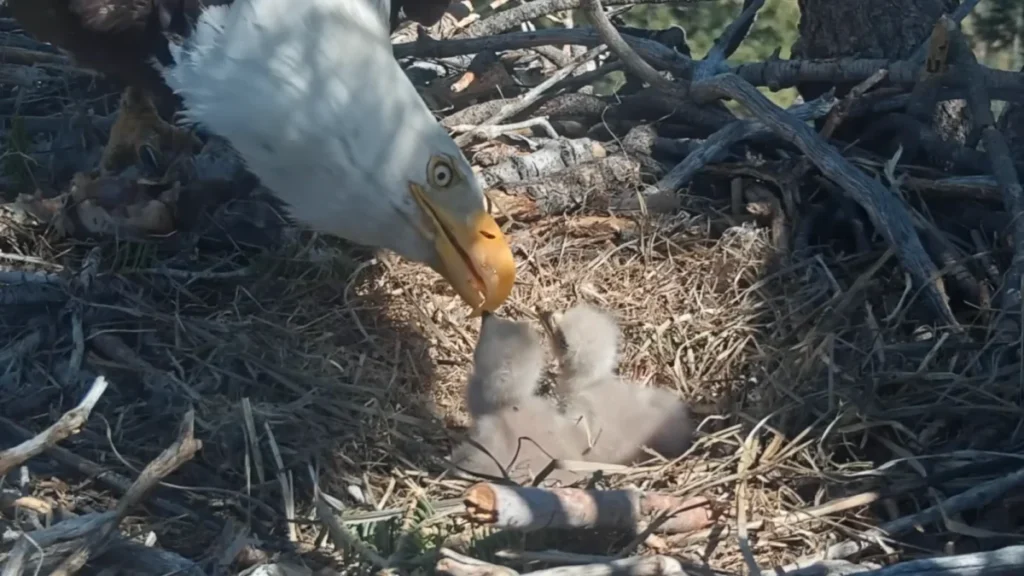
The San Bernardino National Forest has become the center of international attention once again as Jackie and Shadow, the renowned bald eagle pair of Big Bear Valley, successfully welcomed two new chicks into their high-altitude nest. Following a period of uncertainty and early-season loss, the arrival of the two eaglets marks a triumphant chapter in what has been a volatile nesting season for the avian couple. The hatching events, documented by the Friends of Big Bear Valley (FOBBV) through a 24-hour high-definition livestream, have provided researchers and the public alike with a rare, intimate look at the early developmental stages of North America’s most iconic bird of prey.
The 2026 Hatching Timeline
The arrival of the new brood began in the late hours of April 4, 2026. After weeks of diligent incubation by both parents, the first signs of a "pip"—the initial hole made by a chick in its shell—were observed. Chick 1 officially emerged at 9:33 p.m. PDT on April 4, entering the world under the cover of darkness while Jackie provided warmth. The second arrival followed less than twelve hours later; Chick 2 successfully hatched at 8:30 a.m. PDT on April 5.
This successful double-hatch is particularly significant given the events of earlier this year. In January 2026, Jackie and Shadow faced a devastating setback when their first clutch of eggs was destroyed by ravens. The loss of a clutch to predators is a common yet harsh reality of the wild, but the pair’s ability to "recycle"—the biological term for laying a second set of eggs in the same season—demonstrates their health and the abundance of resources in the Big Bear Valley region.
Sibling Dynamics and the "Bonking" Phenomenon
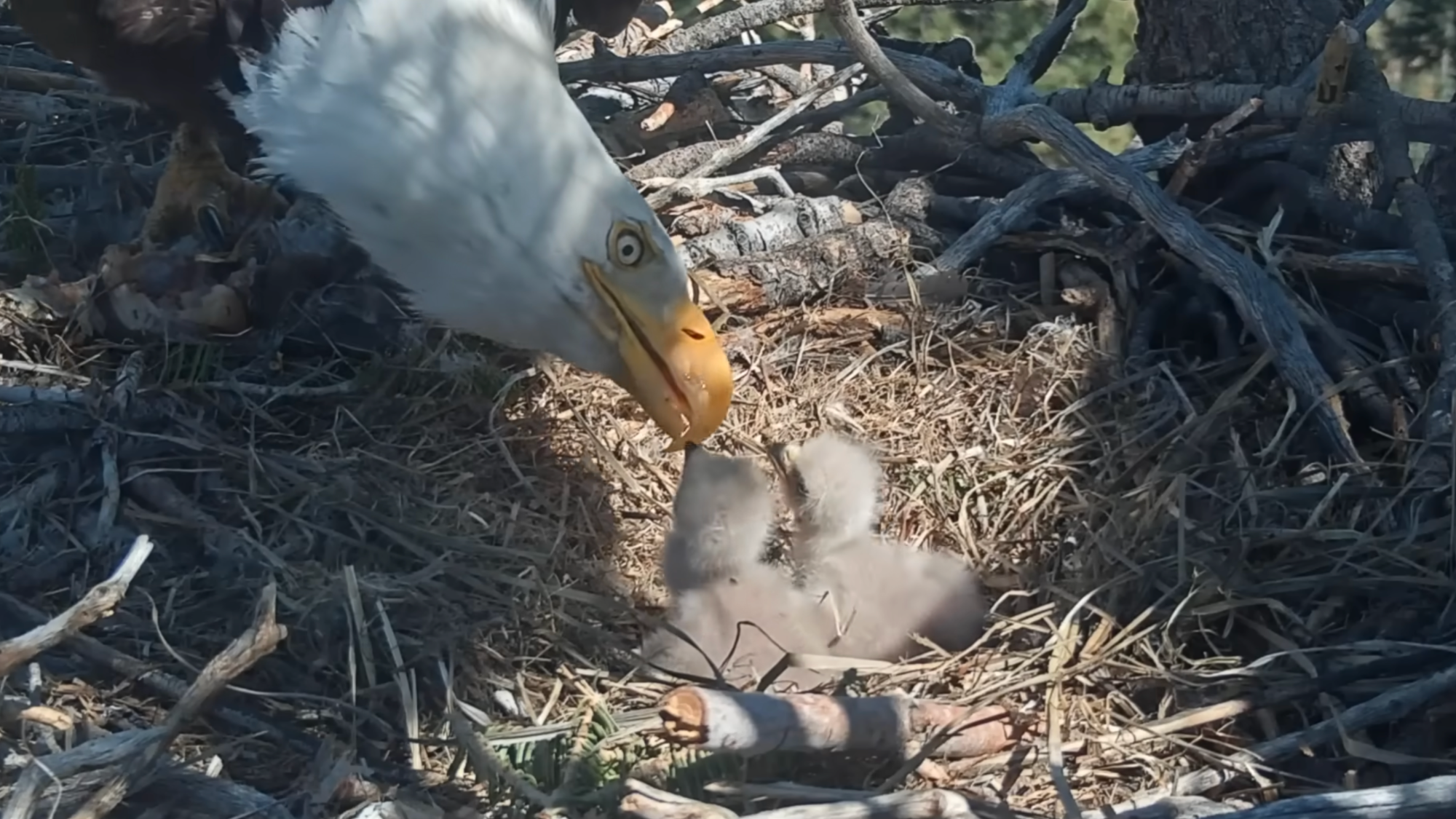
In the days following the hatch, viewers of the livestream have noted intense interactions between the two siblings. These behaviors, colloquially referred to by eagle monitors as "bonking," involve the chicks pecking, pushing, and asserting dominance over one another, particularly during feeding sessions. While these displays can appear aggressive to the casual observer, biologists with the Friends of Big Bear Valley emphasize that this is a standard and necessary component of bald eagle development.
The "pecking order" established in the nest determines which chick receives priority during feedings. Typically, the larger or more aggressive chick—often the one that hatches first—will take the lead. This hierarchy ensures that at least one offspring remains strong and well-fed if food resources become scarce. However, the smaller chick is not without its own survival strategies. Observations from the Big Bear nest show the subordinate chick waiting for the dominant sibling to become satiated and fall asleep before moving in to claim the remaining scraps. In many cases, once the initial hierarchy is established, the aggression subsides as both chicks grow and food remains plentiful.
Parental Roles and Nest Management
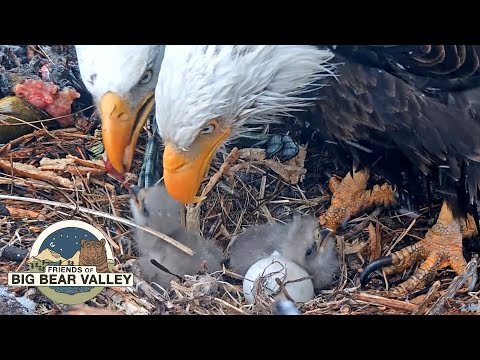
The division of labor between Jackie and Shadow has been a hallmark of their success as a breeding pair. Jackie, the female, is the larger of the two—a common trait in raptors—and often takes the lead in long-term brooding, particularly during inclement weather. Shadow, the male, is primarily responsible for foraging and nest defense.
The pair has been observed alternating shifts, allowing one parent to hunt for fish in the nearby Big Bear Lake while the other remains in the nest to protect the chicks from predators and the elements. During a recent rainstorm that swept through the San Bernardino Mountains, Jackie remained hunkered down over the chicks for hours, using her waterproof feathers to create a dry, warm microclimate for the vulnerable eaglets. As the weather cleared, Shadow arrived with a fresh catch, demonstrating the logistical precision required to raise two growing raptors at an altitude of nearly 7,000 feet.
A Legacy of Resilience: 2018 to 2026
Jackie and Shadow first established their partnership in 2018 and have since become a focal point for wildlife education. Their history is a mixture of remarkable success and natural hardship, illustrating the low survival rates often associated with bald eagle nesting.
- 2019 & 2022: The pair successfully raised and fledged chicks, contributing to the local eagle population.
- 2023 & 2024: These years were marked by disappointment as the eggs failed to hatch, likely due to environmental factors or infertility of the specific clutches.
- 2025: A year of high drama, Jackie laid three eggs, all of which hatched in early March. However, a severe late-season snowstorm dumped two feet of snow on the nest. Despite the parents’ best efforts, one chick perished in the extreme conditions. The two survivors, later named Sunny and Gizmo, successfully fledged.
Statistically, only about 50 percent of bald eagle eggs successfully hatch in the wild. Factors such as temperature fluctuations, predation, and the fitness of the parents all play critical roles. By successfully hatching two chicks in 2026 after losing their first clutch, Jackie and Shadow have defied the odds, underscoring the resilience of the species.
The Role of Technology and Community Engagement
The Friends of Big Bear Valley (FOBBV), a non-profit organization, has been instrumental in bringing the lives of these eagles to a global audience. The use of high-definition cameras with infrared capabilities allows for non-intrusive monitoring of the nest 24 hours a day. This technology serves two purposes: it provides a wealth of data for ornithologists studying eagle behavior in high-altitude environments, and it fosters a sense of environmental stewardship among the millions of viewers who tune in.
A unique aspect of the Big Bear eagle program is its integration with local education. Following a long-standing tradition, the naming of the chicks is handled through a contest involving third, fourth, and fifth-grade students at an elementary school near the San Bernardino Valley. This initiative is designed to engage the next generation in wildlife conservation. In 2025, the naming contest saw over 54,000 submissions from fans worldwide before the final selection was made by the students.

Scientific and Developmental Milestones Ahead
The next few months will be critical for the development of the two eaglets. As they transition from their soft, grey down to their juvenile brown plumage, several milestones will be monitored:
- Sex Determination (Week 10): While it is difficult to determine the sex of bald eagles in the early stages, experts will look for size discrepancies and vocal pitches around the ten-week mark. Females are generally about 25% larger than males.
- Branching: Before they take their first flight, the chicks will begin "branching"—hopping onto nearby limbs of the nesting tree to practice their grip and balance.
- Fledging (Weeks 10–14): The chicks are expected to take their first flight between 10 and 14 weeks of age. Even after fledging, they will remain near the nest for several weeks while the parents continue to provide food and teach them hunting skills.
Broader Implications for Bald Eagle Conservation
The success of Jackie and Shadow is a microcosm of the broader recovery of the bald eagle in North America. Once on the brink of extinction due to habitat loss, hunting, and the effects of the pesticide DDT, the bald eagle was removed from the endangered species list in 2007. However, they remain protected under the Bald and Golden Eagle Protection Act and the Migratory Bird Treaty Act.
The presence of a breeding pair in the San Bernardino National Forest is a positive indicator of the ecosystem’s health. It suggests that Big Bear Lake provides a sufficient prey base and that the forest offers the old-growth trees necessary for large nests, which can weigh up to a ton and span several feet in diameter.
Conclusion
As the 2026 season progresses, the eyes of the world remain fixed on the Big Bear nest. The story of Jackie and Shadow is more than just a wildlife documentary; it is a narrative of persistence in the face of environmental adversity. While nature remains unpredictable—as evidenced by the losses in 2023 and the storm of 2025—the current health and vigor of the two new chicks offer a hopeful outlook for the future of this iconic lineage. For now, the focus remains on the daily struggle for growth, the establishment of the pecking order, and the tireless efforts of two parents dedicated to the survival of their species.