


Artificial intelligence is fundamentally altering the corporate landscape, forcing organizations to rethink job roles at a velocity that exceeds the traditional capacity of internal learning and development (L&D) functions. As generative AI and sophisticated automation tools permeate the enterprise, workflows are being systematically redesigned, decision-making authority is shifting from human agents to algorithmic systems, and tasks once considered the bedrock of professional experience are being offloaded to machines. For many organizations, the reflexive response to this disruption has been a reactive one: identify the emerging "skills gap" and scramble to build training programs to bridge it. However, this sequence is increasingly viewed by industry experts as fundamentally flawed. By the time L&D is consulted on curriculum design, the most consequential decisions—workflow architecture, technology selection, and job decomposition—have already been finalized. In the current climate of rapid AI integration, treating learning as an afterthought is a strategic error that threatens organizational resilience.
A Shift in Sequencing: Moving Upstream
The emerging challenge for L&D leadership is not merely the refinement of reskilling initiatives but a fundamental shift in positioning. To remain effective, these departments must move "upstream," participating in the initial design phases of business processes rather than acting as a post-implementation support mechanism. This paradigm shift requires L&D to evolve from a training provider into an architect of work-capability, ensuring that the human element is not "automated away" during the pursuit of operational efficiency.
The Centre for Healthcare Innovation (CHI) at Tan Tock Seng Hospital in Singapore provides a robust framework for this approach. By utilizing the CHI Innovation Cycle, the hospital creates a closed-loop system connecting care process redesign, the deployment of IT and robotics, and subsequent job redesign. This model operates on continuous Plan-Do-Study-Act (PDSA) cycles, allowing organizations to pilot changes, evaluate the impact on both efficiency and human capital, and refine their strategy in real-time. The critical takeaway from this model is the hierarchy of implementation: the organization first reconsiders the work itself, then introduces technology to enable that redesigned workflow, and only finally revamps job roles. In most corporate environments, this sequence is inverted, leading to a disconnect between the training provided and the actual demands of the job.
The Consequences of Decoupling Skills from Work
A central tension exists between the assumption that skills exist in a vacuum and the reality that they are, in fact, functional consequences of specific workflows. When a company automates an analysis that previously required manual data collation, the immediate instinct is to provide "AI training." However, this fails to address the shifting nature of the employee’s accountability. If an AI handles the initial drafting, the employee’s role transitions from "compiler" to "auditor" or "strategist." They must now possess the capability to validate, interpret, and contextualize algorithmic output.
If L&D is not involved in the design of this new workflow, they cannot accurately define the required competency architecture. Without this clarity, companies risk creating training that is obsolete by the time it is deployed. Furthermore, there is a developmental risk: many traditional roles serve as "training grounds" for junior staff. When an entry-level task is automated for the sake of efficiency, the organization may inadvertently remove the mechanism through which junior employees build professional judgment and institutional knowledge. Managers, in turn, often struggle to make high-level decisions because they missed the foundational operational experience that AI has now absorbed. Consequently, L&D leaders must ask a deeper set of questions: How is expertise developed through this task, and if the task is automated, what new experiences must be created to ensure the next generation of leadership remains capable?
The "Ward of the Future" and Evidence-Based Outcomes
The "Ward of the Future" initiative at Tan Tock Seng Hospital serves as a benchmark for how human-centric design can yield tangible performance metrics. Through the integration of technology and role redesign, nurses saw a 24.8% increase in direct patient care time and a reduction in physical strain, as measured by a decrease in walking distance by 3.9 kilometers per shift. More importantly, these changes led to a measurable improvement in staff retention, with attrition falling from 8% to 6%.
This case illustrates that the ultimate goal of AI integration should not be the simple reduction of labor, but the optimization of human capacity. When automation releases, for instance, 20% of an employee’s capacity, the strategic question should not be "how many hours were saved?" but "how will this newfound capacity be redirected to create higher-value outcomes?" If this question is not addressed, organizations may realize minor productivity gains while simultaneously eroding long-term capability, employee morale, and intellectual depth.
Establishing New Metrics for Success
As organizations move into the implementation phase of AI, the standard KPIs—processing time, error rates, and cost—are insufficient. These metrics, while essential, capture only the output efficiency of a system, not its long-term viability. A workflow might be faster, but if it degrades the quality of independent human judgment, it represents a net loss for the organization.
L&D leaders should advocate for the inclusion of capability-based metrics during the pilot phase of any AI transformation. These metrics should track:
- Proficiency and Judgment: The quality of human intervention when AI outputs require verification or correction.
- Exception Handling: The ability of employees to manage non-standard cases that fall outside of algorithmic parameters.
- Transfer of Learning: How effectively new hires gain mastery of the domain in a partially automated environment.
- Developmental Pipeline Health: The availability of "stretch" assignments that ensure junior staff are prepared for senior roles.
By measuring these outcomes, L&D ensures that the organization is not merely optimizing for today’s speed, but for tomorrow’s expertise.
The New Mandate for L&D: Architecting the Future
The blurring of boundaries between workforce transformation and learning is creating a new mandate for L&D executives. To be "closer to the business," as has been the mantra of the function for decades, now means participating in the core conversations of operational model design. This involves shifting from being a recipient of training requests to being a co-architect of the work system.
The L&D leader of the future must be fluent in the language of technology and process design, understanding how algorithms interact with human cognitive capacity. This expertise is a distinct value-add. While operations and IT teams focus on the technical feasibility of automation, and HR focuses on headcount and organizational structure, L&D brings the unique perspective of how humans learn, adapt, and build expertise over time.
Conclusion: From Reaction to Design
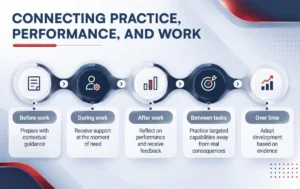
The transition from a reactive model—where training is a response to change—to a proactive model—where learning is integrated into the design of work—is the defining challenge for the current generation of L&D leaders. The traditional sequence of "implement technology, redesign jobs, identify gaps, and train" is becoming increasingly unsustainable. A more robust, forward-looking sequence involves redesigning work first, determining the appropriate balance between human and machine contributions, and building the necessary capability architectures concurrently with the deployment of technology.
This approach transforms the function of L&D from a support department into a strategic driver of organizational change. It allows companies to prevent skills gaps rather than merely addressing them after they have already hindered performance. As AI continues to reshape the nature of professional life, the most successful organizations will be those that recognize that workforce development is not a separate project, but a fundamental component of their operational architecture. In this new era, the question for every CEO and Chief Learning Officer is not just whether their employees are ready for the future, but whether they had a seat at the table when that future was being designed. By moving upstream, L&D can ensure that the AI-driven workplace of tomorrow is not just more efficient, but more capable, more resilient, and more deeply human.