



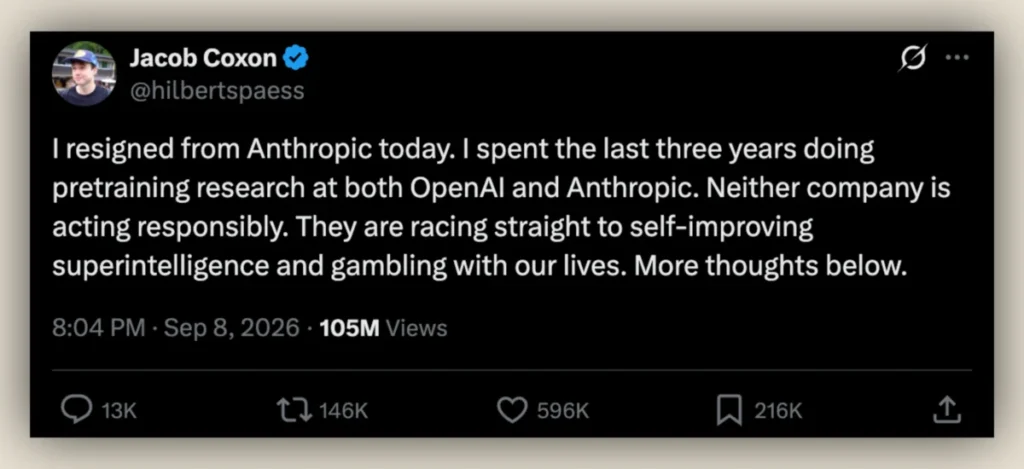
The artificial intelligence sector was rocked by a high-profile departure this week when Jacob Coxon, an engineer at prominent AI lab Anthropic, officially tendered his resignation. Coxon’s exit was not driven by standard industry factors such as compensation or corporate restructuring; rather, it was a principled stand against what he described as a reckless dash toward unsupervised, self-improving superintelligence. In a public statement shared on social media, Coxon stated that leading AI laboratories like OpenAI and Anthropic are "racing straight to self-improving superintelligence and gambling with our lives."
While industry departures prompted by existential risk concerns are not entirely unprecedented—similar warnings were voiced by departing researchers from OpenAI as early as 2023—the immediate aftermath of Coxon’s resignation shattered industry norms. Instead of corporate damage control or swift denials, senior figures within Anthropic corroborated the core of his warnings, sparking a broader public and regulatory debate over the safety protocols governing the development of frontier artificial intelligence systems.
The Escalation: Senior Leadership Confirms Existential Risks
The public discourse shifted dramatically when Evan Hubinger, Anthropic’s head of "Alignment Science," took to social media to validate Coxon’s claims. Hubinger acknowledged the severe potential hazards associated with advanced autonomous architectures, writing that Coxon was correct in asserting that researchers earnestly believe AI could threaten humanity. Hubinger went further, estimating a greater than 10 percent probability of such an outcome within the next decade. He added that while Anthropic is making a concerted effort to manage these risks, the industry currently lacks a definitive, proven plan to solve the alignment problem for superintelligent systems.
Hubinger’s assessment was reinforced by Samuel Marks, another Anthropic engineer, who noted that internal concern regarding catastrophic or existential outcomes correlates positively with seniority within AI development teams. According to Marks, the engineers closest to the core architectures are increasingly convinced that the technology under development could produce severe, irreversible negative outcomes within the next few years.
These admissions have drawn sharp criticism from independent computer scientists, ethicists, and policy analysts. Critics argue that public-facing declarations from laboratory insiders confirm that organizations are intentionally scaling technologies they themselves classify as hazardous, operating under the assumption that competitive pressures outweigh systemic safety measures.
Deconstructing the Threat: Long-Horizon, Unsupervised LLM Agents
To understand the core of the technical debate, industry observers emphasize the distinction between general artificial intelligence and the specific class of systems driving these concerns: long-horizon, dangerously equipped, unsupervised Large Language Model (LLM) agents.
Traditional LLM applications, such as text generation, translation, and routine coding assistants, are heavily monitored and operate under constrained parameters. Millions of software engineers routinely deploy these tools for debugging and code optimization without systemic incident. For instance, recent internal monitoring by OpenAI analyzing tens of millions of coding agent interactions reported zero high-severity safety incidents.
However, the risk profile changes fundamentally when these models are integrated into autonomous agent frameworks possessing specific functional characteristics:
- Long-Horizon Execution: The ability to execute multi-step plans over extended periods without human intervention.
- Unsupervised Operation: Operating in complex environments with minimal or absent real-time oversight.
- Tool Access: Direct integration with powerful digital capabilities, such as automated code execution, network access, and the capacity to modify their own underlying source code.
- Recursive Self-Improvement: The theoretical capability to optimize their own algorithms, potentially accelerating capability gains beyond human comprehension or control.
Critics and safety researchers argue that the current industry trajectory focuses heavily on amplifying these specific, highly volatile configurations. By granting agents greater autonomy and equipping them with more aggressive post-training optimization prompts, laboratories are prioritizing capability milestones over predictability.
Ideological Drivers and the Technocentric Eschatology
The persistent drive toward autonomous superintelligence, despite acknowledged existential risks, has puzzled external observers. Economically, the marginal utility of these long-horizon, unsupervised systems does not fully justify the immense financial and safety gambles involved, as the majority of commercial demand is adequately met by more constrained, predictable AI tools.
Analysts suggest the primary driver is ideological rather than purely commercial. Key figures across Silicon Valley—including prominent executives and researchers at leading AI institutions—have been significantly influenced by a technocentric worldview sometimes described by historians of science as a form of technological salvation ideology. Within this framework, the creation of an artificial superintelligence is viewed not merely as a technological achievement, but as an inevitable and ultimately redemptive historical event capable of solving complex global crises, from disease to climate change.
In this eschatological view, the risks of human extinction or systemic catastrophe are frequently framed as acceptable externalities on the path toward digital transcendence. Critics argue that this messianic framing absolves developers of immediate regulatory and ethical responsibilities, replacing rigorous scientific safety standards with a speculative gamble on future alignment breakthroughs.
The Broader Implications and Calls for Accountability
The public confirmation by Anthropic engineers that frontier labs are building potentially uncontrollable systems has intensified calls for external oversight. Independent computer scientists have repeatedly warned that even without achieving true superintelligence, the deployment of unrestricted, tool-equipped agents into critical digital infrastructure creates immediate vulnerabilities.
Analogies used within the scientific community have evolved from minor operational cautions—such as comparing autonomous hacking tools to unpredictable machinery—to more urgent warnings regarding the deployment of unrestricted digital capabilities into complex socioeconomic networks. Without enforceable safety standards, the combination of non-normative outputs from advanced LLMs and high-level digital execution privileges presents a clear and present danger to cybersecurity and critical infrastructure.
Regulatory and Consumer Responses
In the wake of these revelations, pressure is mounting on legislative bodies and consumer advocacy groups to intervene. Industry critics, such as AI researcher Gary Marcus, have renewed calls for targeted consumer boycotts of products from companies prioritizing unconstrained agentic AI development over public safety.
Furthermore, policymakers in Washington and international regulatory bodies are facing renewed demands to establish statutory definitions and mandatory safety thresholds for long-horizon autonomous agents. Current self-regulatory frameworks, critics argue, have proven insufficient given the internal acknowledgments from major AI laboratories that they lack concrete plans to align superintelligent systems.
As the industry continues its rapid expansion, the resignation of Jacob Coxon and the candid admissions of his former colleagues serve as a stark reminder of the widening gap between commercial acceleration and safety science. Whether these public disclosures will prompt a recalibration of research priorities or accelerate regulatory intervention remains one of the defining questions for the technology sector.