

The act of wishing someone a happy birthday is a universal social ritual, yet the linguistic expression of this milestone varies significantly across the Francophone world. While the sentiment remains consistent, the delivery depends heavily on regional nuances, formality, and established social protocols. Understanding these variations is essential for navigating social interactions in France, Quebec, and other French-speaking territories.
Linguistic Foundations and Core Greetings
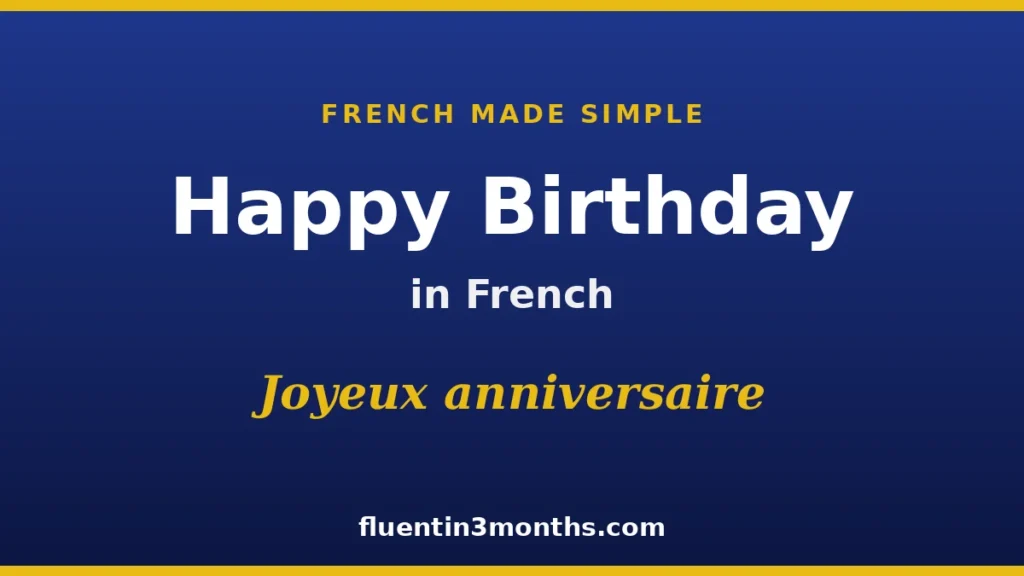
In standard French, the primary expression for "Happy Birthday" is "Joyeux anniversaire!" The phrase is a direct translation of the sentiment, combining "joyeux" (joyful) and "anniversaire" (anniversary/birthday). A common, equally acceptable alternative is "Bon anniversaire!" which translates roughly to "Good anniversary."
From a grammatical perspective, both phrases are interchangeable in professional, casual, and written contexts. There is no hierarchical difference in formality between the two. However, the pronunciation requires careful attention to the "liaison," a phonetic rule in French where the final consonant of a word is pronounced when followed by a vowel. In "Joyeux anniversaire," the silent ‘x’ at the end of the first word is linked to the ‘a’ of the second, producing a /z/ sound. Similarly, in "Bon anniversaire," the ‘n’ in "Bon" transitions smoothly into the following vowel, effectively removing the nasal quality of the ‘n’ to create a flowing, rhythmic delivery.
For informal settings, particularly in text messaging or among close acquaintances, the term is frequently clipped to "anniv." This abbreviation mirrors the English "b-day" and is considered acceptable only in low-stakes, highly casual environments.
The Evolution of Birthday Customs: A Chronological Context
The celebration of individual birthdays is a relatively modern phenomenon, gaining traction in Western culture only over the last few centuries. In historical terms, the tradition of marking the specific date of one’s birth was often reserved for nobility or religious figures. As secular society evolved during the 19th and 20th centuries, the ritualized celebration—including cakes, candles, and song—became standardized.
In France, the "Bon anniversaire" song, popularized in the 1950s by performer André Claveau and composed by Louiguy and Jacques Larue, remains a staple of formal gatherings. Unlike the English-language "Happy Birthday to You," which relies on a simple melody and repetitive lyrics, the French version possesses distinct, copyrighted lyrics that carry a specific cultural weight. Guests are advised to observe the host’s lead before joining in, as the melody and lyrical structure are not merely translated but are part of a curated musical tradition.
Regional Discrepancies: The Quebecois Exception
One of the most critical distinctions in the Francophone world concerns the phrase "Bonne fête." In France, "Bonne fête" is almost exclusively associated with the Catholic tradition of the "name day," where individuals are honored on the feast day of the saint for whom they are named. While this practice has faded in some secular circles, it remains a distinct cultural marker.
Conversely, in Quebec and parts of the Canadian Maritimes, "Bonne fête" is the standard, preferred way to wish someone a happy birthday. The Office québécois de la langue française formally recognizes this usage as the regional standard. Visitors to Canada who utilize "Joyeux anniversaire" will be understood, but "Bonne fête" will be perceived as the more authentic, localized expression. This divergence serves as a prime example of how linguistic geography dictates social etiquette.
Social Protocol and Workplace Etiquette
Navigating the logistics of a birthday celebration requires an awareness of local workplace and social norms. In many French office environments, the burden of providing the cake, or "le gâteau," often falls upon the person celebrating their birthday. This contrasts with some Anglo-American traditions where colleagues might organize a surprise party for the individual.
Furthermore, the physical interaction during a greeting is subject to regional variation. The "bise"—the practice of kissing on the cheek—is common in France, but the number of kisses and the side on which one begins varies by department and city. In a professional setting, or if the relationship is not yet established, a handshake remains the safest and most respectful protocol.
Data regarding social habits suggests that approximately 60% of French workplaces maintain some form of communal recognition for birthdays, though the nature of these recognitions is increasingly shifting toward digital acknowledgments via internal messaging platforms.
Strategic Implications for Language Learners
For those seeking to integrate into French-speaking communities, the mastery of these greetings is more than a vocabulary exercise; it is an exercise in cultural intelligence. The choice between the informal "tu" and the formal "vous" when extending birthday wishes is a litmus test for the relationship. Using "tu" implies a level of intimacy that, if used prematurely with a superior or an acquaintance, may be viewed as overly familiar.
Fact-based analysis suggests that the most effective way to navigate these nuances is to observe the host or the central figure of the event. If the environment is celebratory and relaxed, "Joyeux anniversaire" combined with a warm, sincere sentiment is universally appropriate. If the context is a formal card or a business-related acknowledgment, keeping the message professional—or "soutenu"—is recommended.
Broader Impact and Global Connectivity
As the French language continues to evolve in the digital age, the way birthdays are acknowledged has seen a transition toward rapid, text-based communication. However, the core values associated with these greetings—respect, recognition, and interpersonal connection—remain steadfast. Whether one is in Paris, Montreal, or Dakar, the underlying intent of the birthday wish is to acknowledge the individual’s value within the community.
The professionalization of language learning has provided resources for speakers to move beyond basic memorization. By understanding the phonetic requirements, such as the liaison, and the cultural context, such as the Quebecois preference for "Bonne fête," the speaker demonstrates not just linguistic proficiency, but an appreciation for the cultural fabric of the language.
Conclusion: Best Practices for Success
When preparing to offer birthday wishes in French, prioritize clarity and context. Start with the foundational phrases, ensure the correct use of "tu" or "vous" based on your existing rapport, and remain sensitive to the regional variations that define the Francophone experience.
For those looking to deepen their proficiency, consistent practice—ideally through conversation with native speakers—is the most reliable method. By moving beyond the textbook and into the practical application of these phrases, one gains the ability to participate authentically in one of the most fundamental of human social rituals. Whether in a written card or a spoken toast, a well-placed "Joyeux anniversaire" serves as a bridge to meaningful cultural engagement.