


The sub-$1,000 camera market has undergone a significant transformation. Driven by shifting global supply chains, rising import tariffs, shifting product lifecycles, and rapid technological advancements in sensor design and mobile-adjacent stabilization, finding the right entry-level or enthusiast camera requires a newly calibrated approach. With flagship models from major manufacturers routinely exceeding $2,000, the sub-grand tier serves as the primary gateway for smartphone upgraders, aspiring content creators, and budget-conscious photojournalists.
Current economic pressures have reshaped this landscape considerably. Price adjustments driven by United States tariff policies have pushed former staples—such as the Sony a6400, which now clears $1,000 for the body alone—out of the budget-friendly category. Meanwhile, traditional manufacturers are shaking up their product lineups. Canon has begun winding down the availability of the popular EOS RP in select global markets, GoPro has introduced its 1-inch sensor Mission 1 Pro rather than a traditional Hero 14 iteration, and regulatory bottlenecks have kept DJI’s latest pocket gimbals from securing official U.S. distribution.
Despite these market fluctuations, a robust selection of interchangeable-lens cameras, pocket gimbals, and fixed-lens compacts remains accessible for under $1,000. Navigating these options successfully requires balancing sensor size, lens ecosystems, stabilization methods, and intended use cases—whether the priority is street photography, narrative filmmaking, or solo vlogging.
Evaluating the Landscape: How Sub-$1,000 Cameras Are Tested
Selecting the right imaging device in this price tier demands rigorous evaluation of performance metrics, build quality, and system longevity. Drawing from decades of professional camera journalism and field-testing across major consumer releases, industry experts assess these tools based on distinct photographic strengths, durability, autofocus reliability, and access to comprehensive lens catalogs.
Market realities play an equally vital role. Every finalist must be weighed against live retail pricing and manufacturer availability checks. For instance, while certain bodies like the Fujifilm X-T30 III offer extraordinary value on paper, retail supply chain constraints and localized stock shortages often require buyers to pivot toward alternative configurations or consider compact prime lenses to stay within the strict $1,000 ceiling.
Top Recommendations: The Best Cameras Under $1,000
The current market offers specialized options ranging from approximately $620 to $1,000, split between interchangeable-lens mirrorless bodies and all-in-one fixed-lens systems.
Best Overall: Canon EOS R50
For consumers transitioning away from smartphone photography, the Canon EOS R50 remains the definitive benchmark. Priced competitively with an RF-S 18-45mm IS STM kit lens, the R50 leaves sufficient room in a $1,000 budget for essential accessories like high-speed memory cards and carrying cases. Furthermore, refurbished inventories from authorized channels frequently offer deep discounts backed by official manufacturer warranties, though high demand keeps restocks moving quickly. Consumer analytics consistently highlight it as one of the top-selling mirrorless options on major e-commerce platforms.
The R50’s technical specifications punch well above its price point. It delivers uncropped 4K video at 30 frames per second oversampled from a rich 6K source, ensuring wide-angle integrity when switching between still photography and motion capture. Coupled with intelligent subject-detection autofocus that seamlessly tracks human subjects and animals across the frame, the camera minimizes technical friction for novices.
Its standout feature for beginners is the Advanced A+ Assist mode. Unlike standard automated settings, this mode dynamically analyzes difficult lighting environments—such as backlit portraits or nocturnal scenes—to deliver balanced exposures, allowing users to gradually transition to aperture-priority manual controls as their skills mature. While it lacks in-body image stabilization (IBIS), pairing it with optically stabilized lenses or the affordable RF 50mm f/1.8 STM prime lens provides exceptional low-light capability.
Best for Vlogging: Insta360 Luna Ultra
For content creators focusing heavily on self-filmed video, traditional mirrorless setups can be cumbersome. Pocket gimbal cameras bridge this gap by integrating mechanical stabilization directly into a portable body featuring a front-facing monitor. The Insta360 Luna Ultra redefines this category by pairing a large 1-inch sensor behind a Leica Summicron primary lens with a secondary 3x telephoto camera housed on a 3-axis mechanical gimbal.
This dual-lens system offers significant operational flexibility. Creators can capture wide self-tapes and instantly punch in on distant subjects without physically changing positions. The device supports up to 8K resolution at 30 fps, 4K at 120 fps for fluid slow-motion, Dolby Vision HDR, and 10-bit I-Log profiles. Because the stabilization is handled physically via the 3-axis mechanical gimbal rather than aggressive digital cropping, video retains its full field of view and crisp detail.
Additionally, the detachable 2-inch OLED screen doubles as a wireless remote monitor from up to 20 meters away, proving invaluable during tripod-mounted shoots. With regulatory hurdles continuing to delay competing devices like DJI’s latest pocket gimbal lines in the United States, the Luna Ultra stands out as a premier all-in-one video tool.
Best for Video on a Budget: Canon EOS R50 V
Tailored specifically for desktop creators, live streamers, and video-first producers who prefer interchangeable lenses over fixed pocket gimbals, the Canon EOS R50 V strips away the traditional electronic viewfinder and built-in flash of the standard R50 to optimize its chassis for motion capture.
In place of traditional stills-focused ergonomics, the R50 V integrates a dedicated headphone jack alongside a microphone input, a front-facing tally lamp to signal active recording, and a secondary tripod mount on the side to facilitate vertical video framing without awkward accessory brackets. It delivers the same oversampled 4K/30 video performance as its sibling, alongside a cropped 4K/60 mode. When paired with a wide-angle power zoom kit lens, it provides an ideal focal range for arm’s-length piece-to-camera recording.
Best Fujifilm Camera: Fujifilm X-T30 III
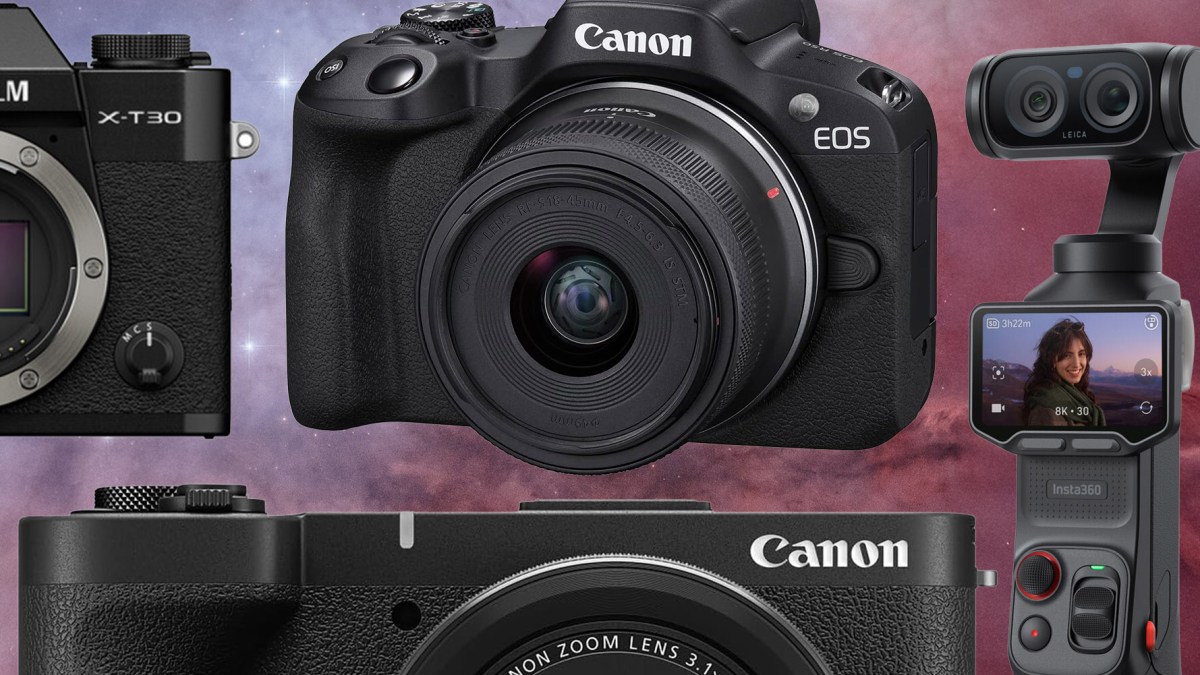
Fujifilm’s distinct color science and film simulation profiles have cultivated a dedicated following among enthusiast photographers. The X-T30 III incorporates the powerful X-Processor 5 alongside a 26.1-megapixel X-Trans CMOS 4 sensor, retaining a high-resolution electronic viewfinder that lower-tier models omit.
The defining characteristic of the X-T30 III is its top-plate physical control dial, which grants immediate access to 20 distinct film simulations and custom recipe slots. This tactile approach moves color-grading decisions out of dense digital menus and onto the exterior of the camera. On the video front, it punches above its weight class with open-gate 6.2K recording at 30 fps and full-sensor 4K output with 10-bit internal color capture. Prospective buyers should note that supply chain constraints often make body-only purchases the most viable path, encouraging users to pair the camera with Fujifilm’s lineup of compact prime lenses.
Best Retro Camera: Nikon Z fc
Evoking the classic aesthetic of the iconic Nikon FM2 film SLR, the Nikon Z fc offers a masterclass in tactile camera design. Dedicated, engraved aluminum dials govern shutter speed, ISO, and exposure compensation, allowing photographers to verify critical exposure parameters even when the camera is powered off.
Beneath its vintage exterior lies a modern 20.9-megapixel DX-format sensor capable of uncropped 4K video at 30 fps and high-speed continuous stills shooting at up to 11 fps. A fully articulating touchscreen and a bright OLED viewfinder complete the package. Furthermore, the short flange distance of the Nikon Z-mount makes the Z fc an exceptional platform for vintage manual-focus glass via simple third-party adapters.
Best Point-and-Shoot: Canon PowerShot V1
For users seeking a pocketable, fixed-lens device optimized for both high-end stills and extended video sessions, the Canon PowerShot V1 fills the void left by older compacts. Equipped with a large 1.4-inch type sensor boasting 22.3 megapixels, the V1 offers roughly double the surface area of standard 1-inch compact sensors, resulting in cleaner low-light performance and natural background separation.
Crucially, the V1 integrates an active cooling fan, bypassing the thermal recording limits that plague many compact cameras and enabling sustained 4K video recording. Combined with a built-in neutral density (ND) filter for bright daylight shooting and optical image stabilization, it serves as a robust creative tool for travel and documentary work.
Best Full-Frame Entry: Canon EOS RP
As manufacturers pivot aggressively toward advanced APS-C and crop-sensor designs at lower price points, full-frame cameras under $1,000 have become increasingly scarce. Canon’s EOS RP occupies this rare space, offering a lightweight introduction to full-frame imaging for stills-focused creators.
A full-frame sensor matches the dimensions of traditional 35mm film, allowing lenses to perform precisely at their designated focal lengths and making it easier to isolate subjects with shallow depth of field. While its video capabilities are limited compared to newer dedicated hybrid models, its 26.2-megapixel sensor excels in low-light environments and ensures that any glass invested in the system remains fully compatible with Canon’s professional-tier R-series bodies later on.
Best Action Camera: GoPro Mission 1 Pro
Breaking away from traditional incremental updates, GoPro’s flagship action camera utilizes a massive 1-inch, 50-megapixel sensor designed to dramatically improve low-light clarity and dynamic range compared to smaller-sensor predecessors.
Retaining the rugged, waterproof housing-free design that defines the category, the Mission 1 Pro supports 8K video capture at 60 fps, extreme slow-motion at 4K/240 fps, and professional-grade 32-bit float audio recording via a multi-microphone array. It remains the gold standard for high-intensity sports and rugged environmental documentation.
Key Considerations When Buying a Camera Under $1,000
Selecting the right device ultimately depends on identifying personal shooting habits rather than obsessing over raw specifications.
Sensor Size vs. Megapixels
While pixel counts between 20 and 26 megapixels are more than sufficient for large prints and digital cropping, sensor dimensions dictate light collection and depth control. Full-frame sensors offer maximum light gathering, while APS-C sensors strike an optimal balance between portability, telephoto reach, and affordability. Smaller 1-inch and compact sensors prioritize extreme portability over shallow depth of field.
Interchangeable vs. Fixed Lenses
Mirrorless systems provide long-term flexibility by allowing users to upgrade and swap lenses for specialized tasks like portraiture or wildlife photography. Conversely, fixed-lens compacts and gimbals offer streamlined, all-in-one convenience without the added cost and weight of auxiliary glass.
Video Workflows and Codecs
Buyers prioritizing motion capture must look beyond simple 4K resolution claims. Evaluating sensor crop factors, internal bit depths, log color profiles, and thermal management systems ensures the chosen device can handle extended recording sessions without bottlenecking post-production workflows.
Conclusion
The sub-$1,000 camera market proves that professional-grade imaging capabilities are no longer reserved exclusively for high-end budgets. Whether opting for the versatile Canon EOS R50 for general photography, the Insta360 Luna Ultra for dynamic vlogging, or a tactile retro body like the Nikon Z fc, understanding individual creative needs remains the key to making a sound investment. Ultimately, mastery of the instrument matters far more than the price tag attached to it.