


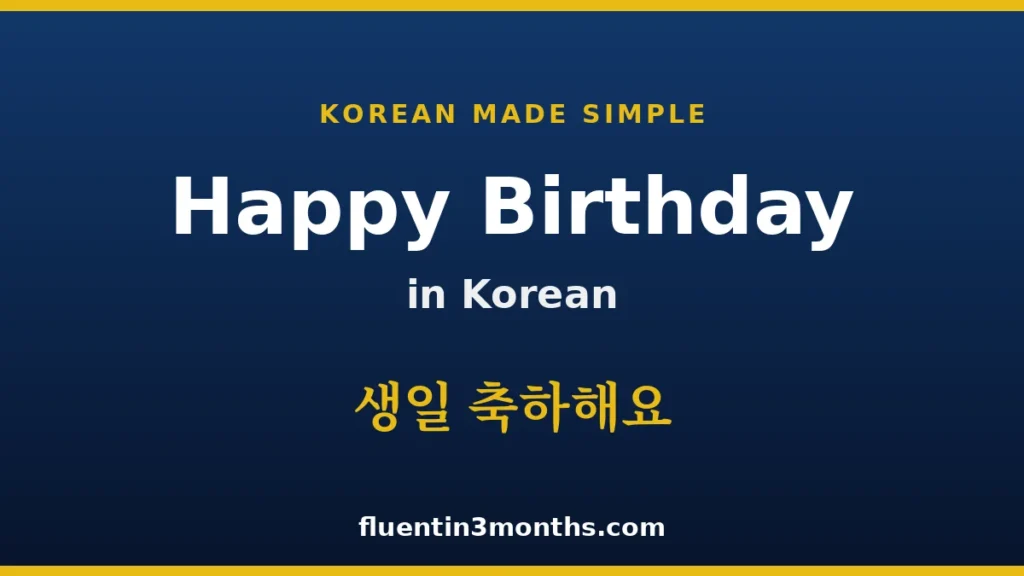
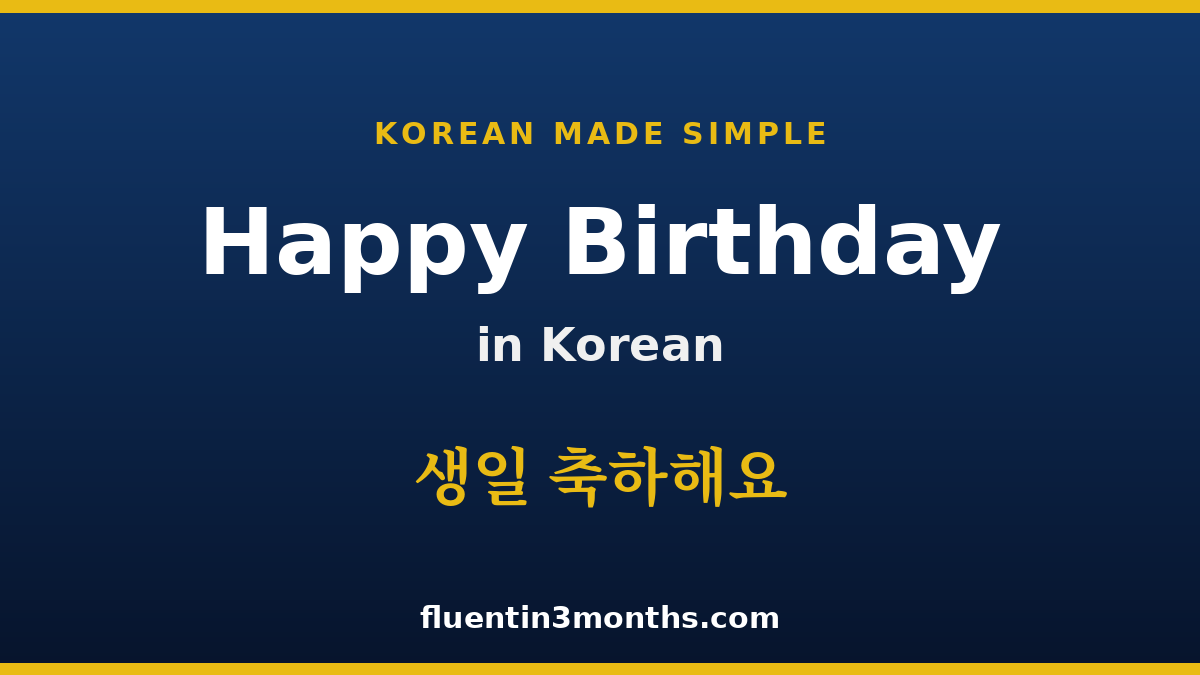
The most common and versatile way to express “Happy Birthday” in Korean is 생일 축하해요 (saengil chukhahaeyo). While this phrase serves as the linguistic cornerstone for birthday greetings across South Korea, its application is nuanced, deeply rooted in the country’s hierarchical social structure, and dictated by the specific relationship between the speaker and the recipient. Understanding the appropriate usage of these greetings requires a grasp of both honorifics and the evolving social conventions that define modern Korean communication.
The Linguistics of Celebration: Beyond a Single Greeting
Korean society places a high premium on social harmony and respect, which is reflected in the language through distinct levels of politeness. Unlike English, where a singular “Happy Birthday” suffices regardless of the recipient’s status, Korean utilizes different endings and honorific nouns to adjust the level of deference.
The standard phrase, 생일 축하해요 (saengil chukhahaeyo), is considered polite but not overly ceremonial. It is the appropriate choice for acquaintances, professional colleagues, or individuals with whom one does not share a close, informal relationship. The structure of the phrase is essentially a congratulatory statement regarding the person’s day of birth. The inclusion of the honorific suffix "yo" (해요) provides a buffer of politeness that makes it safe for most social interactions.
However, as the relationship dynamic shifts, so too does the language. For individuals who have established a close, personal rapport, Korean speakers utilize banmal (반말), or casual speech. In this context, one would simply say 생일 축하해 (saengil chukha-hae), dropping the polite ending. Conversely, when addressing someone of a higher social standing or an elder—such as a grandparent or an employer—the language undergoes a formal transformation. In these instances, speakers replace the word for birthday (saengil) with the honorific equivalent, 생신 (saengsin), and modify the verb to denote humble respect: 생신 축하드립니다 (saengsin chukhadeurimnida). This distinction is critical in maintaining the cultural etiquette expected in Korean society.
A Chronology of Birthday Customs
The tradition of celebrating birthdays in Korea has evolved from ancient rites to modern social gatherings. Historically, the most significant birthday for an individual was their first, known as doljanchi (돌잔치). In centuries past, when infant mortality rates were significantly higher, reaching one’s first birthday was a milestone of profound relief and joy.
The doljanchi ceremony remains a staple of Korean culture. A centerpiece of this event is the doljabi (돌잡이), a ritual where the child is placed before an array of symbolic objects. Tradition dictates that the object the child chooses—such as a piece of thread, signifying a long life; money, signifying wealth; or a brush, signifying academic success—serves as a playful, yet culturally significant, prediction of their future path.
Following childhood, another major cultural touchstone is the consumption of miyeokguk (미역국), or seaweed soup. This dish is inextricably linked to birth, as it is traditionally consumed by new mothers to aid in recovery and provide essential nutrients. By eating this soup on their birthday, individuals honor the labor of their mothers and acknowledge the care provided during their infancy. While modern urban life has seen a diversification of birthday customs, the practice of serving miyeokguk remains a widespread, sentimental tradition that bridges generations.
Legislative Shifts and the Age Calculation Debate
The discourse surrounding age in South Korea has undergone a radical transformation due to recent legislative action. Historically, Korea employed a system known as seneun nai (세는 나이), or the "Korean age," in which a person is considered one year old at birth, and every individual ages one year on January 1st. This system often resulted in a person being one or two years older than their international chronological age.
In response to public confusion and the inefficiencies this caused in legal and administrative settings, the South Korean government passed legislation in December 2022 to standardize the use of the international "man nai" (만 나이) system. Effective June 2023, the international system—based on the actual date of birth—became the primary standard for all civil and administrative laws.
Despite this legislative mandate, the transition in daily social life is ongoing. While the legal framework now favors the international system, the traditional method remains deeply ingrained in social parlance. Many Koreans continue to calculate age based on the calendar year during informal interactions, and there remains a third, hybrid method called yeon nai (연 나이), or "year age," which is still utilized in specific legal contexts, such as military conscription or school entrance requirements. This coexistence of systems necessitates that individuals verify the age context when engaging in formal or legal discourse.
Comparative Analysis: Politeness and Honorifics
The complexity of Korean greetings lies in the interplay between speech style and honorific vocabulary. It is a common misconception that age alone determines the level of politeness. While seniority is a factor, the degree of intimacy between parties is equally, if not more, significant.
The following hierarchy of usage provides a framework for selecting the appropriate greeting:
- Casual/Intimate: Saengil chukha-hae (생일 축하해). Used between close friends, siblings, or partners who have explicitly agreed to forgo formal speech.
- Standard Polite: Saengil chukhahaeyo (생일 축하해요). The "default" mode for the workplace, acquaintances, or people of similar status who are not close friends.
- Formal/Respectful: Saengil chukhamnida (생일 축하합니다). Used in public settings or professional environments where a higher level of formality is required.
- Highest Honorific: Saengsin chukhadeurimnida (생신 축하드립니다). Reserved for elders and superiors to show profound respect.
This structure underscores that language in Korea is not merely a tool for communication, but a reflection of social alignment. Failing to use the correct level of politeness can be perceived as dismissive or disrespectful, particularly when interacting with elders.
Broader Implications and Cultural Literacy
The importance of linguistic precision in birthday greetings reflects the broader Korean emphasis on jeong (정)—a deep sense of connection, empathy, and community. By choosing the correct honorifics, a speaker acknowledges the other person’s place in the social order and demonstrates a commitment to the collective harmony of the group.
For international observers or those learning the language, the transition from basic romanization to the Hangul writing system is essential. Developed by King Sejong the Great and his scholars in the 15th century, Hangul is designed to mimic the physical positions of the speech organs. Learning these characters provides a clearer understanding of phonetics than romanized versions ever could. As the global interest in Korean culture continues to expand, the ability to navigate these linguistic nuances becomes more than just an academic exercise; it is a fundamental component of cultural literacy.
In professional environments, international firms operating in Korea are increasingly aware of these nuances. Missteps in greeting etiquette can hinder the development of trust and rapport, which are essential for long-term business success in the region. Consequently, cultural training often emphasizes that while the intent of a birthday greeting is universal, the execution must be tailored to the specific social context.
As South Korea continues to integrate its administrative systems with international standards while simultaneously preserving its rich cultural heritage, the way citizens communicate—including how they celebrate their births—remains a fascinating case study in how a society manages the balance between tradition and modernization. Whether through the humble act of sharing seaweed soup or the careful selection of an honorific suffix, the birthday remains a vital expression of the values that underpin Korean society.