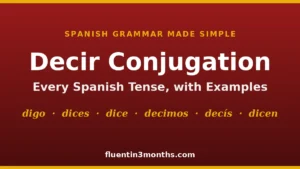



The Spanish verb decir, which translates to "to say" or "to tell," represents one of the most significant hurdles for learners due to its pervasive irregularity and essential role in daily communication. Unlike regular verbs that adhere to predictable conjugation patterns, decir functions as a cornerstone of Spanish syntax while simultaneously violating the standard rules of the second conjugation. As a high-frequency verb, it is indispensable for reporting information, issuing commands, and facilitating interpersonal dialogue. Linguistic studies on Spanish acquisition consistently highlight decir as a foundational element that necessitates early mastery for effective oral proficiency.
The Structural Complexity of Decir
The irregularities found within decir are not merely random deviations; they reflect historical shifts in Latin and the evolution of the Ibero-Romance language group. The verb originates from the Latin dicere, and its present-day forms demonstrate a combination of stem changes, syncope, and unique inflectional endings that distinguish it from regular -ir verbs.
In the present indicative, the first-person singular becomes "digo," an abrupt shift from the root "dec-." This "g-insertion" is a hallmark of several common Spanish verbs, including hacer (hago) and salir (salgo). In the preterite, the verb undergoes a "strong" conjugation, shifting to "dije," which requires the use of a j-stem that persists throughout the entire preterite tense. Furthermore, the future and conditional tenses utilize a syncopated root, "dir-," rather than the full infinitive "decir-," resulting in forms like "diré" and "diría."
Chronological Usage and Linguistic Evolution
To understand the weight of decir in contemporary Spanish, one must examine its historical trajectory. The verb has functioned as a primary conduit for reporting speech since the medieval period of the Spanish language. As Castilian Spanish standardized during the 15th and 16th centuries, the irregular forms of decir became firmly entrenched, resisting the pressures of regularization that affected less frequently used verbs.
For the modern learner, this creates a distinct timeline of acquisition. During the initial stages of language immersion, students typically prioritize the present tense to facilitate immediate, basic interactions. As competency increases, the acquisition of the preterite (dije) and imperfect (decía) becomes critical for distinguishing between finished, singular statements and habitual or ongoing speech. The advanced stages of learning involve the mastery of the subjunctive mood—specifically forms like "diga" and "dijera"—which are essential for expressing requests, doubts, and hypothetical scenarios.
Comparative Analysis: Decir vs. Hablar and Contar
A frequent point of confusion for non-native speakers involves the semantic overlap between decir, hablar, and contar. Data from corpus linguistics indicates that errors in selecting the appropriate verb of communication are among the most common mistakes made by intermediate-level learners.
Decir is primarily employed when the content of the message is the focal point. It functions similarly to the English "say" or "tell." In contrast, hablar refers to the physical act of speaking or the ability to communicate in a language. For example, "hablo español" (I speak Spanish) focuses on the linguistic capability, whereas "dije que sí" (I said yes) focuses on the specific information transmitted. Contar occupies a different niche, typically reserved for narratives, such as telling a story (contar un cuento), a joke (contar un chiste), or a secret (contar un secreto). Understanding these distinctions is vital for achieving professional fluency.
Strategic Conjugation Tables and Usage Patterns
The following tables synthesize the essential conjugations of decir, categorized by mood and tense for academic reference.
Indicative Mood: The Foundation of Factual Reporting
The indicative mood represents the most frequently used category in journalistic and professional contexts.
| Pronoun | Present | Preterite | Imperfect | Future | Conditional |
|---|---|---|---|---|---|
| Yo | digo | dije | decía | diré | diría |
| Tú | dices | dijiste | decías | dirás | dirías |
| Él/Ella/Ud. | dice | dijo | decía | dirá | diría |
| Nosotros | decimos | dijimos | decíamos | diremos | diríamos |
| Vosotros | decís | dijisteis | decíais | diréis | diríais |
| Ellos/Uds. | dicen | dijeron | decían | dirán | dirían |
The Imperative Mood and Directive Language
In professional settings, the imperative is used to provide instructions. The irregular informal command "di" is highly common in idiomatic expressions, such as "¡Dime!" (Tell me!).
| Pronoun | Affirmative Command | Negative Command |
|---|---|---|
| Tú | di | no digas |
| Usted | diga | no diga |
| Nosotros | digamos | no digamos |
| Vosotros | decid | no digáis |
| Ustedes | digan | no digan |
Analysis of Common Usage Patterns and Errors
Research into second-language acquisition reveals that students often attempt to apply regular conjugation patterns to irregular verbs, a phenomenon known as overgeneralization. Common errors include the production of "decí" instead of "dije" or "deciré" instead of "diré." These errors are largely attributed to the brain’s attempt to simplify the complexities of the Spanish verb system.
To mitigate these errors, educators suggest the "Anchor Method," where learners prioritize the most high-frequency forms—specifically the present tense and the preterite—before moving toward the subjunctive or perfect tenses. The compound tenses, which utilize the auxiliary verb haber followed by the irregular participle "dicho," are generally considered more manageable once the student has mastered the conjugation of haber.
Broader Implications for Language Learners
The mastery of decir serves as a litmus test for a student’s overall grasp of Spanish verb morphology. Because it touches on nearly every major irregular category, proficiency with this verb often acts as a gateway to understanding other irregular verbs like hacer, tener, and venir.
From an educational standpoint, the pedagogical approach to decir has shifted from rote memorization of tables toward context-based learning. By integrating the verb into everyday scenarios—such as reporting news, relaying messages in an office environment, or participating in social dialogue—learners are able to internalize the irregularities through repeated exposure rather than isolated study.
Conclusion and Expert Perspective
In summary, while the verb decir presents a significant challenge due to its morphological irregularities, it remains a fundamental tool for effective communication in Spanish. By breaking down the verb into its functional components and focusing on the most common forms, learners can navigate the complexities of the language with greater precision. As with any high-frequency verb, the transition from theoretical knowledge to active usage requires consistent practice and contextual application. For those aiming for professional-level fluency, viewing decir not as an obstacle, but as a core pillar of the language, is essential for long-term success. Through dedicated practice of the indicative and subjunctive forms, students can ensure their speech remains both accurate and natural, regardless of the complexity of the conversation.