


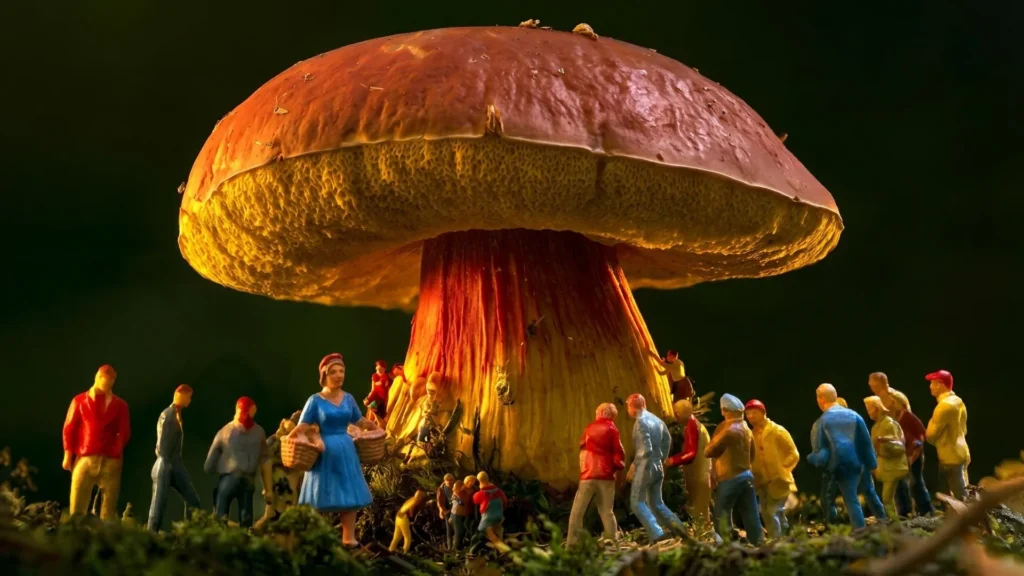
For nearly a century, reports from disparate corners of the globe have described a surreal and consistent psychological experience: the sight of tiny, human-like figures interacting with the physical world. From the highlands of Papua New Guinea to the remote villages of Southwest China and the northern reaches of the Philippines, individuals who consumed certain wild mushrooms have reported vivid visions of miniature people—often standing no more than six inches tall—climbing furniture, walking across surfaces, and engaging in complex movements. Long dismissed as cultural folklore or mere coincidence, this phenomenon, known as "Lilliputian hallucinations," has finally been granted a biological framework by a team of researchers from the University of Utah.
The recent study, published in the journal Mycologia, utilizes advanced DNA sequencing to identify the culprit behind these accounts: a mushroom species known as Lanmaoa asiatica. By tracing the genetic signatures of fungi collected across international borders, researchers have moved beyond anecdotal reports to provide a compelling, evidence-based link between a specific organism and a highly specific neurological state.
A Century-Long Chronology of "Mushroom Madness"
The history of this scientific enigma begins in 1934, when Western observers in Papua New Guinea first documented a phenomenon local populations referred to as "mushroom madness." Anthropologists noted that following the consumption of certain bolete mushrooms, residents reported seeing small figures that appeared indistinguishable from real people.
Throughout the 1950s and 1960s, a period marked by intense interest in ethnomycology, researchers attempted to isolate the psychoactive agents responsible for these visions. The investigation drew the attention of prominent figures in the field, including Albert Hofmann, the Swiss chemist world-renowned for his discovery of LSD and the isolation of psilocybin. Despite his expertise, Hofmann and his contemporaries failed to identify any known hallucinogenic compound within the samples provided. This failure led many in the scientific community to pivot toward a psychosocial explanation, suggesting that the visions were not chemically induced but rather the product of deeply ingrained cultural expectations and regional mythology. By the late 1960s, the scientific investigation into these mushrooms had largely stalled, leaving the mystery to languish in the archives of anthropology.
The narrative took an unexpected turn in the 1990s when reports of similar hallucinations surfaced in Yunnan, China. Local populations consuming mushrooms known as "Jian shou qing"—roughly translated as "see hand blue"—described the same miniature figures previously reported in the Pacific. While the species remained unidentified, suspicion centered on the Lanmaoa genus. The case remained dormant until 2024, when doctoral student Colin Domnauer and mycologist Bryn Dentinger of the University of Utah identified a third, independent report from an Indigenous community in the Northern Cordillera of the Philippines. Here, the mushroom, locally known as "Sedesdem," was implicated in identical visual disturbances, providing the researchers with a vital cross-continental link.
DNA Analysis and the Identification of Lanmaoa asiatica
The investigative methodology employed by the University of Utah team represents a significant shift from the chemical-first approaches of the 20th century. Domnauer traveled extensively to Yunnan and the Philippines, conducting interviews with community members and collecting fresh specimens of the suspected fungi.
Upon returning to the laboratory, the team conducted a comprehensive genomic analysis of 53 specimens. The sequencing confirmed that the "Jian shou qing" of China and the "Sedesdem" of the Philippines were, in fact, the same species: Lanmaoa asiatica. This revelation was scientifically significant, as it expanded the known geographic range of the species and provided a biological common denominator for the hallucinations.
Crucially, the team performed rigorous chemical assays to search for psilocybin, psilocin, and other known tryptamines. The results were negative. The mushroom contained no trace of the psychoactive substances common to other hallucinogenic fungi. This absence confirms that the neurological effects of L. asiatica are mediated by an entirely novel, unidentified compound—a discovery that researchers believe could represent a "holy grail" for neuropharmacology.
The Phenomenological Consistency of the Visions
What continues to baffle researchers is the striking consistency of the hallucinations. In roughly 90% of documented cases, the visions follow a specific set of characteristics:
- Dimensions: The figures are consistently reported to be between 3 and 30 centimeters in height.
- Behavioral Realism: Unlike typical drug-induced hallucinations, which may involve geometric patterns or abstract imagery, these figures appear to obey the laws of physics. They navigate around obstacles, climb objects, and react to their environment with intentionality.
- Appearance: Witnesses describe the figures as resembling clowns, elves, or folkloric beings, often garbed in vibrant, detailed clothing.
- Integration: The figures are frequently reported to be "superimposed" onto the real world with high fidelity, appearing as solid as any physical object in the room.
Domnauer highlighted a specific account where a participant reported observing miniature figures leaping from a spoon into a bowl of soup, swimming, and remaining visible within their mouth during the act of eating. This level of granular, persistent detail suggests that the substance acts on specific visual processing pathways in the human brain, rather than triggering a generalized state of delirium.
Broader Implications for Neuroscience and Medicine
The implications of this discovery extend far beyond the study of fungi. Lilliputian hallucinations are a known symptom in various clinical settings, including the early stages of alcohol withdrawal, specific types of dementia, and ocular conditions such as Charles Bonnet syndrome, where vision loss leads the brain to "fill in" missing data with hallucinations.
Currently, medical science has few tools to modulate or study these hallucinations in a controlled manner. If the psychoactive compound in L. asiatica can be isolated and synthesized, it could serve as a probe for researchers to understand the neural circuits involved in the brain’s construction of reality. By mapping how the chemical influences the visual cortex, scientists may gain a deeper understanding of how the brain creates stable perceptions—and how those processes fail during disease states.
Fungal Biodiversity and Future Research
Beyond the neurological implications, the study provided a windfall for fungal taxonomy. The genomic analysis of the Lanmaoa genus resulted in the discovery of four previously unknown mushroom species, two of which were already sitting unidentified in museum collections. This underscores a persistent challenge in biology: the vast majority of fungal diversity remains hidden in plain sight, awaiting the application of modern sequencing technologies.
The research team is now focused on the daunting task of isolating the specific chemical responsible for the hallucinations. Given that the mushroom is a staple in certain regional diets—provided it is cooked thoroughly—there is a pressing need to understand the mechanism that renders the toxin inert under heat.
As the scientific community turns its attention toward this mysterious compound, the story of Lanmaoa asiatica stands as a testament to the intersection of traditional knowledge and modern molecular biology. What was once dismissed as a curiosity of folklore has been reclaimed as a legitimate area of scientific inquiry, one that may eventually rewrite our understanding of the human nervous system.
The research was made possible through the support of the National Science Foundation (award #DEB-2114785), and it serves as a reminder that the natural world continues to hold profound, undiscovered secrets that, once revealed, possess the potential to fundamentally alter our medical and biological paradigms. Whether through the lens of history, anthropology, or neurology, the quest to explain the "mushroom madness" of the Cordillera and the Yunnan highlands represents a significant step forward in the ongoing attempt to map the boundaries of human consciousness.